“I think,” I said carefully, steadying my voice even though the floor felt like it had shifted under me, “we need to talk.”
Amanda didn’t flinch, though I caught something flicker in her eyes — regret, maybe, or guilt.
But before we could get into it, Tom started the formal questions.
I forced myself to focus, answering with the same honesty I always carried, though every word felt heavier under her gaze.
Then Tom asked the question I knew was coming.
“Why did you miss your original interview?”
I turned and looked straight at Amanda.
“I stopped to help someone who needed it,” I said. “Someone stranded on the side of the road, scared, with a car that wouldn’t move. I chose helping that person over being here on time.”
Amanda didn’t look away.
Her next question came quiet but sharp.
“Do you regret that choice?”
I shook my head.
“No. I don’t regret helping someone who needed me. But I do have questions about why that someone thought she had to lie about who she was.”
The silence that followed pressed heavy against the glass walls.
Janet cleared her throat, suggesting a break, and Tom stepped out with her.
That left just the two of us.
Me and the woman who had turned my life upside down before I even knew her real name.
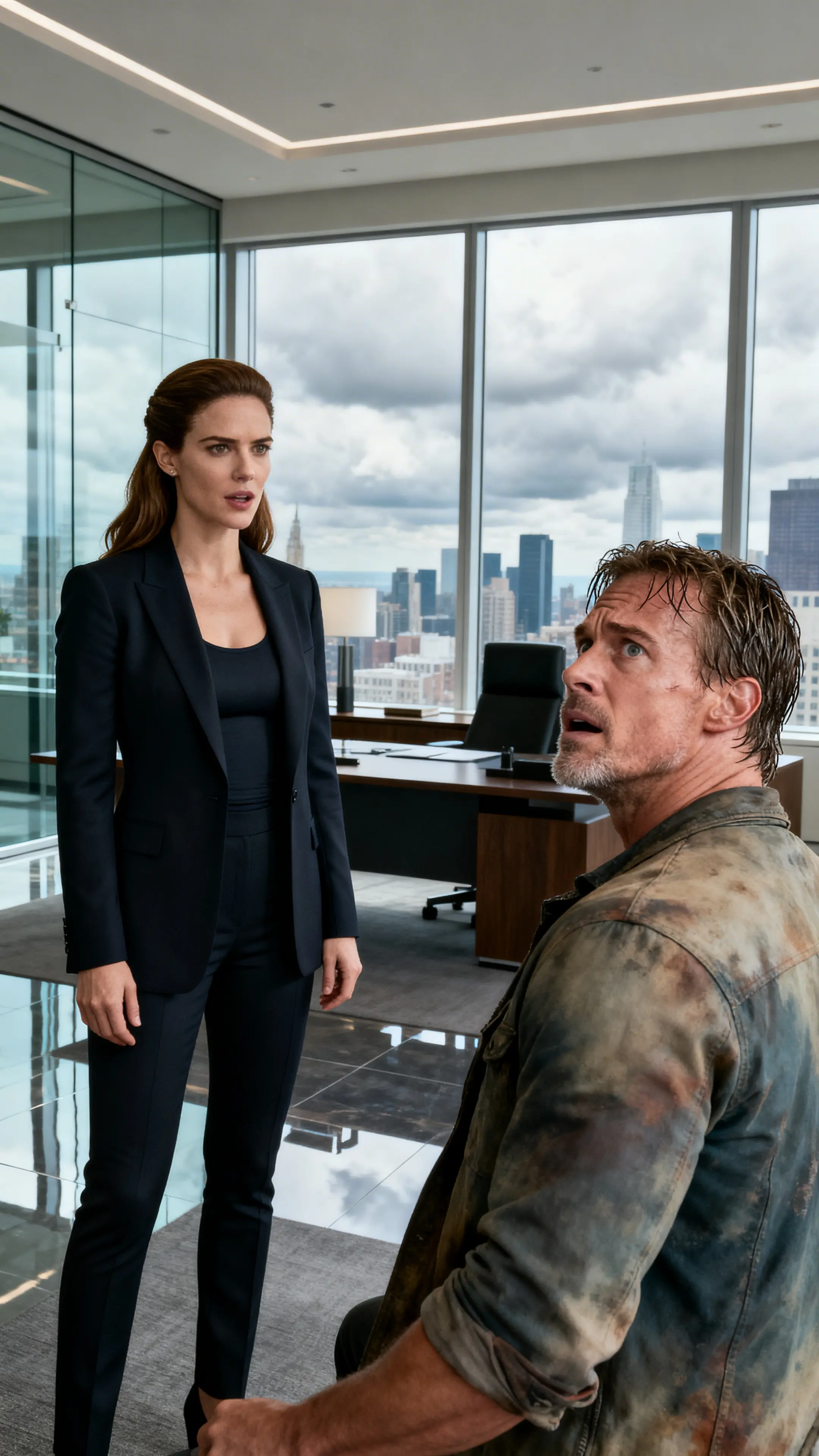
The room felt tight once Tom and Janet stepped out, like the air itself was waiting to hear what I’d say next. Amanda stood by the window, arms folded, gaze fixed on the parking lot where my beat-up pickup sat among polished company cars.
For the first time since I met her, she looked unsure of herself.
“You have every right to be angry,” she said quietly. Her voice had lost the CEO polish, carrying more of the strain I remembered from that rainy morning.
“Do I?” I asked. “Because right now, I’m not sure what game I’m playing here. You lied about who you were.”
She turned, face softening.
“Because I wanted to know who you were when you didn’t think it mattered. I spend my life surrounded by people who want something from me. I needed to see if your kindness was real or just… calculated.”
I studied her, trying to decide if I was hearing honesty or just another performance.
Before I could push further, Janet’s voice broke in from the hall, sharp and urgent.
“Amanda, emergency at Plant 2. Major equipment failure on Line Three.”
Amanda’s face tightened, and within seconds she was all business again, tapping her phone as she rattled off questions.
I didn’t think — my body reacted the way it always had around broken machinery.
“What kind of failure?” I asked, already moving for the door.
Amanda blinked, startled. “Ryan, you don’t work here.”
“Not yet,” I cut in. “But if you want to know who I really am… let me show you.”
Twenty minutes later, I was in the passenger seat of her BMW as she wove through traffic toward Plant 2. My mind was already working, flipping through possibilities — hydraulic failures, belt slips, sensor malfunctions.
She drove like someone carrying the weight of more than one world. Jaw set, eyes focused.
Between us, silence stretched, but it wasn’t hostile.
It felt like we were in this together, at least for the moment.
Plant 2 was chaos when we arrived.
Machines hummed and clanked across the floor, but Line Three — the big one — was dead. Supervisors barked into radios. Engineers stood in clusters with clipboards and furrowed brows.
I could smell the tension as clearly as I smelled the burnt hydraulic fluid.
Tom Stevens hurried over, relief washing across his face when he saw Amanda.
“We’ve been down two hours. Every minute costs us thousands. Nobody can figure it out.”
I crouched beside the massive drive assembly, hands tracing the lines of steel and hoses like they were veins in a body.
I’d been in enough shops to recognize the signs.
The frustration was familiar.
Good men staring so hard at a problem they couldn’t see the simple thing hiding in plain sight.
“Has anyone checked the secondary filter housing on the hydraulic reservoir?” I asked.
Tom frowned. “We changed all filters last month.”
“Primary filters? Sure,” I said, sliding out from under the machine. “But there’s a secondary housing most people forget about. Hidden behind the main panel. Clogs up faster under heavy production. Seen it before.”
I shrugged out of my jacket, rolled up my sleeves, and barked for a 3/8 wrench and a flashlight.
Within minutes, I was on my back, crawling into the guts of the machine, oil dripping onto my shirt.
The crowd behind me muttered, doubtful.
Amanda stood with her arms crossed, eyes locked on me, watching every move.











