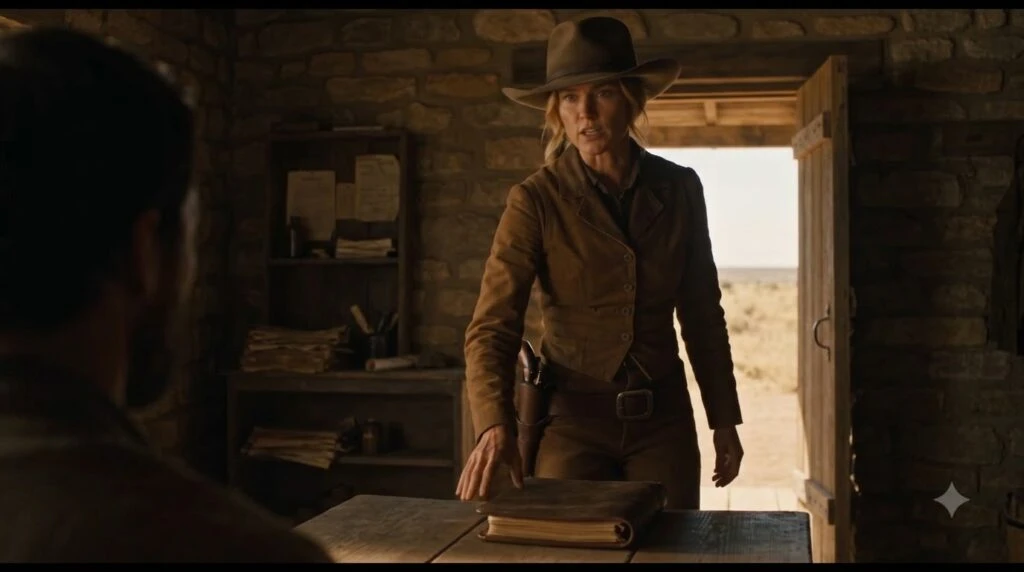
Judith Renick had practiced what she would say for 9 miles, and not one word of it survived the front porch. It was the 12th of August, 1886, a Thursday, and Texas Hill Country had gone without a proper rain since May. Branic Creek, which had turned her father’s millwheel for twenty-two years, was a string of cracked white stones. Her mill sat idle.
Her note at the bank was coming due, and a man named Ezra Colton owed her $86.40 for feed. She was 34 years old. She had never married, and she was not in the habit of begging, but she was in the habit of collecting. A miller who could not collect was a miller who would soon be selling the stones.
The Colton place sat in a fold of the hills, a low stone house with a deep porch, and a barn that had been patched more than once. The first thing she noticed was the trough. It stood at the corner of the yard, fed by a pipe from somewhere uphill, and clear water ran over its lip and soaked into the dirt. In that summer, with every creek for 20 miles gone dry, a man was letting good water run onto the ground.
She tied her mare to the post and climbed the steps. The front door stood open for the air. She raised her hand to knock. A voice came from the kitchen at the back of the house.
It was low and unhurried, and it was not speaking to her. “Lord, thank you for this bread and for the hands that raise the wheat. Thank you for the rain we haven’t got yet. Bless the ones who are hungry tonight and the ones who are tired.”
She lowered her hand. She could see straight down the hall to the kitchen. A long table ran under the window, a table that could have seated a family of eight. Six chairs were stacked against the wall behind it, legs in the air, the way a person stores chairs they do not expect to need.
One chair stood at the table. One plate sat in front of it. The man at the table was tall and broad through the shoulders with a short dark beard and a hat hung on the chair post. A thin white scar cut through his left eyebrow.
He had his head bowed and his thumbs hooked in his belt as though even prayer was a thing he did while standing ready to work. “Mama always ended it there,” he said quietly. “Amen. I reckon I’ll add the next part myself.”
He stopped. The kitchen was so still she could hear a fly against the window glass. “Lord,” said Ezra Colton, “I’m tired of eating alone.” Judith stood on the porch with her hands still half raised and did not breathe.
Then he said, “Amen,” and picked up his fork, and the sound of it was ordinary and terrible. She stepped back. She meant to leave. She made it as far as the second board, and the second board creaked.
“Somebody there?” There was nothing to do but knock. So she knocked. The fork went down.
Boots crossed the hall. He filled the doorway, taller than she had expected. And he looked at her. The way a man looks at a stranger who has come a long way on a hot day.
“Miss Renick,” he said. “From the mill.” “Mr. Colton.” She had her ledger book under her arm. She held it a little tighter.
“I wrote out about your account.” “I figured you might.” He did not look away and he did not look ashamed which annoyed her. “You’ve come nine miles. Will you come in out of the sun?”
“I will not be long.” “Then you’ll be long on the porch.” He stepped aside. “I’ve got coffee and the plates cooling.”
She almost said no. She had the whole speech ready. It began with the words. “The terms of the account were thirty days,” and it went on from there in a firm, clear voice.
But the table was behind him and the single plate and the six chairs in the air. She went in. She sat in the chair he pulled out, the only chair, and he took the end of the bench by the stove. He put a cup in front of her.
She opened the ledger and found the page. Her hand was steady, and she was proud of that. “$86.40,” she said. “Since March. Feed, meal, and four sacks of oats.”
“I have never sent you a second notice, Mr. Colton, because my father always said a neighbor should have the courtesy of the first one being enough.” “It was. Then I wonder why it hasn’t been paid.” He turned his cup in his hands. “My cattle money doesn’t come till the November drive.”











