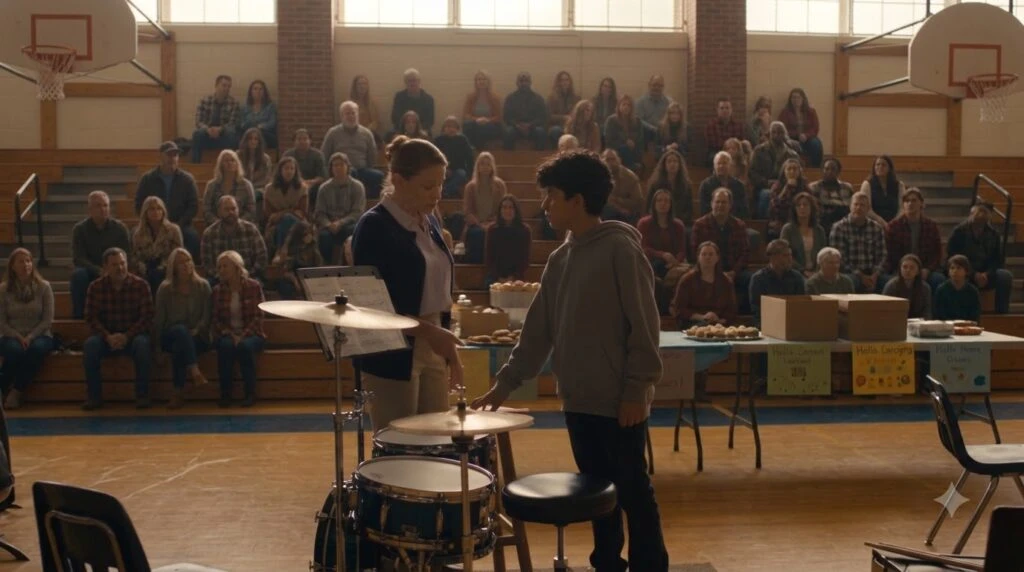
By a quarter past seven the gym at Wheatland Middle School smelled like chili, floor wax, and the burnt sugar of a cotton-candy machine that a PTA dad had rented from a party store in Dodge City and could not get to stop smoking. Folding tables lined both long walls under the faded championship banners. There was a cakewalk table with numbered paper plates taped to the floor in a circle, a silent auction table where people had bid on a quilt, a smoker, two oil changes, and a signed football from a Kansas State linebacker nobody could quite identify. There was a table selling tamales in foil by the dozen, and another selling raffle tickets for a riding mower that was parked, gleaming and absurd, under the far basketball hoop. A hand-lettered banner hung over the stage end of the gym, its letters running out of room as they went: WHEATLAND FAMILY NIGHT – EVERY KID AN INSTRUMENT – HELP US BUILD OUR LENDING LIBRARY!
The bleachers on the north side had been pulled out, and they were full. Parents sat in their work jackets and church clothes and Friday-night clothes, younger siblings crawled under the rows hunting dropped popcorn, and grandmothers held paper bowls of chili on their knees and talked across three people at once. Garden City was not a big town, but on a night like this it seemed to have found every one of its people and pressed them into one room. English and Spanish and Somali and Vietnamese and the flat, friendly English of western Kansas rose together into the rafters and came back down as one warm roar.
At the end of the gym nearest the locker rooms, on a riser made of four plywood stage platforms bolted together, the Wheatland Jazz-Rock Ensemble had been standing still for eleven minutes.
They were supposed to be the centerpiece of the evening. It said so on the program, which a sixth grader had photocopied slightly crooked: 7:00 PM – LIVE MUSIC BY THE WHEATLAND JAZZ-ROCK ENSEMBLE. Priya Natarajan stood with her bass guitar hanging low and her thumb resting on the E string, not playing it. Hailey Schuster had turned her keyboard on and off twice to make sure it still worked, which it did. Evan Pruitt, the guitarist, a narrow, freckled seventh grader with hair that would not stay out of his eyes, kept tuning a guitar that was already in tune. Behind them, in the center of the riser, sat the school’s drum kit, a battered set of blue-sparkle shells with a crash cymbal that had a crack running in from the edge like a river on a map. The throne was empty. A pair of hickory drumsticks lay across the seat of a metal stool beside it, where someone had set them down and walked away.
Ms. Renee Halvorsen, the band director, stood at the edge of the riser with her phone pressed to her ear and a clipboard pressed to her chest. She was a tall woman with reading glasses pushed up into gray-blond hair, and she wore the black blouse she wore to every concert, the one with a safety pin holding the cuff together. She had called Tyler Brandt’s cell phone four times and his mother’s twice. Each time she got voicemail, and each time she looked up at the bleachers as if the eighth-grade drummer might simply be sitting there eating a tamale.
Out on the gym floor the principal, Mr. Okonkwo, was doing what principals do to buy time. He had the microphone and was reading the names of the businesses that had donated to the auction, slowly, adding a little personal remark for each, the way a pilot talks over the intercom while the plane sits at the gate. “And a big Wheatland thank-you to Sandoval Tire and Brake, who I believe have rotated the tires of everyone in this room at least once . . .”
Lucas Ibarra had been standing by the bottom row of the bleachers with his hands in the front pocket of his gray hoodie for most of those eleven minutes. He was twelve, small for the seventh grade, in black jeans worn pale at the knees and black-and-white sneakers whose laces he had double-knotted that afternoon without knowing why. He had come with his family because his mother had bought a dozen raffle tickets for the riding mower and wanted to be present when she did not win it. His father was somewhere up in the bleachers. His mother and his little brother were out in the hallway, by the trophy case, where the noise was a little less.
Evan had looked at him three times. The first time was a question. The second time was a longer question. The third time Evan had pointed with his chin, very slightly, at the drumsticks on the stool, and then held up four fingers against the body of his guitar where only Lucas could see them.











