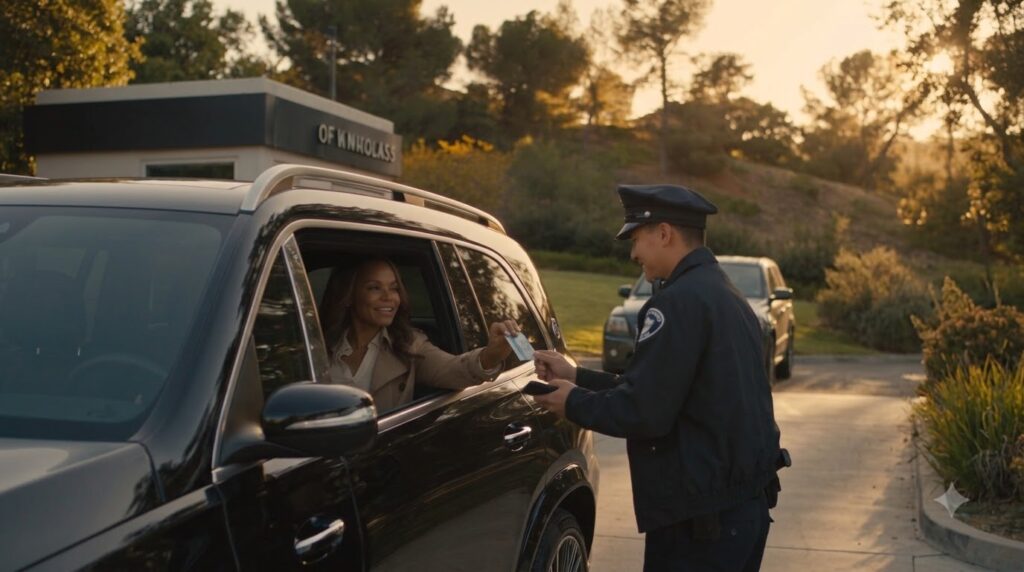
The pickup lane at Arroyo Hills Day School began forming at a quarter past two, though the bell did not ring until three. By half past, the lane was a long, idling procession of polished metal that wound from the iron security gate down the jacaranda-lined drive and out onto Linda Vista Avenue, where it bent politely around the corner so as not to block the neighbors. Range Rovers, Escalades, a white Tesla with a dent that someone was surely embarrassed about. The engines hummed low. Nobody honked. Honking at Arroyo Hills was the kind of thing people remembered about you.
Erica Johnson had parked rather than joined the lane, because she had come straight from a meeting in Glendale and because she liked, once in a while, to walk up to the gate and see her son before he saw her. There was a particular expression Miles wore when he was unaware of being watched, a sort of inward concentration, as if he were working out a problem none of the adults around him had thought to give him. She wanted to catch it. She had been missing it lately. Work had been heavy, the quarter was closing, and three times in the past month she had texted Darren at two o’clock to say she couldn’t make it, and three times he had texted back a thumbs-up and nothing else.
The light that afternoon was the kind Los Angeles saves for October, low and amber and forgiving. It lay across the stucco of the administration building and turned the bougainvillea on the fence a shade of magenta that looked almost artificial. The children waiting behind the gate threw long shadows on the concrete. They sat on their backpacks or swung them by one strap. A few of the older ones had phones out, held close to their faces. The younger ones chased each other in tight circles around the planters under the eye of an aide in a green lanyard.
Erica wore a fitted cream blouse under a camel jacket and the good jeans, the dark ones, and she had pulled her curls back with a tortoiseshell clip that was already losing the fight. She was thirty-eight and slim and she walked like a woman who had spent a decade in rooms where she was the only one who looked like her, which was to say she walked as if the room had been built for her and the architects had simply forgotten to say so. Her eyes, long and almond-shaped, moved across the waiting children and found Miles almost at once.
He was standing near the far planter, a little apart, his navy uniform sweater tied around his waist the way he had seen the fourth graders do it. His backpack, the gray one with the reflective dinosaur on the flap, sagged from his shoulders. His short curls caught the light. He was seven and medium-brown and long in the leg like his father, and he was looking not at the gate, not at the cars, but at the lane, at a point somewhere down by the corner, as though he expected someone particular to come around it.
Erica lifted her hand. He didn’t see her.
At the pedestrian gate a security guard stood with a tablet in a rubberized case. He was a broad man in his fifties with a gray mustache and a navy windbreaker that said ARROYO HILLS SECURITY across the back in block letters, and his name badge read H. ALVARADO. Erica knew him a little. Everybody did. Hector Alvarado had been working the gate for six years, longer than the head of school had been employed, and he had the gift of remembering every child’s name and most of the parents’, and of making the security procedures feel less like a checkpoint than a courtesy. He scanned digital passes off phones, glanced at faces, checked the tablet, and waved the children through to their cars one at a time, calling each by name.
“Mrs. Johnson,” he said, smiling, when she reached him. “Haven’t seen you up here in a while.”
“I know. I’m a terrible mother.”
“No, ma’am. Just a busy one.” He held out his hand for her phone, and she opened the school app and turned the screen toward him. The tablet chirped. He glanced down at it and something in his face shifted, not much, a small recalibration.
At the same moment Erica heard a car door close behind her and turned to see Darren walking up the sidewalk from the lane. He was tall, forty, built like the shooting guard he’d been at Cal State Fullerton two decades ago, and he moved with the same easy, slightly forward-leaning stride. Close-cropped hair, a trimmed beard with a single thread of gray near the chin that he pretended not to notice. A charcoal polo, the company logo stitched small on the breast. He’d left his car, the black Lexus, at the front of the lane with the hazards on, which was against the rules, and she could tell from the set of his jaw that he hadn’t expected to see her.











