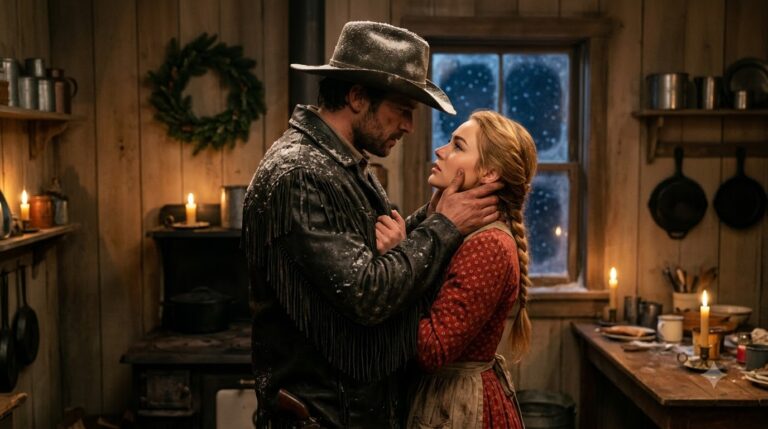
“Try.”
The Widowed Rancher looked at the snow.
Then at her.
“I want you here.”
She kissed his cheek.
“See?”
“Terrible.”
“You survived.”
“Barely.”
Spring came late.
With it came a challenge neither expected.
The Ranch Woman became ill.
Nothing dramatic at first.
Fatigue.
A cough.
Fever.
She ignored it.
Worked anyway.
The Widowed Rancher noticed when she failed to arrive Tuesday morning.
By noon, he was at her door.
No answer.
He entered.
Found her asleep near the stove, fully dressed.
His heart stopped.
“Ranch Woman.”
She stirred.
“Go away.”
“No.”
“I’m sleeping.”
“You have a fever.”
“I noticed.”
He touched her forehead.
She swatted weakly at his hand.
“Stop fussing.”
“Absolutely not.”
He rode for the doctor.
Fast enough that his horse was lathered by town.
The doctor examined her.
Pneumonia.
Not severe yet.
Rest.
Warmth.
Fluids.
Monitoring.
The Widowed Rancher heard only the word pneumonia.
His wife had died after a winter lung illness.
The Ranch Woman saw the memory hit him.
After the doctor left, he sat in a chair beside her bed.
Too still.
She reached out.
“Look at me.”
He did.
“I am not her.”
His face tightened.
“I know.”
“This is not then.”
“I know.”
“The doctor said I’ll recover.”
“I know.”
“Then breathe.”
He tried.
Failed.
The Ranch Woman squeezed his hand.
“I’m staying.”
“You don’t know that.”
“Neither do you.”
His eyes filled.
She continued.
“But fear doesn’t get to decide before life does.”
He looked at her.
“Where did you learn to say things like that?”
“Too much time alone.”
The Widowed Rancher stayed for six days.
Slept in a chair.
Made soup badly.
Burned bread.
Argued with the doctor.
Argued with the Ranch Woman.
Argued with anyone suggesting he go home.
By the fourth day, her fever broke.
He almost cried from relief.
She caught him.
“Are you crying?”
“No.”
“You are.”
“Fever damaged your vision.”
She smiled weakly.
“Come here.”
He sat on the edge of the bed.
The Ranch Woman touched his face.
“You cannot love me by expecting me to die.”
The words hurt.
He knew they were necessary.
“I’m trying.”
“I know.”
He kissed her forehead.
She recovered.
Slowly.
When she finally walked outside again, the Widowed Rancher stood close enough to catch her if wind became dangerous.
She glared.
“I can walk.”
“I know.”
“You’re hovering.”
“I’m nearby.”
“You’re practically attached.”
“That sounds efficient.”
She rolled her eyes.
He smiled.
The illness changed something.
Not their affection.
Their sense of time.
The Widowed Rancher had spent years believing caution protected him from loss.
Now he understood caution could become another way of losing time willingly.
One May evening, he invited the Ranch Woman to supper.
Nothing unusual.
She arrived with bread.
He had cooked.
Poorly.
She looked at the table.
“Should I be afraid?”
“Yes.”
The roast was slightly burned.
The potatoes were excellent.
He had apparently devoted all talent to one dish.
Afterward they walked outside.
The sunset colored the mountains pink.
The Widowed Rancher guided her toward the orchard.
She became suspicious.
“You’re strange tonight.”
“I’m always strange.”
“Stranger.”
He stopped beneath an apple tree.
The same kind she used for the pie.
The Ranch Woman looked at him.
“Why are we here?”
He removed his hat.
Her heart began beating faster.
The Widowed Rancher held the hat with both hands.
A man who could face stampeding cattle looked terrified.
The Ranch Woman said nothing.
He began.
“I had a speech.”
She smiled.
“What happened?”
“I forgot it.”
“That seems unfortunate.”
“Yes.”
“You can try again.”
He stared toward the ground.
“I loved my wife.”
The Ranch Woman’s smile softened.
“Yes.”
“I’ll always love her.”
“I know.”
He looked up.
“And I love you.”
She stopped breathing.
The Widowed Rancher continued quickly, perhaps afraid courage would fail.
“Different.”
She listened.
“Not less.”
His voice roughened.
“Not replacement.”
Her eyes filled.
“Just… another whole thing.”
The Ranch Woman laughed through tears.
“Another whole thing?”
“I told you I forgot the speech.”
“It’s beautiful.”
“It’s terrible.”
She stepped closer.
“Continue.”
He swallowed.
“I spent years thinking grief was proof.”
“Proof of what?”
“That the first life mattered.”
The Ranch Woman waited.
“I finally understand the life mattered whether I ruined the rest of mine or not.”
A tear slipped down her cheek.
He brushed it away.
“You walked across that field for three years.”
“Yes.”
“You made my house feel occupied before you ever lived in it.”
Her breath caught.
“You taught me terrible coffee tastes better with somebody complaining about it.”
She laughed.
He smiled.
“I know your chimney smoke.”
Her eyes closed briefly.
“Your horse.”
His voice softened.
“Your knock.”
He reached inside his shirt pocket.
The Ranch Woman covered her mouth.