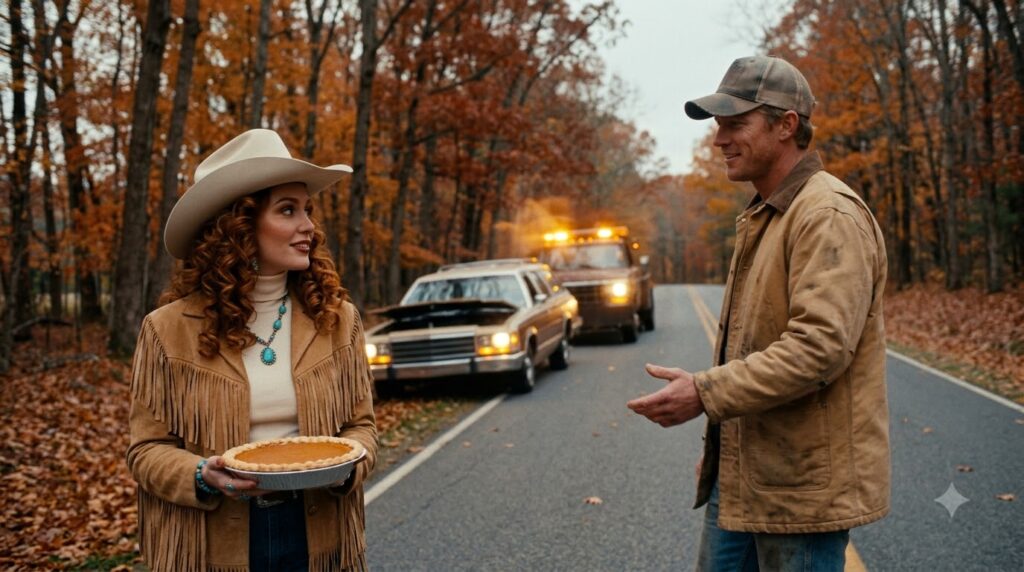
The pastel convertible shuddered once, twice, then surrendered with a soft mechanical sigh that rolled out across the empty two-lane country road like a confession. Jolene Whitaker gripped the cracked leather of the wheel, felt the sweet potato pie box slide an inch on the passenger seat, and said, with the weary affection of a woman speaking to an old friend who had chosen a terrible moment to quit, “Not today, Betsy. Not on pie day.”
Autumn had dressed East Tennessee in orange and red that Thanksgiving afternoon in 1980, the hills burning gentle as a banked fire, and the road between Johnson City and Mama’s place outside Erwin lay almost empty. No traffic, no hurry, only the thin white line and the distant crow of a rooster somewhere behind a fence. Betsy—a 1957 Bel Air convertible painted the soft color of peach ice cream—had carried Jolene through three states and two album cycles and one spectacular professional disappointment. Now she sat silent in the ditch’s edge, her chrome nose tilted toward a stand of maples that looked as if someone had spilled a jar of paprika across the sky.
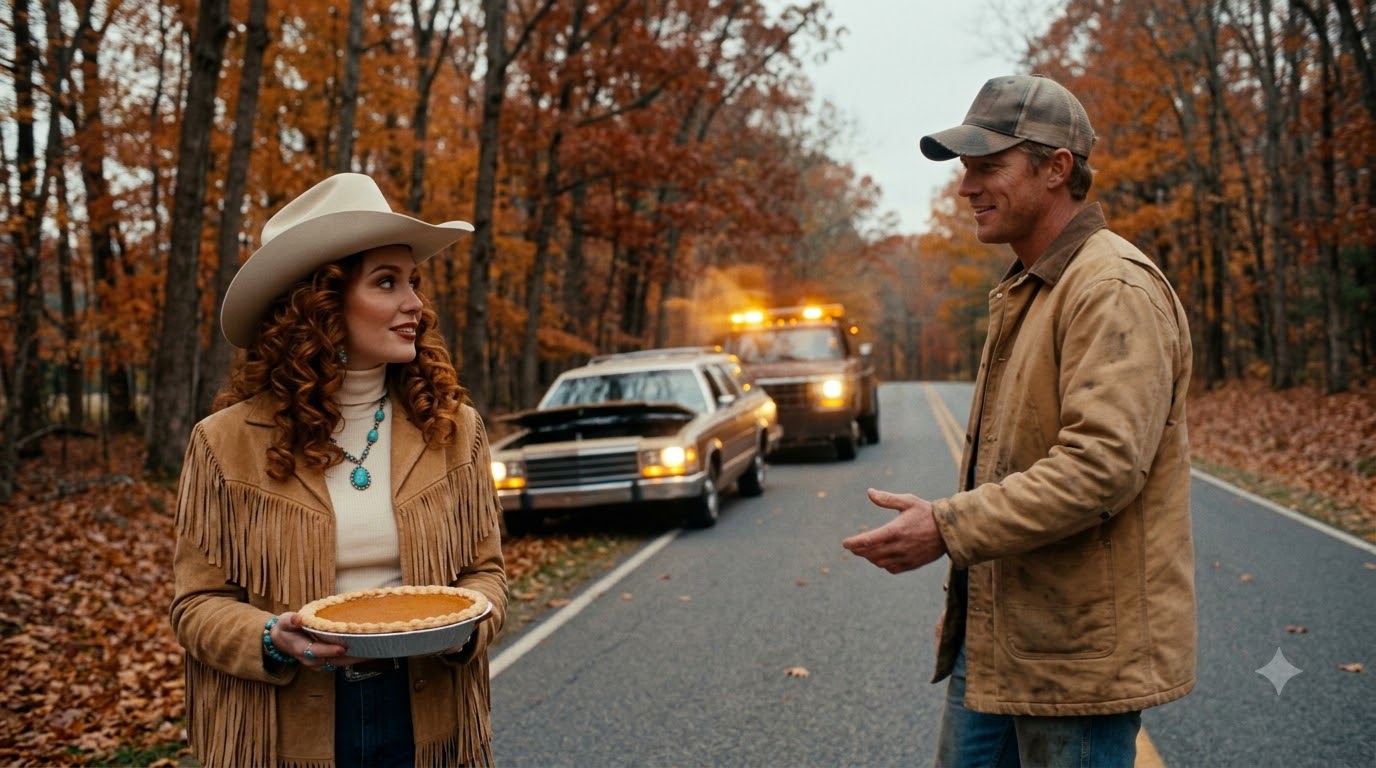
Jolene sat a moment longer with her hands on the wheel. Her auburn curls, freed that morning from rollers in a Nashville motel bathroom, spilled from beneath a cream cowboy hat. She wore a fringed suede jacket the color of toasted pecans, jeans stiff with newness, and boots that had walked more stages than kitchens. On her lids she had brushed warm bronze that caught the afternoon light; her lips were glossy rust-red, the shade Mama used to say made a girl look like she meant what she sang. In the box beside her, wrapped in foil and a dish towel printed with tiny cornucopias, rested the sweet potato pie she had baked before dawn in a borrowed kitchen, the crust still faintly warm through the cardboard.
She climbed out. Gravel shifted under her heels. The wind smelled of woodsmoke and leaf mold and the particular sweetness of late November. She lifted the hood, peered into the engine as if it might apologize, and found nothing she understood beyond the general truth that something important had stopped talking to something else.
That was when she heard the diesel growl.
A tow truck came around the bend like a patient animal, yellow and solid, its winch gleaming. It slowed. It stopped. The door opened, and a man stepped down into the leaf-littered shoulder with the easy economy of someone who spent his holidays fixing other people’s bad luck.
He was about thirty-two, sandy-haired, wearing a grease-stained tan canvas coat over a flannel shirt and a trucker cap that had once been navy. His hands looked capable. His eyes, when he took in Jolene and Betsy and the pie box she had already gathered protectively into her arms, held a flicker of humor that did not mock.
He glanced from the Bel Air to her face and said, mild as buttermilk, “You named your car Betsy?”
Jolene adjusted her grip on the pie. “Did you name your truck anything?”
He tipped his chin toward the yellow hulk behind him. “Big Earl. He’s very sensitive.”
Jolene almost smiled. “Careful. She’s older than both of us.”
His gaze dropped to the foil-wrapped box. The smell of cinnamon and nutmeg and roasted sweet potato had escaped the towel and was doing missionary work in the cold air. “Is that sweet potato pie?”
Jolene answered with the gravity of a woman delivering sacrament. “This pie belongs to my mama.”
He nodded once, as if that settled a dozen questions at once. “Then let’s get you and the pie to Mama.”
What followed was a wide, quiet stretch of afternoon in which no one spoke much of consequence. Big Earl’s winch sang. Chains clicked. Betsy’s pastel body rose and settled onto the flatbed with a dignity that suggested she had been towed before and found the experience undignified but survivable. Jolene climbed into the cab of the tow truck with the pie balanced on her knees. Buck Callahan—he had offered his name while securing the last chain—checked mirrors, put Big Earl into gear, and eased them back onto the two-lane road. The hills scrolled past in flame colors. A barn leaned into its own shadow. Somewhere a church steeple pointed at a sky the pale blue of washed denim.
Jolene watched the road and felt the pie’s warmth through the towel. After a mile she said, looking not at Buck but at the windshield and the future beyond it, “Mama always sets an extra plate, you know.”
Buck’s hands stayed easy on the wheel. “Does she.”
“Every Thanksgiving. Every Christmas. Every time the family gathers and someone might be missing a place to go. She says the plate is for whoever the road brings. Or for whoever the Lord happens to remember.” Jolene’s voice softened. “She’ll set one for you if you come in. She won’t even ask first.”











