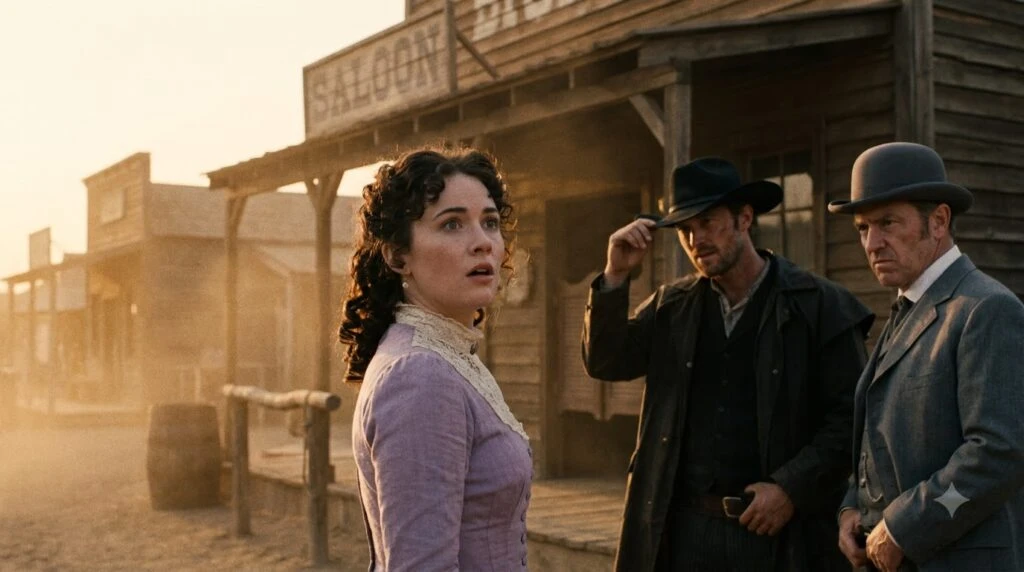
The sun went down over Caliche Springs the way it always did in late September, slow and molten, as if it were reluctant to leave the town to its own devices. It poured itself along Front Street in long bars of gold, catching every mote of dust that the afternoon wagons had kicked loose, so that the air itself seemed to glitter. The false front of the Lone Cedar Saloon took the light like a stage curtain. Its boards were grey with weather and its sign was missing the second E, so that for three years the whole county had called it the Lone Cdar without anyone bothering to fix it. A piano inside played something that had once been a waltz. At the hitching post out front, a tall bay gelding stood with his saddlebags packed tight and a bedroll lashed behind the cantle, flicking his tail at the flies and waiting for the man who owned him.
The man was standing at the edge of the boardwalk with one hand on the horse’s neck and the other hanging loose at his side, as if he had not yet decided what to do with it. He was thirty-one years old and looked older in the face and younger in the shoulders. His jaw was sharp enough to cut the light, darkened with three days of stubble, and his black hat sat low so that only the lower half of his eyes showed beneath the brim. He wore a long canvas duster gone the color of the road, open over a leather vest worn smooth at the pockets, and a red bandana knotted loosely at his throat. His boots were scuffed and spurred, and when he shifted his weight the rowels gave a small, tired ring against the planks.
His name was Wade Callister, and he was leaving.
The woman who had run the length of Front Street to stop him arrived out of breath, one hand pressed flat to her ribs. She was twenty-three and she was, by the general agreement of every man who had ever loitered on that boardwalk, the most beautiful thing Caliche Springs had produced in its short and dusty life. Her hair was dark and heavy and curled, pinned up at the back of her head in a way that was meant to be severe and schoolmarmish, though half a dozen curls had come loose in the running and lay against her neck. Her brows were dark and sharply arched, giving her face a look of perpetual, intelligent challenge. She had drawn a fine line of kohl along her upper lids and swept it out at the corners into a small upward flick, the way the ladies in the Galveston fashion papers did, and it made her eyes look long and feline beneath full, dark lashes. Her lips shone with a salve of beeswax and rose that she made herself and would never have admitted to wearing. Her dress was lavender calico, cut plain for the prairie, with a narrow waist and a long full skirt now powdered at the hem with road dust, and at her throat sat a collar of white lace her mother had tatted before Lily was born.
Her name was Lily Pruitt, and she taught the twenty-two children of Caliche Springs their letters in a one-room schoolhouse at the end of this same street.
“Please don’t go,” she said. “He’ll marry me by Sunday.”
Wade did not look at her right away. He looked down Front Street, at the bank with its brass rail, at the feed store, at the long violet shadows reaching across the ruts. When he did turn, the sunset caught his eyes beneath the hat brim, and they were not hard at all.
“Hank’s a rich man, Lily,” he said. “I’m nobody.”
“You’re not nobody to me.”
“That’s a kindness. It doesn’t buy flour.”
She took a step closer. A pair of cowhands lounging on the bench outside the saloon stopped talking and pretended to study their boots. Somewhere behind the batwing doors the piano faltered and resumed.
“You don’t understand,” she said, and her voice dropped, as though the words were heavy and she had carried them a long way. “My father sold me to him for a debt.”
Wade’s hand closed on the horse’s mane.
“Sold,” he said.
“He calls it an arrangement. He calls it a good match. He says Mr. Dorsey has eight thousand acres and a stone house with glass in every window, and that I’ll never want for anything.” She laughed, and it was not a laugh. “He told me last night. He’d already shaken on it.”
Before Wade could answer, the sound of polished boots came along the boardwalk, measured and unhurried, the walk of a man who had never once in his adult life needed to hurry anywhere. Hank Dorsey was forty, broad through the chest and gone a little soft at the middle, dressed in a grey wool suit too fine for the heat and a bowler hat brushed to a dull shine. A gold watch chain looped across his waistcoat. His mustache was trimmed and his face was ruddy and not unhandsome, and there was in it an expression that Wade had seen before on cattle buyers in Abilene: the look of a man reckoning the value of what stood in front of him.











