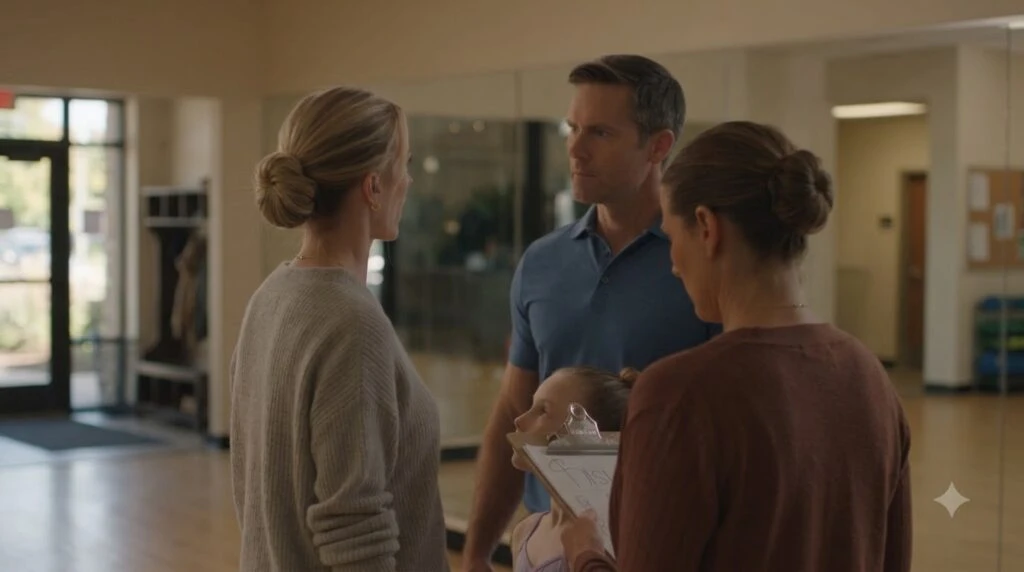
At six-forty on a Tuesday in October, the lobby of the Desert Bloom Dance Academy in Scottsdale smelled like hairspray, warm rosin, and the cinnamon-sugar pretzels somebody’s grandmother had brought in a paper sack and was quietly distributing to anyone under four feet tall. The lights were the color of honey. Mirrors ran the length of the east wall, so the room was always twice as full as it actually was: twice as many mothers on twice as many padded benches, twice as many fathers holding twice as many garment bags with plastic windows showing a flash of sequins, twice as many little girls in buns and tights moving through the hallway like a school of bright fish.
Maya Bennett had come straight from the hospital. She was thirty-seven, slim, fair-skinned, and tired in the specific way of someone who had spent nine hours checking dosages for other people’s children. She had let her long honey-blonde hair down in the car and then, at a red light on Shea Boulevard, pulled it back up into a ponytail, because down it felt like a performance and she did not have one left in her. Her light gray sweater had a small coffee stain near the cuff that she had decided not to care about. Her jeans were the good ones. Her green eyes, in the mirror across from her, looked like the eyes of a woman waiting for a train.
She did not usually do Tuesday pickup. Tuesday was Jason’s night. Tuesdays she worked until seven at the outpatient pharmacy at Honor Health, and Jason left his office in the Kierland building early, and the two of them traded the week back and forth like a ball neither of them was allowed to drop. But the pharmacy’s system had gone down at four, and her supervisor had sent half the shift home, and Maya had sat in the parking garage with her hands on the steering wheel and thought, with a small private gladness, I get to see her come out.
It was an ordinary wish. That was what she would remember later. She had wanted nothing more than to see her daughter come out of a door.
The Studio B door opened at six forty-five and released a dozen seven-year-olds in a single exhale. They were all elbows and ribbons and the high excited noise of girls who had been made to be quiet for an hour. Sophie came out fourth. She was small for her age, with Jason’s chin and Maya’s coloring, her fine blonde hair scraped into a bun that had begun to surrender on the left side. She wore her lavender leotard with the thin straps and carried the glittery dance bag she had chosen herself at the start of the season, purple sequins that changed to silver when you brushed them the wrong way. She brushed them the wrong way constantly. It was, she had explained to her mother, the whole point.
Sophie saw her and stopped, and for one second her face did something complicated, surprise and pleasure and something else, a quick calculation, as if a picture on the wall had moved. Then she ran.
“Mom! Is Uncle Ryan coming later?”
Maya caught her by the shoulders, laughing, and the laugh stayed on her face a beat after it had left the rest of her.
“Who is Uncle Ryan?”
Sophie blinked up at her. Behind Sophie, the instructor had come out of Studio B with a clipboard pressed against her chest. Celeste Ortega was in her late forties, a former company dancer with a dancer’s long neck and a voice that could quiet twenty girls without ever rising. She had taught Sophie for two years. She knew Maya by name and by face, knew the allergy forms, knew the story of the time Sophie threw up in the wings at the spring showcase and then insisted on going on anyway. Now she looked from Maya to the clipboard and back.
“Oh,” Celeste said, and then, kindly, as if correcting a small scheduling error, “I thought Ryan was doing pickup tonight.”
The lobby did not go silent. Lobbies like that never go silent. A toddler was shrieking happily about a sticker. Two mothers by the cubbies were debating the price of recital costumes. But the noise seemed to recede for Maya, the way the ocean pulls back off the sand before a wave, and in that receding she heard the front door chime and turned and saw her husband walk in.
Jason Bennett was forty, fair, with short dark-blond hair that had begun, just this year, to thin at the crown in a way only she was allowed to notice. He had blue eyes and a day of light stubble and he was wearing the navy polo with the small company logo he wore when he had client calls but no client lunches. He was holding his phone and his keys in one hand, and he was walking fast, the walk of a man who was a few minutes late and had been rehearsing an apology. Then he saw Maya standing there with her hands on Sophie’s shoulders and Celeste beside them with the clipboard, and his walk changed. It did not stop. It slowed, the way a car slows when the driver sees the lights behind him.











