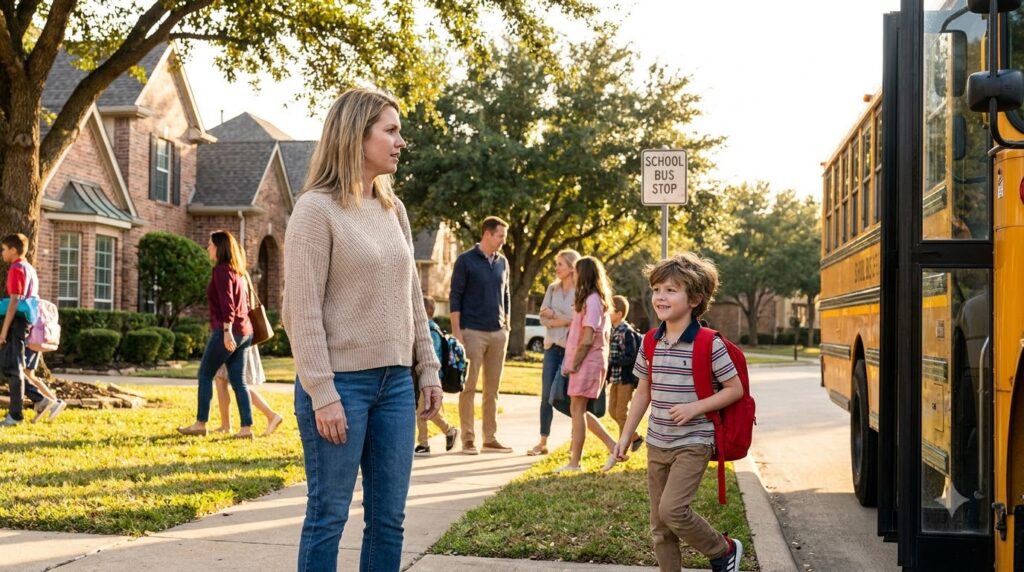
The bus stop at the corner of Live Oak Bend and Meadowridge Drive was not, strictly speaking, a bus stop. There was no shelter and no sign, only a stretch of St. Augustine grass between two driveways that the homeowners’ association mowed every Tuesday whether it needed it or not, and a single crape myrtle that had been pruned so hard it looked like a hand making a fist. The parents who waited there called it the Corner. You met at the Corner. You were late to the Corner. In October, in that part of Texas, the afternoons still pressed down like a palm, and the mothers stood in the thin shade of the myrtle with their sunglasses pushed up into their hair and talked about volleyball schedules and kitchen remodels and whose husband was traveling again.
Megan Turner had not been to the Corner on a Wednesday in almost four months.
It was not a decision she had made so much as one that had been made around her. In June her firm had moved her standing client call to Wednesday afternoons, three to five, and Daniel had said, easily, the way he said most things, “I’ll handle Wednesdays. I can work from the car for an hour. It’s nothing.” And because it was nothing, and because Daniel was the kind of man who actually did the things he said he would do, she had let Wednesdays go. She had let them go so completely that she had stopped thinking about them at all. Wednesday afternoons had become a door in her house she never opened.
Today the client had canceled at two-fifteen with an apology about a sick child, and Megan had sat for a minute at her desk in the converted guest room with the sudden, almost guilty lightness of unclaimed time. She could have texted Daniel. She thought about it. Then she thought about Noah’s face if she were the one standing there when the bus doors folded open, the small surprise of it, and she put on her beige sweater, the fitted one that was too warm for the day but which she liked because it made her feel put together, and she walked the four blocks to the Corner in her jeans and flats with her shoulder-length hair still holding the shape of the clip she had pulled out of it.
The other mothers were there. Kristen Ables waved with two fingers. Someone’s grandmother sat in a folding chair she had brought from her trunk. Megan stood a little apart from them, at the curb, and when the yellow bus came around the bend from Meadowridge, sighing on its brakes, she felt a ridiculous lift in her chest, as though she were the one coming home.
The doors opened. The children came down the steps in their usual avalanche, backpacks first, and Noah was the fifth one off, his red backpack hanging from one shoulder the way she’d asked him a hundred times not to carry it, his brown hair standing up in the back where it always stood up no matter what she did with water and a comb. He was wearing the navy polo shirt she’d laid out that morning, now with something orange on the collar, and his sneakers, which were new in August and already looked as if he’d walked to school from Oklahoma.
He saw her and stopped on the bottom step.
“Mom? You’re picking me up?”
It was not the face she had imagined. It was not delight. It was something closer to the look he got when she walked into the den while he was watching a show he wasn’t supposed to be watching: a quick freezing, a recalculation.
“Of course,” she said, and smiled, and heard the smile go slightly stiff. “Why?”
Behind him the driver leaned forward over the big flat wheel. Megan knew her by sight, the way you know the people who touch your child’s day without ever quite entering your own. She was a Black woman somewhere in her fifties, with reading glasses on a beaded chain and her hair cut close and silver at the temples, and a laminated badge clipped to her lanyard that said O. PRUITT. The kids called her Miss Odessa. Noah had drawn her once, in first grade, as a giant with a steering wheel for a heart.
“Mrs. Turner,” Miss Odessa said, pleasantly, as if confirming an item on a list, “I thought Mr. Turner’s friend was coming again.”
Megan looked up at her. The afternoon seemed to rearrange itself very slightly, the way a room does when someone moves a single chair.
“Again?”
“He’s been meeting Noah here Wednesdays.” Miss Odessa said it kindly, and then, because she had been driving children for a long time and could read a face in a rearview mirror at forty miles an hour, her own expression changed. Just a little. Just the eyebrows. “I mean, she has. His friend. He set it up with the school. It’s on the card.”











