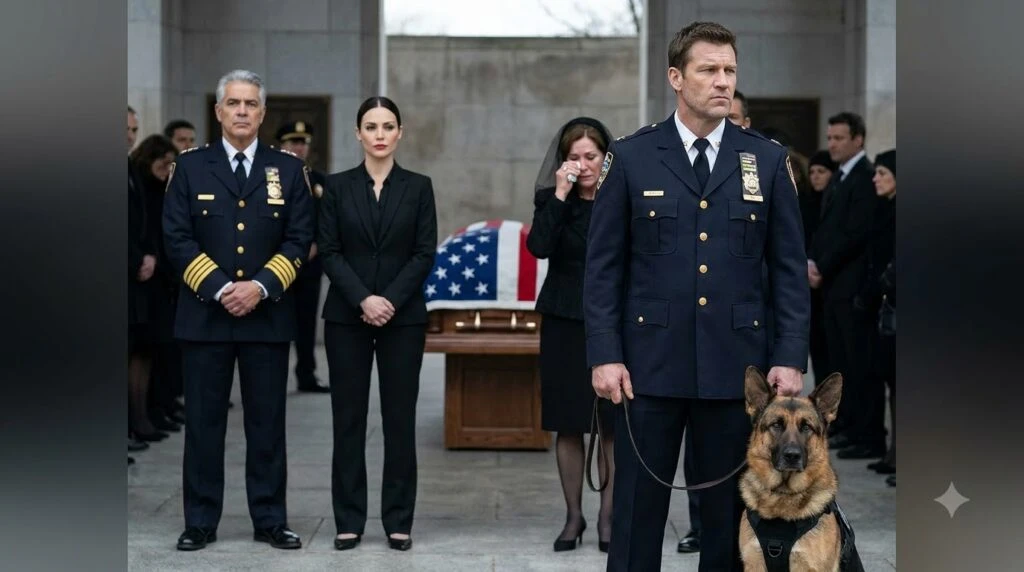
Everyone in the church froze when the police dog suddenly lunged forward, barking desperately at the officer’s coffin and refusing to let anyone get close.
Officers tried to pull him back, but the German Shepherd wouldn’t stop. His gaze was locked on the officer’s still body, as if he sensed something terrifying no human could understand. People whispered.
Some thought the police dog was grieving. Others thought he was losing control. Then the police dog’s growls turned frantic, his paws clawing at the coffin as if begging someone to open it.
The dog wasn’t confused. He was trying to warn them. Moments later, when they finally opened the coffin to calm the dog, they uncovered a truth so unexpected it changed everything.
The sky hung low and gray over the city, as if even the heavens were mourning the loss of Officer Daniel Hayes.
A bitter wind swept through the police memorial hall, rattling the tall glass windows and carrying with it the weight of grief that settled heavily over everyone who entered.
Rows of black suits, polished badges, and somber faces filled the room, each person standing in silence as they approached the wooden coffin resting at the center.
A folded American flag lay perfectly across the top, its colors stark against the muted tones of the hall.
No one spoke. No one dared interrupt the quiet sorrow that clung to the air. Daniel had been more than an officer. He had been a friend, a brother, a mentor.
His sudden accidental death had sent shock waves through the entire department. It wasn’t just the loss of a good man. It was the loss of someone who stood for justice with unwavering conviction.
His mother sat in the front row, her trembling hands clasped tightly around her husband’s. His young sister wept silently, her head on her mother’s shoulder.
Then the doors at the back of the hall opened.
Every eye turned.
Rex entered.
The German Shepherd walked slowly beside Lieutenant Harris, his police K-9 vest still strapped to his muscular frame. Rex had been Daniel’s partner for five years. Inseparable, loyal, brave, normally confident and steady, Rex now moved with hesitation, sniffing the air as though searching for a scent that didn’t belong.
Whispers rippled through the hall as people instinctively stepped aside, watching the dog with a mix of sympathy and curiosity. They expected him to sit beside Daniel’s portrait. Maybe rest his head on the floor in mourning.
But Rex had no intention of sitting still.
His ears twitched, his brows tightened, his steps quickened.
Lieutenant Harris gently tugged the leash. “Easy, boy. Easy.”
But Rex ignored him. His gaze locked onto the coffin. A low whine escaped his throat, soft at first, like the cry of a child who didn’t understand why their world had suddenly fallen apart. Then he took another step forward, pulling harder on the leash, his body tensing with urgency.
Some officers exchanged glances.
“Poor thing,” one whispered.
“He just misses his handler,” another murmured.
But Harris frowned. He had worked with K-9s for over ten years. Grief looked different. This wasn’t sadness. It was agitation.
Rex’s tail was stiff. His breathing quickened. His eyes never left the coffin.
Something was wrong. Deeply, unmistakably wrong.
And this was only the beginning.
Rex’s nails clicked sharply against the polished floor as he pulled harder toward the coffin, each step more urgent than the last. Lieutenant Harris tightened his grip on the leash, but the German Shepherd refused to slow down. His ears were pinned forward, his breaths fast and uneven, and his muscles quivered with a tension no one could explain.
The quiet murmur of the funeral hall shifted into uneasy whispers.
“What’s wrong with him?”
“Is he reacting to the scent of his handler?”
“Maybe he’s just confused.”
But confusion didn’t look like this.
Rex wasn’t wandering or whining aimlessly. He was focused, laser-focused, on the coffin, as if something inside was calling to him.
Harris knelt down, placing a gentle hand on Rex’s shoulder. “Rex, buddy, it’s okay. Daniel’s gone. You can rest now.”
But the moment his hand touched Rex’s fur, the dog jerked forward with such force that Harris nearly lost his balance. The leash stretched tight, vibrating with the intensity of the dog’s determination.
Rex let out a sharp bark.
Heads turned. Some jumped. Daniel’s mother gasped quietly, clasping her daughter’s hand. Officers straightened, unsure whether to intervene or simply observe. After all, grief was unpredictable. Perhaps this was the dog’s way of saying goodbye.
But the bark wasn’t mournful. It wasn’t broken or trembling like a grieving animal.
It was a warning.
Deep, sharp, commanding.
A bark Rex used on the job when he sensed danger, not loss.
A cold ripple traveled through Harris’s chest. He slowly rose to his feet, eyes fixed on Rex’s rigid posture. Only one thing made a trained K-9 behave this intensely.











