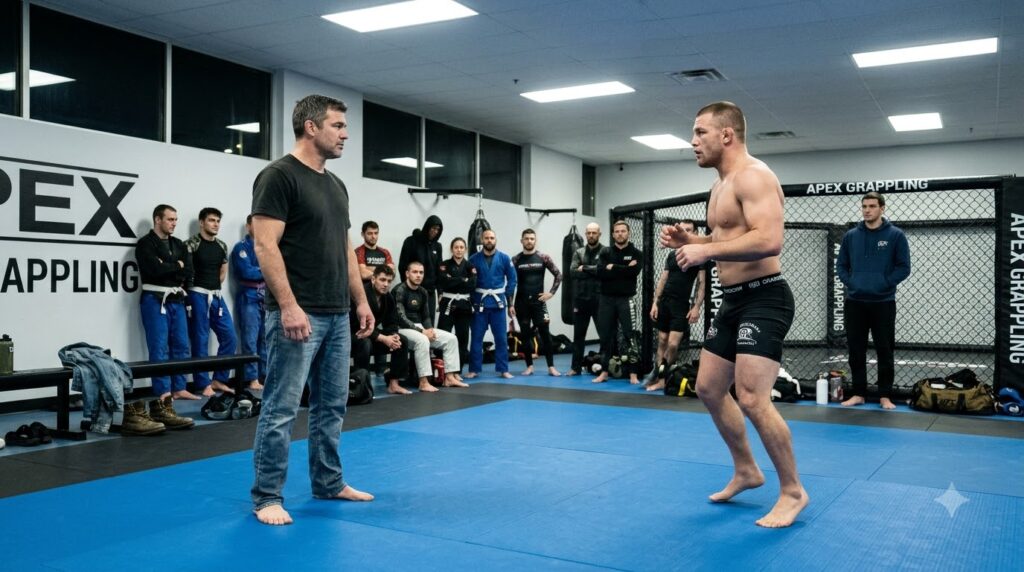
My driveway was suddenly occupied by a stranger in a tight black t-shirt, grinning like he just hit the jackpot. Rolling his shoulders and crossing his arms, he commanded me to back off. He wanted to hurt me, completely oblivious to the fact that violence used to be my day job. The death of a marriage isn’t a sudden explosion. It’s a slow leak.
A tire losing pressure over a thousand miles until you’re riding on the rim, wondering why the steering feels heavy. For Sarah and me, the leak started three years ago, right around the time I took a desk job in logistics. Spreadsheets, quarterly reviews, khakis that always felt too stiff. I was 38, my knees popped when it rained, and I was desperately trying to be normal. I was trying to be the guy who complained about property taxes and crabgrass, instead of the guy who used to wake up at 3:00 a.m. in a shipping container in Fallujah.
Sarah never really knew that version of me. We met a year after my discharge. By then, I had boxed up the medals, shoved the tactical gear into a plastic bin in the attic, and buried the memories under a deliberate, manufactured calm. I didn’t talk about the teams. I didn’t watch war movies.
If a loud noise went off, I forced myself to blink slowly instead of hitting the deck. I wanted a quiet life. I wanted a soft life. I wanted her. But quiet gets boring.
It started with the gym. Sarah decided she wanted to take a women’s self-defense class at a place called Apex Grappling downtown. I thought it was a great idea. Two nights a week turned into four. Then came the weekend seminars.
Then came the sudden wardrobe shift, the overpriced athletic wear, the protein powders cluttering the kitchen counter, the constant texting. I didn’t snoop. I didn’t need to. When you spend a decade reading the baseline behavior of hostile crowds, a cheating spouse is about as subtle as a flare gun in a dark room. She was defensive when her phone buzzed.
She smelled like a specific brand of sandalwood body wash that we didn’t own. Her eyes, whenever they met mine, carried that distinct cloudy mixture of guilt and contempt. The confrontation happened on a Tuesday. It was raining. The house smelled like the pot roast sitting in the slow cooker.
I was at the kitchen island staring at the utility bill when she walked in from training. She dropped her gym bag by the door. The strap caught the edge of a side table knocking over a framed picture of us from a vacation in Maine. It hit the hardwood with a sharp crack, the glass spiderwebbing across our smiling faces. Sarah didn’t even flinch.
She just looked at it, then looked at me. “I’m not picking that up, Jack,” she said. Her voice was flat, dead. “I know,” I said. I slid the utility bill aside.
“Are you going back to his place tonight or are you staying here?” She froze. The bravado slipped for a fraction of a second revealing the panicked teenager beneath before the hardened mask snapped back into place. She crossed her arms. “How long have you known?”
“Long enough.” She walked over to the fridge, opened it, and stared inside as if the leftover Tupperware held the answers to the universe. “His name is Liam. He owns the gym.” “Okay.”
She shut the fridge harder than necessary. “Is that it? Just okay? You’re not going to yell? You’re not going to throw a plate against the wall?”
She laughed, a short bitter sound that scraped against the silence of the kitchen. “God, you’re so predictable. You’re just nothing.” I kept my hands flat on the granite countertop. In the teams, losing your temper meant losing your life.
You trained to lower your heart rate when the bullets start flying. You trained to breathe through the panic. My heart was breaking, tearing itself apart in my chest, but my breathing stayed even. “What do you want me to do, Sarah?” I asked, my voice barely above a whisper.
“I want you to care,” she snapped, finally looking at me. “I want you to be a man. Liam takes what he wants. He’s alive. He’s passionate.
You just sit there day after day watering the lawn and paying the bills. You’re weak, Jack. I’m sorry, but it’s the truth. You’re a soft suburban drone. I can’t breathe in this house anymore.”
I looked at the woman I had built my entire fragile peace around. She thought my restraint was weakness. She thought the cage I had built to keep the monster inside was proof that the monster didn’t exist. “If that’s how you feel,” I said, standing up slowly. “I’ll pack a bag.











