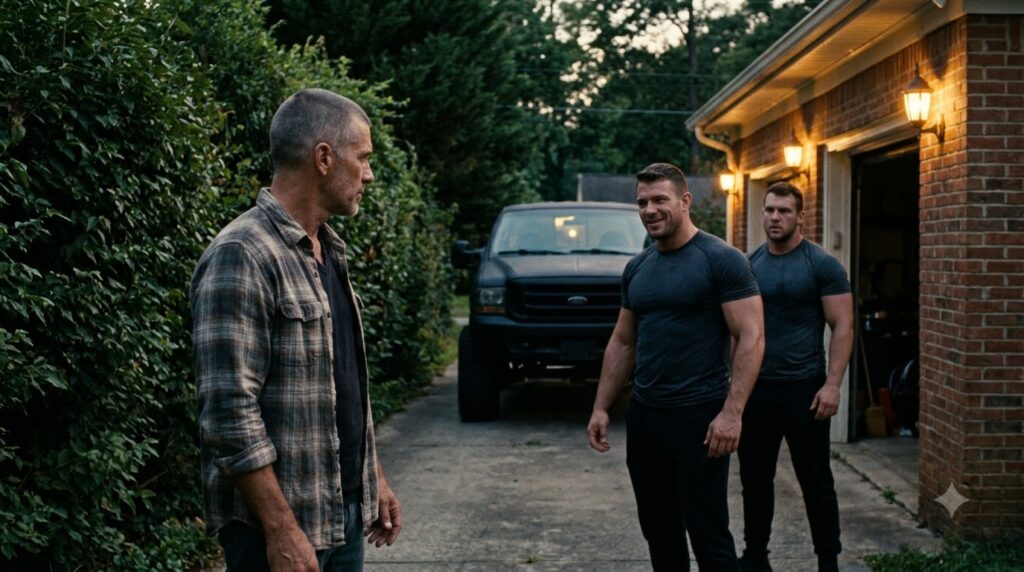
The pavement dug into my back, and the local grappling champion was whispering threats through a smug smile, fully believing he had won. He thought I was just the quiet middle-aged guy from 42B. He had absolutely no idea I spent the last decade teaching Navy SEALs how to survive. To understand how a suburban driveway transformed into a tactical combat zone, you have to understand the sanctuary I was trying to build. My name is Jack Reynolds.
For 14 years, my office was a windowless concrete walled facility in Virginia Beach, interspersed with extended undisclosed trips to places where the sand is hot and the local populace would rather you didn’t exist. I was an independent defense contractor and a close-quarters battle CQB instructor. My primary clients, tier one operators, specifically the men of the United States Naval Special Warfare Development Group. I didn’t teach them how to shoot. They already knew that.
I taught them how to survive when the rifle jammed, the room went pitch black, and the distance between them and a hostile was reduced to zero. I taught close-quarters survival and control under extreme conditions. When I retired at 46, I had enough savings, enough phantom adrenaline, and enough ghosts to last three lifetimes. I bought a single-story ranch house in Oakridge Estates, a quiet, aggressively mundane neighborhood in northern Virginia. I wanted the silence.
I wanted to wake up, water my hydrangeas, drink dark roast coffee on my porch, and never have to assess another human being’s threat level for the rest of my natural life. For the first 8 months, it was paradise. I was the boring guy at the end of the cul-de-sac. I drove a 10-year-old Honda Accord, wore faded flannel shirts, and kept my hair buzzed short purely out of habit. To the rest of the world, I was just an aging accountant or a mid-level manager trying to nurse a bad back.
Then, Derek Wallace moved in next door. Derek was 32, fueled by pre-workout supplements, new money, and an ego that entered a room a full minute before he did. He drove a matte black lifted Ford F-250 with tires that belonged on a piece of agricultural machinery, and he made sure everyone in Oakridge Estates knew when he was coming or going. But, the truck wasn’t his defining characteristic. His defining characteristic was his newly minted black belt in Brazilian Jiu-Jitsu.
Derek trained at a highly publicized local facility called Apex Striking and Grappling. It was run by a guy named Ray Mitchell, a legitimate former regional MMA champion who had built a lucrative business training local businessmen and amateur fighters. Derek was Ray’s star pupil, a fact Derek made sure to broadcast to anyone within earshot. He wore tight, moisture-wicking shirts emblazoned with the gym’s logo. He made his martial-arts identity part of his presence around the neighborhood.
He spoke in a bizarre vernacular of sweeps, submissions, and guard passes. I noticed the shift in the neighborhood’s dynamic almost immediately. Suburban ecosystems are fragile, relying on unspoken rules of mutual respect and non-interference. Derek shattered that. He was a bully who had found a socially acceptable vehicle, martial arts, to justify his aggressive nature.
He started small, parking his massive truck so it partially blocked his neighbor’s driveways, playing bass-heavy music in his open garage until 2:00 in the morning. When confronted, he didn’t apologize. He intimidated. I watched from my kitchen window one Tuesday evening as he backed down Henry, a 68-year-old retired postal worker who lived across the street. Henry had politely asked Derek to move his guest’s car, which was parked on Henry’s sprinkler head.
Derek had puffed out his chest, closed the distance to within inches of Henry’s face, and used a low menacing tone to send the old man shuffling back into his house. I watched Derek’s body language. I watched the way he distributed his weight, the way his chin jutted out, the subtle flare of his lats. In my former life, analyzing an opponent’s physical mechanics was the difference between walking away and being carried out in a bag. Derek was strong, undoubtedly fast and conditioned.
But he was also arrogant, emotionally undisciplined, and profoundly untested outside the padded walls of a gymnasium. I decided to remain the gray man. I’d spent over a decade swimming in violence. I had no desire to dip my toes in a neighborhood squabble. When Derek would stare me down as I checked my mail, hoping for a reaction, I gave him a mild, slightly awkward wave and retreated inside.
He interpreted my lack of aggression as fear. He mistook my silence for submission. And in the mind of a bully, submission is an invitation to push harder. He had no idea that the quiet neighbor he was sizing up wasn’t avoiding a fight out of cowardice, but out of a deeply ingrained, almost mechanical restraint. I wasn’t scared of Derek Wallace.











