Sophie continued, because children answer questions until adults teach them not to. “She came after dinner,” she said. “Daddy said she was helping with work.” Rachel’s chest tightened.
“What was her name?” Sophie thought hard. “Miss Natalie.” Rachel closed her eyes for one second. Natalie Reed. Of course.
The name itself did not arrive as a complete revelation. It arrived as a key sliding into a lock Rachel had not known existed. Natalie was a senior account manager at the consulting firm where David had worked for nearly eight years. Rachel had met her twice at company holiday parties and once at a summer cookout.
Natalie was thirty-six, single, polished, funny, and one of those people who made everyone around her feel as if they were participating in a private joke. Rachel had liked her. That detail hurt immediately. Rachel stood slowly.
“Sophie, I want you to go upstairs and change into your pajamas, okay?” “But I’m playing dress-up.” “I know, baby.”
We’ll talk about that later. Go put your pajamas on and leave the dress on your bed. Sophie’s face fell. “Am I in trouble?” The question struck Rachel hard enough to make her throat ache. “No,” she said immediately.
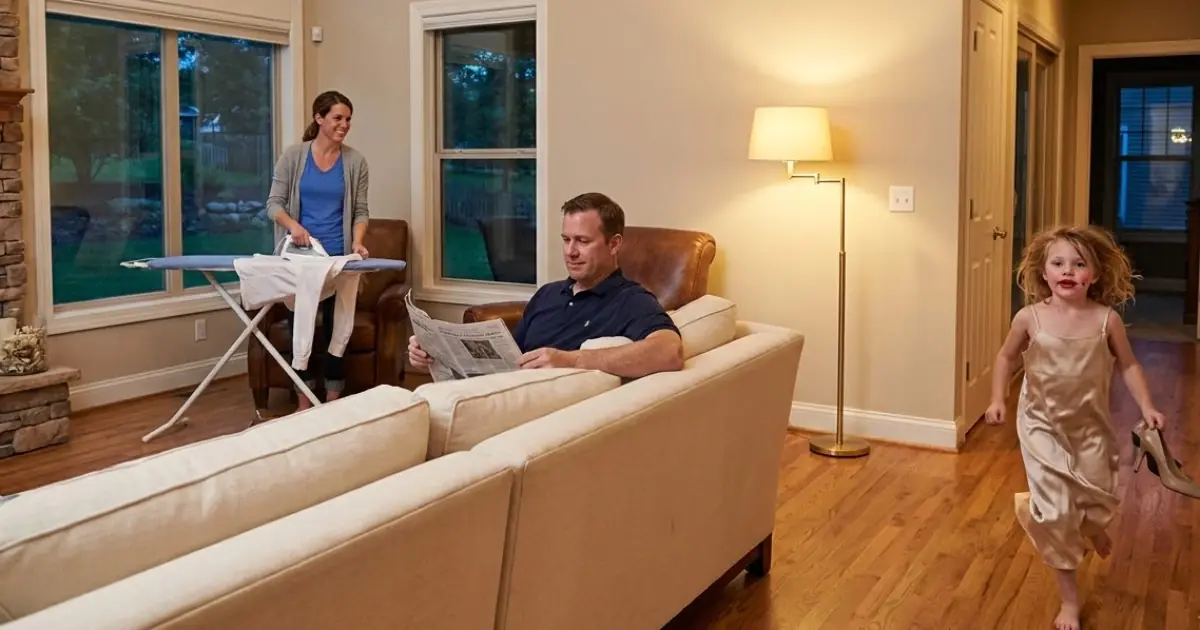
“You are not in trouble at all.” David finally found his voice. “Nobody said she was.” Rachel looked at him. He stopped again. Sophie padded upstairs in one sock and one bare foot, the satin dragging behind her, still carrying the second heel.
Rachel listened until the sound of the dress brushing the steps disappeared. Then she turned off the iron. The click was quiet. “What happened last Saturday?” she asked. David held both hands out in front of him, palms low, the posture of a man trying to calm an animal that had not yet decided whether to bolt or bite.
“Natalie came by because we had to review a presentation for the Halpern account.” Rachel said nothing. “She stayed later than expected.” Rachel said nothing.
“We had wine.” There it was. Not the confession.
The staircase leading to it. Rachel leaned one hand against the ironing board because suddenly the floor felt slightly unreliable. “And she took off her dress because?” David’s mouth opened. No answer came quickly enough. Rachel laughed once, softly.
It was not a happy sound. “You need to understand something,” she said. “Every extra second you take before answering makes the answer worse.” David rubbed his jaw. “She spilled wine on it.” Rachel stared at him.
He continued quickly. “Red wine.” Sophie knocked into the side table when she came downstairs for water. It went everywhere.
Natalie changed into one of your old sweatshirts while we tried to rinse the dress. Rachel looked toward the stairs. “That’s your explanation?” “It’s what happened.”
Rachel’s pulse was pounding now. “Then why did Sophie say she left the dress overnight?” David looked down. Small movement. Catastrophic meaning.
“She was too drunk to drive,” he said. Rachel felt cold despite the warm room. “So she slept here.” “In the guest room.” Rachel nodded slowly. The answer was almost plausible.
That made it more dangerous. People imagine lies as ridiculous things, tangled too quickly to survive examination. The best lies are built mostly from facts. Rachel had learned that in other contexts—at work, with vendors, with relatives pretending not to be angry.
The question now was which parts of David’s story were load-bearing and which were camouflage. “Where was Sophie?” she asked. “Asleep.” “Then how did she know Natalie left her dress?”
David blinked. Rachel felt something settle inside her. He had not thought about what the child knew.
That was the weakness in the story. “She must have seen it the next morning,” David said. Rachel’s voice became very quiet. “Sophie said Natalie came after dinner.”
She knew she was here. She knew you said she was helping with work. She knew whose dress it was. So let’s stop pretending she slept through the night like a decorative prop in your explanation. David’s face tightened.
“I’m not pretending anything.” “Then tell me exactly what my daughter saw.” He looked toward the stairs again. Rachel moved between him and the hallway without thinking.
“No,” she said. “You don’t go ask her what she remembers.” You don’t get to coach the witness. The word witness changed him.
“Rachel, don’t do that.” “Do what?” “Turn this into something criminal.” She stared at him.
“I said witness because she saw something.” If your mind jumped to criminal, that belongs to you. He looked away. That was the first moment Rachel knew, not suspected, that the explanation was incomplete.
She did not know how incomplete yet. The most dangerous part of betrayal is that discovery arrives in installments. If truth appeared all at once, the mind might collapse cleanly under its weight. Instead, it drips. A dress.











