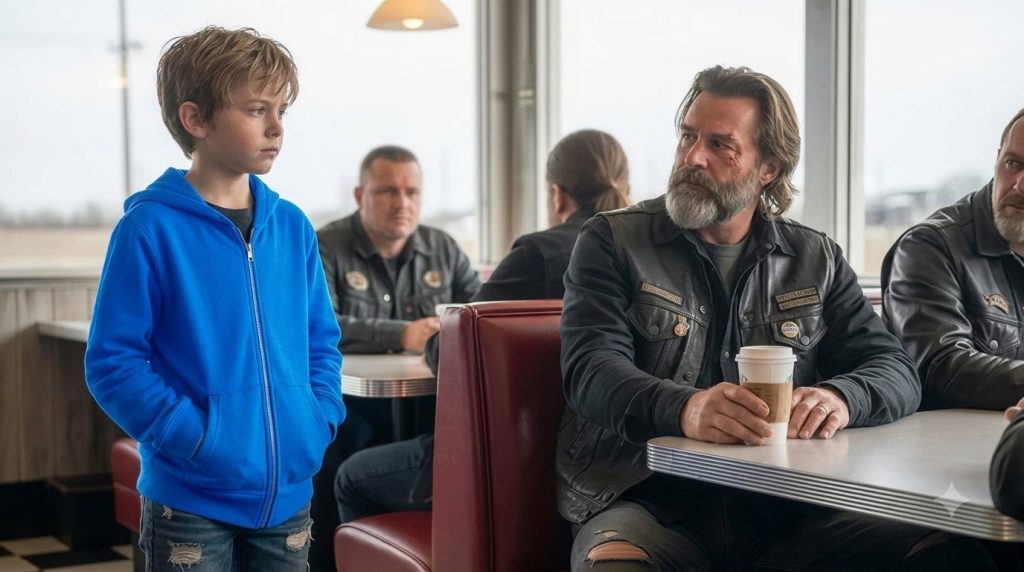
A 10-year-old boy walked four miles through freezing snow to ask a stranger where the police station was. Nobody helped him. Not the gas station clerk who saw him shivering outside the window. Not the woman in the SUV who slowed down then kept driving. Not the off-duty deputy who told him to go home before dark.
The only people who listened were the most dangerous men in the county. A brotherhood of scarred, broken bikers sitting inside a dying roadside diner, carrying more invisible wounds than the boy could ever understand. This is not a story about heroes. This is a story about what happens when the world abandons a child and the only ones left standing wear leather and ride thunder. The diner had no name anymore.
Whatever letters once hung above the door had been stolen years ago, leaving behind only rusted bolts and the pale ghost shapes of words bleached into the aluminum siding by decades of sun and winter. Locals called it Mack’s, though nobody named Mack had worked there since the Clinton administration. The county had condemned its septic system twice. The health inspector visited once a year and left shaking his head. But the coffee was strong.
The parking lot was big enough for 12 Harleys lined abreast, and the old woman behind the counter, Doris, 73, cigarette always burning in a cracked ceramic ashtray beside the register, never once asked anyone to leave. That was enough. Cade Mercer sat alone at the end of the counter, leather jacket dark with melted snow, both hands wrapped around a mug he hadn’t touched in 20 minutes. The coffee was cold. He didn’t care.
He wasn’t here for coffee. He was here because the motel room he’d been renting by the week smelled like mildew and old carpet cleaner, and the walls were thin enough to hear the couple next door arguing about money every night until 2:00 in the morning. And sometimes a man needed to sit somewhere that wasn’t slowly poisoning his mind.
Outside, Route 14 stretched flat and gray beneath a sky that couldn’t decide between rain and snow. The asphalt was wet. The wind carried that particular Midwest cold that didn’t just bite. It settled into your bones like a squatter who had no intention of leaving. Three Harleys sat in the parking lot, engines still ticking as they cooled, chrome catching the sick yellow pulse of the diner’s one surviving neon sign.
Cade was 41 years old and looked 50. Not because life had been unkind to his face, though it had, but because his eyes carried the kind of distance that aged a man from the inside out. Gray threaded through his dark hair at the temples. A scar split his left eyebrow where a bottle had caught him in a bar fight 7 years ago. His knuckles were permanently swollen, the skin across them white and tight like old leather stretched too far.
He had a tattoo on his right forearm, a single word in block letters. Still, people asked what it meant. He never answered. Behind him, two of his brothers occupied the corner booth. Roach, real name Dennis Kowalski, sat with his back to the wall because he hadn’t sat with his back to a room since Fallujah.
He was 56, thin as a fence post with a beard that had gone completely white and hands that shook unless he was holding something. A wrench, a cigarette, the handlebar of his 98 Road King. The shaking had started 3 years ago. The VA said it was neurological. Roach said it was just his body finally catching up to what his mind had been doing since 2004.
Beside him sat a man everyone called Dutch, though his birth certificate read Miguel Espinosa. Dutch was wide shouldered, quiet, and had a face that looked like it had been carved out of sandstone by someone who got bored halfway through. He’d done four years in Leavenworth for assault, a fight he still maintained the other guy started, which was technically true, though Dutch had ended it so thoroughly that the prosecutors used the word excessive nine times during the trial. He’d been out for 6 years now, worked part-time at an auto salvage yard, read paperback westerns in his bunk at the clubhouse, said maybe 40 words on a good day. These were not good men by any standard the world respected.
They paid taxes late or not at all. They drank too much. They’d all seen the inside of a holding cell at least once. Two of them carried felony records that closed more doors than they’d ever be able to count. But they also knew things that respectable people didn’t.
They knew what a fist sounded like hitting a wall at 3:00 in the morning when a child was trying to sleep on the other side of it. They knew what it looked like when a woman smiled too quickly to cover a bruise. They knew the exact silence that filled a house after violence. Not peace, but the terrible pressurized quiet of people waiting for the next explosion. They knew because they’d all grown up in that silence.











