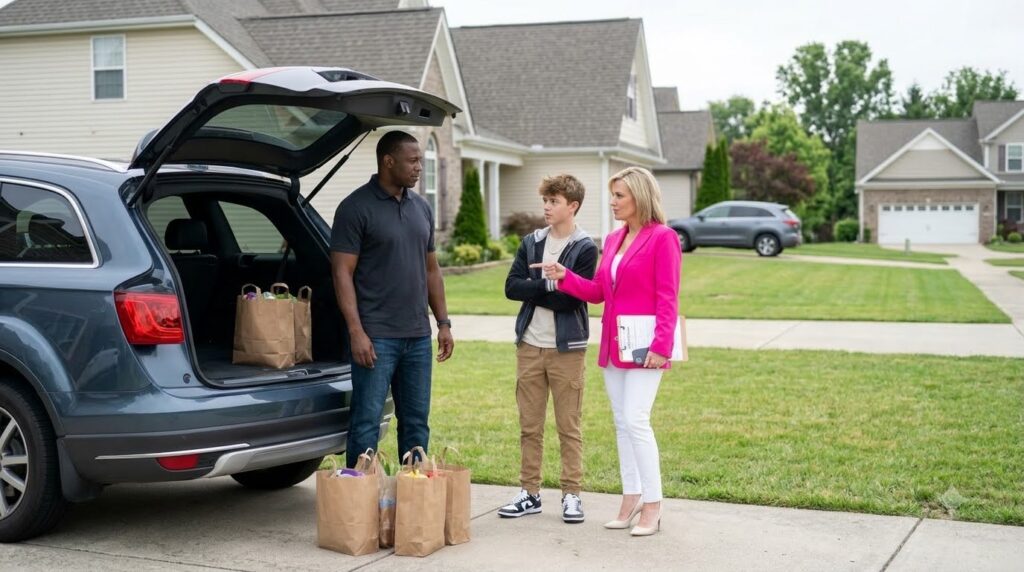
“Hand over the bags. My mom says you owe us.”
The kid was sixteen, blocking my trunk, arms crossed like this was already settled.
I set the groceries down slowly on my own driveway.
“Son,” I said, “you want to think very carefully about what you just said.”
“Or what? You going to call the cops?”
I looked at him for exactly three seconds.
“No,” I said. “I won’t.”
His mother hit my porch four minutes later, phone already out, voice already raised.
“I’m calling the police, and you will regret this. Do you understand me? Do you have any idea who I am in this neighborhood?”
I picked my groceries back up.
“Ma’am,” I said. “Make the call.”
She did. Confident. Satisfied. Not once stopping to ask who I was. Only who she was.
That was the last mistake Bettina Whitmore ever made in Meadowlark Estates.
Let me take you back about fourteen months before that driveway moment, because you need to understand the world I was living in to fully appreciate how spectacularly this all unraveled.
I’m Chief Daniel Mercer, though at the time, nobody in Meadowlark Estates knew that. The development sat just outside the city limits of Ridgecroft, Tennessee, a mid-size town, the kind of place where high school football still fills the bleachers and everybody eventually knows everybody’s business.
I had spent twenty-two years working my way up through the department. Patrol. Detective. Lieutenant. And finally chief, appointed eight months before I moved into the neighborhood. The new role came with a modest bump in pay and a genuine desire to decompress somewhere quiet.
My therapist had actually suggested it. “Get out of the apartment above the precinct parking garage, Daniel. Go somewhere with a yard.” So I bought 14 Brierwood Court. Three bedrooms. A deck that needed refinishing. A dogwood tree that had been badly over-trimmed by the previous owner. And a homeowners association that I, stupidly, assumed would be a minor administrative footnote in my life.
I kept my career to myself intentionally. After two decades in law enforcement, you develop a strong preference for not broadcasting what you do for a living. People act differently. They either treat you like a personal security service, or they get weirdly defensive, like you are cataloging their jaywalking. I just wanted to be the neighbor who waves, mows on Sundays, and goes back inside.
I introduced myself simply as a city employee. Nobody pressed further. The smell of the neighborhood on the day I moved in is still vivid to me. Fresh-cut grass baking under a July sun, the faint chemical tang of someone running a pressure washer two houses down, and above it all, the sour reek of an overflowing garbage bin that someone had failed to roll back to the curb per the HOA’s very specific schedule.
That bin, I would later learn, belonged to the household directly across the street. The Whitmore household. Bettina Whitmore was fifty-three, trim in the way of someone who treats exercise as a competitive sport, and she wore authority the way other women wore cardigans. Permanently. Without thinking about it.
She had served as HOA board president for six consecutive years. She had personally drafted the amendments that established the landscaping color palette guidelines. Yes, that is a real thing. And yes, there was a laminated chart. She also had a habit of appearing at your property line at moments that were always, technically, accidental. “Just out for my walk,” she would say, while clearly reading the brand name on your lawn fertilizer.
Her son, Cody, was sixteen and built like someone had taken a golden retriever’s energy and stuffed it into a teenager who had never once been told to sit. He drove a golf cart, HOA permitted, naturally, around the cul-de-sac with the territorial confidence of a much smaller animal who had no idea what the larger animals around him were capable of.
The first unfair act came three weeks after I moved in. I received a written HOA violation notice, hand-delivered, with a little red sticker on the envelope like it was a summons. It cited me for failure to maintain approved exterior paint integrity on my mailbox post. The post was white. The approved color was antique linen. They are objectively the same color. I have a photograph.
The fine was forty dollars. I paid it, not because I thought it was right, but because I was tired. I had seven cases on my desk and a department budget meeting on Thursday. Pick your battles. I should have picked that one, because Bettina Whitmore read my payment as confirmation that she had found exactly the kind of neighbor she liked best. Someone who would absorb whatever she handed out and write a check.











