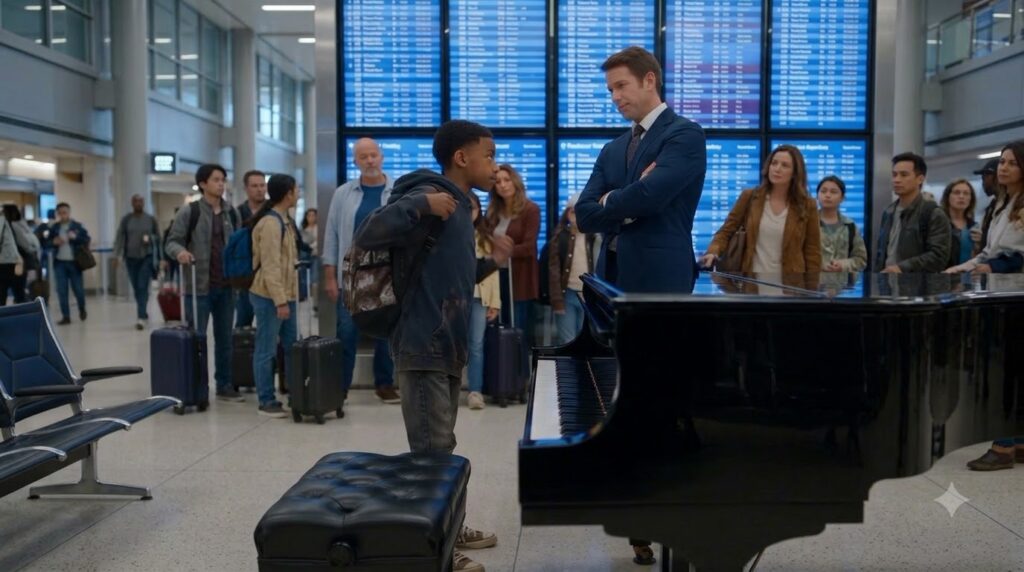
The atrium smelled like coffee grounds and wet wool and the metal of the trains underneath, a Saturday smell, bright through the tall glass even when the sky was the color of the benches. Families cut across the tile with shopping bags and strollers. A kiosk sold burnt regular and called it house blend. The black upright piano sat where the station had put it so people would film themselves and mostly did not. The bench was empty. A paper sign said play if you want, twenty minutes, be kind.
Jonah Hale was ten and thin in the way that came from growing faster than groceries, messy dark hair, a gray hoodie with a cuff unraveling, faded jeans, sneakers scuffed down to the pale at the toe. His backpack was frayed at the strap he held. He stood a few feet from the piano and looked at it the way other boys looked at a scoreboard. He did not bounce. He did not ask anyone to watch. The keys were chipped on the middle C. He already knew that from last Saturday, when he had gotten four minutes before a man with a suitcase needed the bench for a phone call.
Allison Perry noticed him because her daughter had pointed. Allison was late thirties, ponytail, athleisure the color of money that did not announce itself, a shopping bag with tissue paper at the top. She folded her arms and smiled the smile she used at recitals when a child froze.
“Sweetie, you’re too little for that piano.”
A man in a baseball cap and a work jacket, broad through the shoulders, forty or so, laughed under his breath and looked at the other adults the way men look when they want a team. Greg. His son was pulling at a sleeve and being ignored.
“Yeah, go run around with the other kids.”
Denise Walker had her daughter’s hand, Maya, six, a pink coat. Denise was in her thirties, tired from the train and not unkind on other days. She patted Maya’s shoulder and gave the boy the dismissive smile adults save for ambitions that do not match the clothes.
“Kids your age should be playing, not chasing big dreams.”
Jonah’s eyes stayed on the piano. His voice was quiet.
“Maybe you should let me decide that.”
Allison’s brows lifted. Amused, not angry. The atrium kept moving around the small cluster. A stroller wheel squeaked. The kiosk steamed.
“Oh really? You think you can do something with it?”
Greg shrugged, half a grin, the cap brim shadowing the grin so it could be taken back if the boy cried.
“Come on, son, that thing’s not a toy.”
Jonah stepped forward. His jaw set. The backpack hit the tile beside the bench, frayed strap up.
“I know.”
Denise’s hand tightened on Maya’s. The smile slipped.
“What is he doing?”
He sat. Both hands hovered over the keys, not pressing. He looked up at them with the calm of a child who has already done the thing in a smaller room.
“Just wait.”
The adults went quiet. Maya’s coat rustled. A train was called on the board above them, track four, delayed. Jonah’s hands stayed where they were. No note yet. The atrium held its breath in the small way atriums can, between a kiosk and a bench, while a boy who had been told to run around decided not to.
The note, when it came, was not for them. It was the middle C he had learned on a keyboard with two dead keys in a kitchen in South Bend, the keyboard his mother had bought at a church sale for fifteen dollars and a promise she would not have to hear it after nine. He played the C anyway. Then the next. Then a line he had taken apart from a video with the sound low so the neighbor would not knock. It was not a concert. It was in tune enough. The atrium, which had been ready to laugh, did not laugh.
Allison’s arms stayed folded and then did not. Greg’s son stopped pulling the sleeve. Maya said, loud, “He’s playing,” and Denise said a smaller “I see that.” Jonah did not look up again until the line was finished. Twenty minutes was the sign. He used four. He put his hands in his lap. He picked up the backpack. He did not bow. Bowing was for a room he did not have.
“Sorry,” Allison said, and the sorry was real and late.
“It’s okay,” Jonah said, because his mother had told him to say that when adults got strange, and then he walked toward track four because the train he needed was the delayed one and the delay was why he had stopped.











