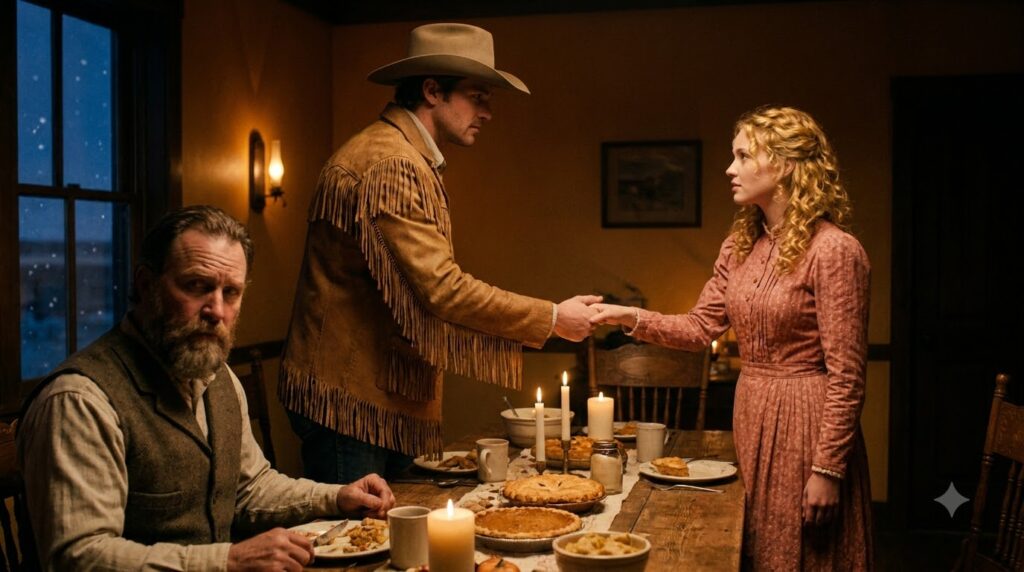
The wind came down off the high ground at dusk the way it always did in late November, low and steady, pushing against the north wall of the Halloway house as if it meant to lean the whole place a little farther south before morning. Out past the windows the prairie had gone the color of an old pewter plate, and the last light lay along the horizon in a thin cold seam of rose and iron. A few cottonwoods along the creek bed rattled their bare limbs. Somewhere beyond the barn a gate chain ticked against its post, ticked and stopped, ticked again.
Inside, the dining room was all amber. Three oil lamps burned along the walls, their chimneys freshly washed, and a pair of tall beeswax candles stood in brass holders at the center of the harvest table, which Amos Halloway’s own father had built from a single walnut tree hauled out of Missouri in a wagon bed. The table had been scrubbed and oiled until it gave back the candlelight like still water. On it sat a roast turkey glazed brown and split at the breast, a dish of cornbread dressing studded with sage and onion, a crock of butter, a bowl of mashed potatoes with a gold lake melting at its center, green beans cooked down with bacon, a jar of watermelon-rind pickles, a plate of biscuits under a linen napkin. On the sideboard, cooling, waited the pies: two pumpkin with fluted edges, one vinegar pie, one dried-apple pie with a lattice crust browned at every crossing. The fire in the stone hearth snapped and settled, throwing its own restless orange light across the floorboards, and the whole room smelled of woodsmoke and cinnamon and roasted fat.
Sarah Halloway had set every bit of it herself, and she stood now at the foot of the table with her hands folded at her waist, waiting for the storm she knew was coming.
She was twenty-four that autumn, and people in Larned and Kinsley and as far off as Dodge said she was the handsomest girl between the Arkansas and the Smoky Hill, which was a large territory to be handsomest in and which she privately thought said more about the territory than about her. Her hair was gold, true gold, the color of wheat stubble with the evening sun behind it, and it fell in loose curls she had pinned up at the crown and let tumble at the back. Her brows were dark for a fair girl,
sharply arched, and gave her face a look of perpetual skeptical inquiry that had made more than one suitor stammer. That evening she had done something she did only on holidays and only behind her bedroom door: with a sliver of burnt cork and a fine brush she had drawn a line along her upper lashes and swept it out at the corners into a narrow wing, the way she had seen it in a fashion plate from Saint Louis, so that her blue eyes tilted at the outer edge like a cat’s. Her lashes were long and full and she had darkened them too. She had rubbed a little beeswax and crushed rose petal into her lips until they shone. Her dress was a prairie dress of rose-colored calico,
close at the waist and full in the skirt, with a high collar of white lace her mother had tatted the winter before Sarah was born. In the lamplight she looked like something that did not belong on the plains at all, something that had been carried in from a painting, and she knew it, and she had done it on purpose, because tonight she needed every weapon she had.
Her father sat at the head of the table. Amos Halloway was fifty-five, broad through the chest and shoulders, with a gray beard cut square and a face that the wind had worked on for so long it seemed to have been carved rather than grown. He wore his good white shirt and his brown wool vest with the horn buttons, and his gray hair was combed back wet. His left hand rested on the table beside his plate. It was missing the last two fingers and the top joint of the middle one, and he kept it there, in the open, the way some men keep a pistol where it can be seen.
The door from the kitchen passage opened, and the cold came in first, a long breath of it that bent the candle flames, and then the man.
Evan Doyle had to duck a little under the lintel. He was twenty-nine and lean in the way of men who ride for wages, with a hard, square jaw darkened by three days of stubble he had evidently tried and failed to shave close with a dull razor. He held his hat in both hands, a sweat-stained cowboy hat with a creased crown, and he had beaten the dust out of it on the porch; you could see the clean places. He wore a fringed leather jacket gone dark at the cuffs, and under it a black vest over a gray flannel shirt, and a faded red bandana knotted at his throat. His boots were greased. He had done everything a man who owned one set of clothes could do to make them presentable, and the effort of it showed in his face the way a fresh wound shows.











