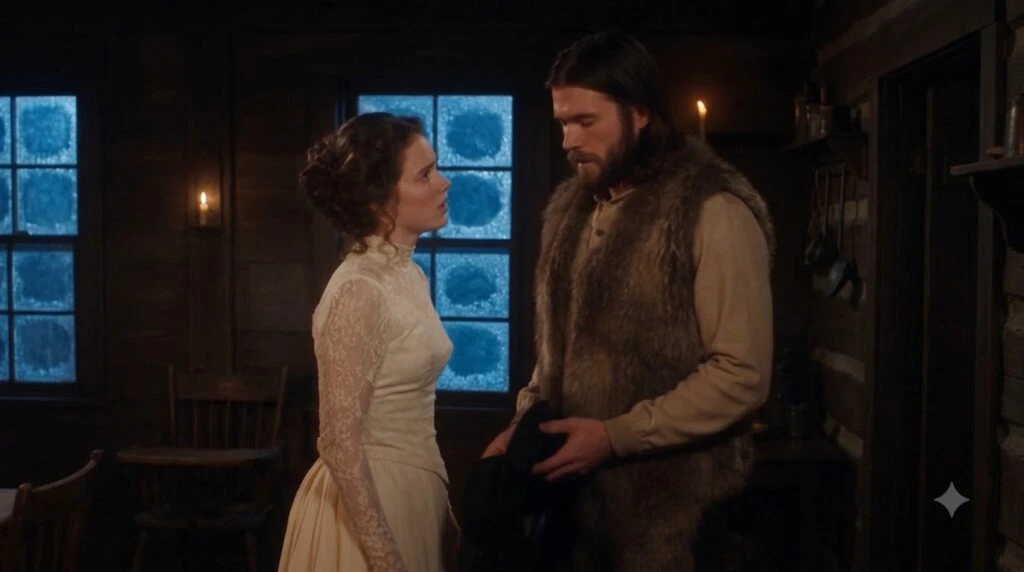
The snow had stopped falling an hour after sundown, and by the time the last wagon of wedding guests had creaked away down the creek road toward Halfmoon, the moon had come up over the Wind River range and laid a cold white shine across every drift on the Halloway place. From the upstairs bedroom the barn looked like something cut from paper and set on a tablecloth, its roof heavy with snow, a thin line of lamplight under the big door where old Gus Ferrell had forgotten to trim the wick.
Inside, two candles burned on the walnut trunk at the foot of the bed. The room smelled of new pine boards, beeswax, and the cedar sachets Ruth had tucked into the bedding that afternoon while the women downstairs were arguing over how long to boil the coffee. Frost had grown up the window in ferns and feathers, and where the candlelight touched it the glass glowed gold.
Ruth stood beside the bed in her wedding dress. It was ivory lace over ivory silk, cut down from her mother’s gown and let out in the bodice and the hips by three women and one very determined sewing machine, and it fit her the way a dress fits when the women who made it love the girl inside it. She was a full-figured young woman, round in the arm and generous at the bosom and hip, with a small waist the lace made the most of, and she had never in her twenty-two years looked as well as she looked that night and she knew it. Her dark brown hair had been pinned up that morning in loose curls by Mrs. Abernathy from the boarding house, and a few of the curls had come down over the course of the dancing and lay against her neck. The cold ride home and the warm kitchen and the cider had put a high rose color into her cheeks, and her lips, which she had bitten all through the vows to keep from grinning like a fool, were red as winter rose hips. Her brows were dark and well shaped, her lashes thick and dark enough that people sometimes asked whether she darkened them with burnt cork, which she did not, and her eyes, a clear brown with green at the rims, had a shine on them in the candlelight that was half happiness and half nerves.
Her husband stood by the door.
Jonah Halloway was so tall that he had built the house with seven-foot doorways and still ducked out of habit, and so broad through the shoulders that the women of Halfmoon said he must have been raised on beef and lumber. His dark hair hung to his collar, or would have if he had been wearing a collar. He had taken off his wedding coat and his good white shirt and folded them over the chair by the washstand, and in their place he had pulled on the old sleeveless fur vest he wore for night chores, so that his arms and the middle of his chest were bare in the candlelight, the skin there pale where the sun never reached and dark with hair. His beard was full and newly trimmed for the occasion. On his head, for reasons Ruth could not yet guess, sat his battered black hat, the one with the sweat stain around the band and the crown pushed in on one side where a horse had stepped on it in 1881.
He had his hand near the doorknob, and he was looking at the floor.
“I’m going to sleep out in the barn tonight,” he said.
Ruth stared at him. For a moment she honestly believed she had misheard him over the crackle of the stove pipe that ran up through the corner of the room, and then she saw that he had his gloves tucked into the waistband of his trousers and his hat on his head, and she understood that he had planned this the way he planned everything, carefully and well in advance.
“The barn? Jonah, it’s our wedding night!”
He winced. He actually winced, a big man flinching like a boy caught with a slingshot. He turned the hat brim a quarter inch with two fingers, and the candlelight slid along his cheekbone and was lost in his beard.
“The horses won’t mind the company.”
There was a silence in which she could hear the clock downstairs, the one her father had carried from Ohio wrapped in a feather tick, ticking its way toward ten. She looked down at herself, at the lace over her bosom, at the swell of her hips under the silk, at the softness of her own arms, and every unkind thing anyone had ever said to her came up her throat at once, the girls in Cincinnati who had called her Butter Churn, the dressmaker who had pursed her lips over the tape measure, Everett Lyle’s mother saying in Ruth’s hearing that it was a shame about the Pruett girl’s figure because she had such a pretty face.











