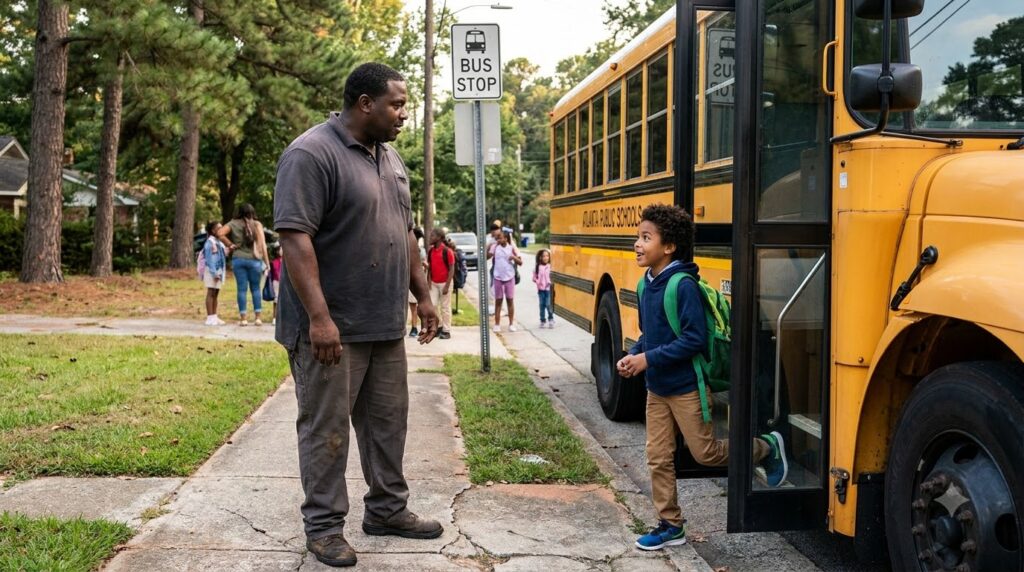
The school bus came around the curve on Dogwood Ridge Lane at 3:41, which was four minutes later than the schedule taped to the Reeds’ refrigerator, and Marcus Reed noticed the four minutes because he had been standing at the corner for twenty of them with nothing to do but count.
He was not used to standing still on a weekday afternoon. At forty-one he had spent most of his working life moving: up ladders, across rooftops, through the bellies of commercial buildings where the air handlers roared like trapped animals. He was a field supervisor for a mechanical contractor out of Marietta, and on a normal Thursday at a quarter to four he would have been forty feet in the air over a warehouse in Smyrna, arguing with a crane operator about wind. Instead a chiller delivery had been pushed to Monday, the job had folded up early, and on the drive home he had thought, for no reason he could name, that he would meet his son at the bus.
He had not told anyone. He had wanted it to be a surprise. He had pictured Caleb’s face.
So he stood at the corner in his charcoal polo with the company’s stitched logo over the heart and his gray work pants still dusted at the knees with drywall powder, a big man with broad shoulders and a close-cut beard beginning to silver at the chin, and he watched the October light come slanting through the sweetgums in long gold bars. The neighborhood was the kind of place that had been built twenty years ago on the edge of what used to be pasture, all brick fronts and two-car garages and young trees that had finally grown tall enough to make shade. Somebody down the block was running a leaf blower. A dog barked twice and gave up. The air smelled of cut grass and the faint burnt-sugar sweetness of the season turning.
The bus hissed to a stop. The folding door shuddered open.
Caleb came down the steps the way he always did, one hand on the rail and the other hooked under the strap of his green backpack, which was too big for him and which he refused to trade for a smaller one because it had seven zippered pockets and he had plans for every one. He was nine, slight for his age, with short dark curls his mother kept trimmed close, and he wore his blue hoodie with the sleeves pushed up to the elbows and khaki pants with a grass stain at one knee that had not been there this morning. He hit the last step, looked up, and stopped.
For a moment Marcus saw exactly the face he had pictured, the quick bright surprise. Then he saw something else slide in behind it, a little crease between the eyebrows, the look Caleb got when a math problem did not come out the way the back of the book said it should.
“Dad? I thought Mom said you were working.”
“I got off early.” Marcus smiled and opened his arms. “Thought I’d walk you home. That all right with you, or am I embarrassing you in front of the whole route?”
Caleb came to him and leaned against his side, which at nine was the most he would allow in public. Marcus put a hand on his head and felt the warm curls under his palm.
The bus driver had not closed the door. He was an older white man, maybe sixty-five, with a gray crew cut and a face that had been weathered red by decades of looking out windshields into the sun. His name was Dale; Marcus knew that much from the beginning-of-year paperwork, and from Caleb, who reported that Dale kept peppermints in a coffee can and gave them out on Fridays to anybody who had not been written up that week. Dale leaned forward over the big wheel and looked at Marcus over the top of a pair of drugstore reading glasses, not unkindly, but with the careful attention of a man who had been driving children for a long time and had learned to notice when a pattern changed.
“Afternoon,” Dale said. “You’re Dad?”
“I’m Dad. Marcus Reed.”
Dale nodded slowly. He glanced at the clipboard wedged beside his seat, then back up.
“Then who’s the gentleman who normally meets him Thursdays?”
The leaf blower down the block cut out. In the sudden quiet Marcus heard the bus engine idling, a low patient rattle, and the sound of kids in the back seats pressing their faces to the windows.
“What gentleman?”
Caleb looked up at him. There was no guile in it. He said it the way he would have said the name of his teacher or the name of the street.











