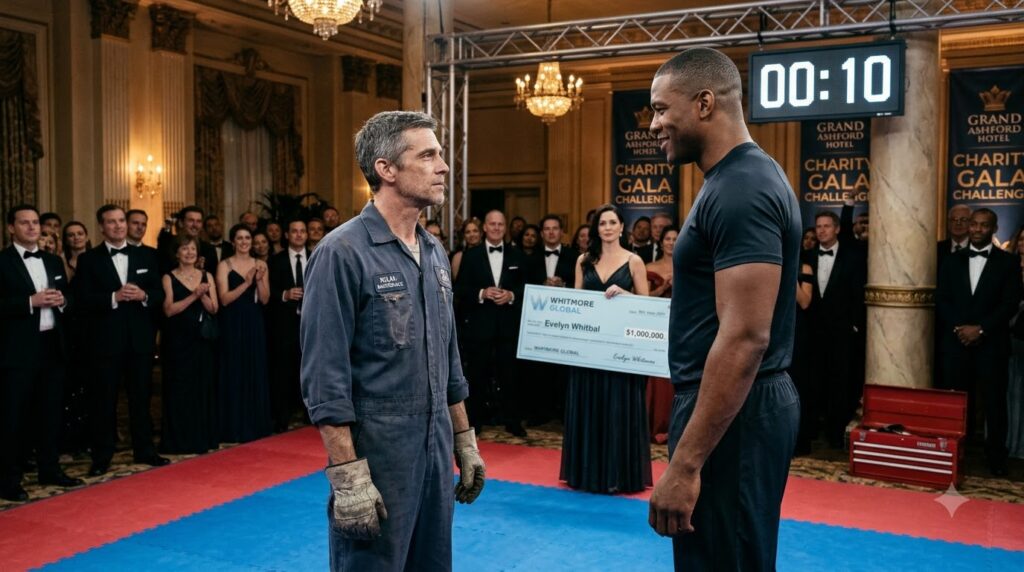
The billionaire CEO raised a million dollar check above her head. “Beat my bodyguard and it’s yours.” Three professional fighters had already failed. Then a maintenance worker in a faded uniform stepped forward. Laughter erupted across the ballroom. The CEO smirked.
Her bodyguard cracked his knuckles, but the single father didn’t remove his work gloves. He simply looked at the giant clock above the stage and said, “I only need 10 seconds.” The room exploded with laughter again. Nobody noticed the vice chairman suddenly stop smiling. And nobody understood why the bodyguard’s expression changed when the stranger quietly mentioned one name. 4 hours before any of that happened, Nolan Rourke was lying on his back inside a service corridor beneath the Grand Ashford Hotel, holding a flashlight in his teeth while he traced a dead circuit through a bundle of wire older than his daughter.
The ballroom above him was worth $40 million in renovations, but the junction box he was working on had been installed when Charlotte still had streetcars, and nobody upstairs had ever thought about it once. His uniform was gray where it had been navy blue. The knees were worn soft, the name patch was fraying at one corner, and his boots had been resoled twice because a new pair cost $90, and Paige’s tuition balance was still $1,100 short. He worked the way he had learned to work a long time ago, slowly, without wasted motion, checking twice before he touched anything. When the circuit came back and the chandelier light bloomed down the stairwell, nobody thanked him because nobody knew he existed.
He came up through the staff entrance with his toolbox in one hand, and that was the moment the two worlds touched. The lobby had been transformed into something that smelled like orchids and cold champagne. Men in tailored tuxedos stood in loose clusters, laughing the way people laugh when the laughter is a kind of currency. Women in gowns that cost more than Nolan’s truck moved between them like slow lights. He kept to the wall, head down, the way maintenance people learn to move through rooms they are permitted to repair but not to occupy.
He had worked 11 years in buildings like this one, and he had gotten very good at being furniture. Grant Blackwood saw him anyway. The executive vice chairman of Whitmore Global Holdings was standing near the coat check with a glass in his hand and a young banker beside him. And when his eyes landed on the gray uniform, something in his face changed by about a millimeter. Recognition, then a decision, then nothing at all, which was the most dangerous of the three.
He turned to the hotel manager and raised his voice just enough to carry into the nearest four conversations. “I was under the impression this floor was cleared for guests. I’d hate for the chairman’s photographs to feature a man with a wrench.” The manager apologized twice.
Blackwood smiled at nobody in particular and added, loud and pleasant, “People like him should fix the lights, not stand beneath them.” Nolan did not look up. He had learned that the price of a reply was always higher than the price of silence. And tonight the price of silence was $1,100 and one semester of his daughter’s engineering degree. He walked where he was told to walk. He put his toolbox down behind a service column at the edge of the ballroom because he had been instructed to stay on call for the stage lighting.
And he stood there in the dark with his hands folded, a man nobody in that room would be able to describe.
An hour later, he did not feel humiliated, exactly. He felt the way a person feels when a stranger steps on his foot and never notices. But something in Blackwood’s voice had been too careful to be casual, and Nolan had spent a decade of his life teaching people how to hear that exact difference.
Then the lights went down, and Evelyn Whitmore walked onto the stage to applause that started before she was fully visible. She was 38 years old, controlled the fourth largest private holding company in the Carolinas, and spoke without notes. She thanked the foundation, named the amount the evening had already raised for the children’s trauma center, and then turned to the real purpose of the night. Whitmore Global was carving out its protection services division, and tonight the buyers and the banks and the trade press were going to watch what that division could actually do. Behind her, a screen the size of a garage door lit up with the words executive protection, certified readiness, and a logo Nolan had not seen in 14 years.
He felt his hand close around the wrench in his pocket before he understood why. The logo was a chevron inside a circle, and beneath it ran a line of small text listing the evaluation standard the program was built on. He knew the kerning on that mark. He knew it because he had argued for 2 weeks about the spacing with a graphic designer in a rented office in Raleigh, back when he still had a professional license and a reason to care. The man credited on the screen as the architect of the readiness methodology was a name he had never heard before in his life.











