The community room of the Owatonna Public Library smelled of carpet shampoo and lemon bars. Somebody’s grandmother had baked two pans of them for the refreshment table, and they sat beside a coffee urn and a stack of paper napkins printed with spring tulips, though outside the windows the April lawn was still the color of wet cardboard and a ridge of gray snow clung to the north side of the parking lot. It was the second Saturday of the month, the day of the Spring Arts Afternoon, and the room was full.
There were forty-two folding chairs, set in six crooked rows, and nearly every one held a parent, a grandparent, or a coat saving a place for someone who had gone to find the bathroom. Little brothers kicked their heels against the chair legs. A father in a Twins cap held a phone at arm’s length, already recording nothing in particular. Along the side wall hung a row of tempera paintings from the morning’s workshop, each one a lopsided sun over a lopsided house, the paint still shining where it had pooled. Through the open double doors to the next room came the sounds of the hands-on instrument table, where a college student in a library T-shirt was letting the younger children bang on a xylophone, blow into a recorder, and strum a ukulele that had already lost its G string.
At the front of the room, where the carpet gave way to a strip of linoleum, there was a single black music stand and, beside it, a small microphone on a short silver stand. It was the microphone the library used for story time, and it had a tendency to whine if anyone stood too close. Next to it a laminated sign, taped to an easel, said RECITAL, in bubble letters somebody had colored in with markers.
Denise Halvorsen had been a parent volunteer at the library for three years, ever since her son Owen started first grade, and she had learned that the key to any children’s event was to keep things moving. She wore a lanyard that said VOLUNTEER and carried a clipboard she had stopped consulting an hour ago,
because she knew the order by heart, or believed she did. The youth services librarian, Patrice Dahl, who usually ran the recital and introduced each child by name, had been called into the next room twenty minutes earlier to deal with a boy who had gotten his finger stuck in the bell of a trumpet. Before she left, Patrice had squeezed Denise’s arm and said, “Just keep them going. You’ve got the list.” Denise had the list. She had left it, folded in half, on the refreshment table beside the lemon bars. But she remembered the shape of it. There were the two sisters who sang a song about a frog, the boy with the tap shoes, the girl who recited a poem about her dog. And then, near the end,
there were two real solos, prepared pieces, the ones Patrice had specifically asked the high school band director to recommend. A saxophone. A flute. The saxophone had just finished. A tall, thin teenager with a cowlick and a borrowed-looking blazer had played something slow and careful, and the parents had clapped generously, and he had folded himself back into a chair in the front row with the instrument across his knees and the expression of someone who had survived a car accident.
So the flute was next. Denise turned toward the back of the room to look for a high school girl, and instead she saw a child walking up the center aisle.
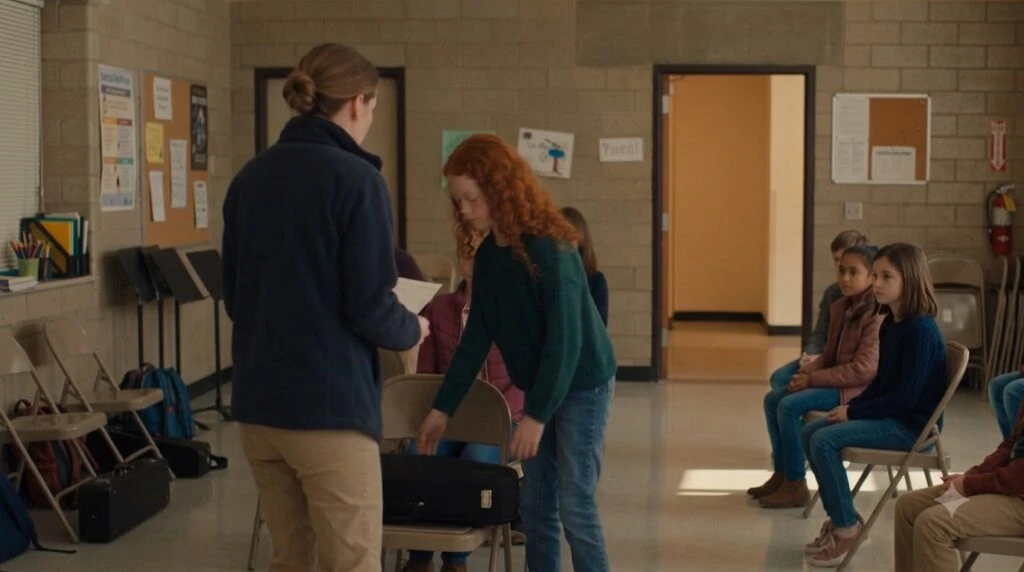
The child was small, even for a fourth or fifth grader, with a great deal of red hair that sprang out from her head in curls no barrette could have managed. Her face was dusted with freckles, a whole constellation of them across the nose and cheeks. She wore a green sweater with the sleeves pushed up, jeans faded at the knees, and white sneakers that had been white a long time ago. In one hand she carried a flat silver case, the kind with a plain clasp and a handle worn smooth, and she held it carefully, slightly away from her body, the way people carry things that don’t belong to them.
She was walking straight toward the microphone.
Denise moved to intercept her. She did it kindly, she would think later, or at least she meant it kindly, with a hand lifted and a smile already in place, the smile she used when a child wandered into the wrong classroom at school. She had seen a hundred children with instrument cases that afternoon. Half of them had come for the hands-on table and the free recorders, and the other half had come because their older siblings were performing and had been bribed with lemon bars to sit still.











