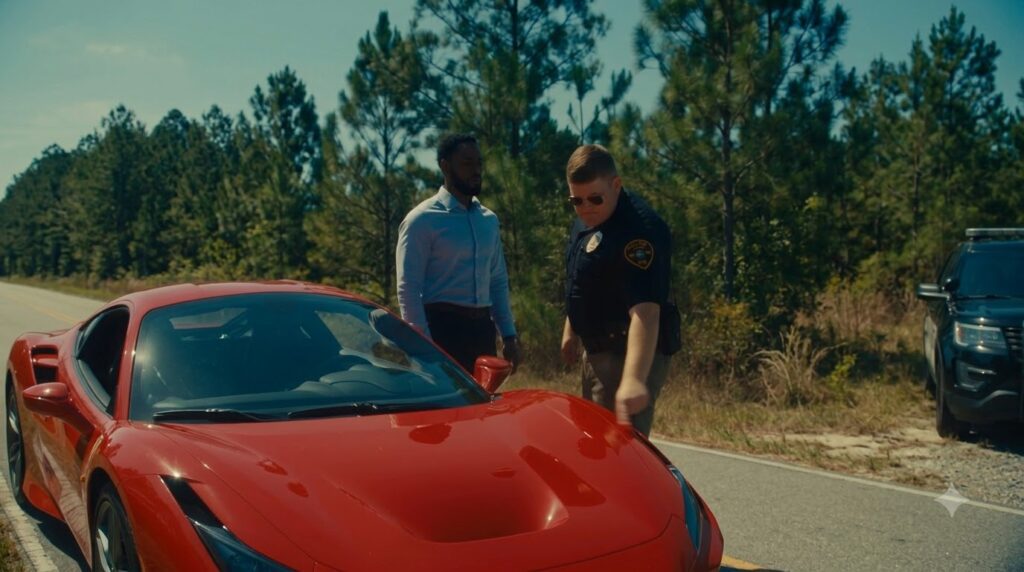
“Officer, I haven’t broken any laws. Why am I being pulled over?”
The cop glared at the red Ferrari, then at the young man behind the wheel.
He spat on the hood.
“Two hundred thousand dollars,” he muttered. “And a kid from Decatur driving it.”
He laughed.
“Get out.”
“Sir, I’m complying.”
“Did I say speak?”
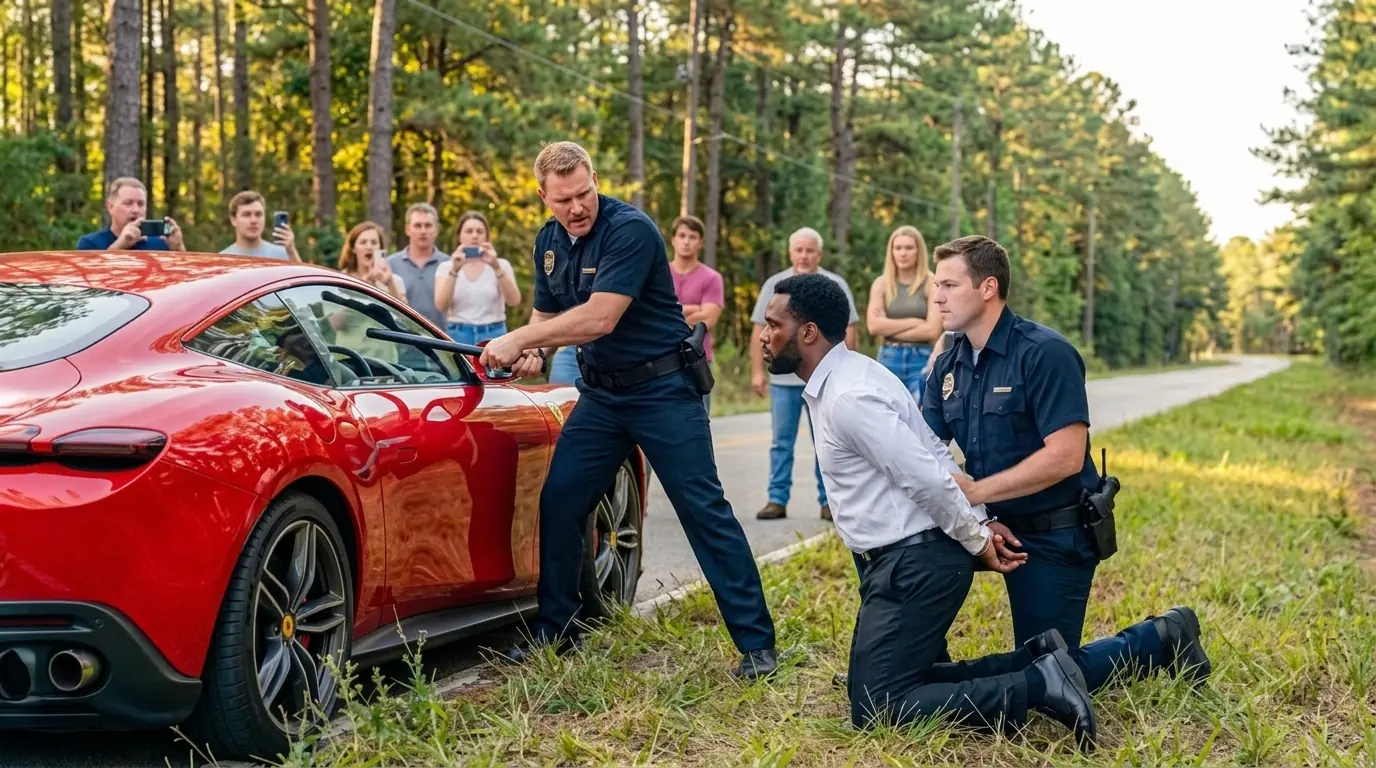
He yanked the door open, dragged Benjamin out, and slammed him against the hood.
“You people are all the same. Flashy cars, fake money, always acting like you earned something.”
He pulled out his keys and scraped them across the Ferrari’s door.
A deep, ugly scratch tore through the paint.
“Someone like you doesn’t deserve a car like this.”
A pickup slowed.
“Wreck that punk’s ride, officer.”
A teenager filmed, laughing.
No one helped.
Just one man watching a cop destroy his two-hundred-thousand-dollar car.
But the officer scratching the paint, and the crowd cheering, had no idea who they were messing with.
Six hours before that traffic stop, the morning sun crept through the blinds of a modest home in Decatur, Georgia.
Benjamin Walker stood in front of his bathroom mirror, adjusting the collar of a freshly ironed dress shirt.
The fabric was crisp.
The creases were sharp.
Every detail mattered to a man who had spent his life proving he belonged in rooms that did not want him.
Thirty-eight years old.
Fourteen years with the Federal Bureau of Investigation.
A veteran of the public corruption unit who had personally helped put seventeen dirty politicians and eleven crooked officers behind federal bars.
But today was not about work.
Today was Sunday.
And Sundays belonged to his mother.
On his dresser sat a framed photograph that Benjamin looked at every single morning.
A younger version of himself in Marine dress blues stood beside an older man with tired eyes, calloused hands, and the proudest smile Benjamin had ever seen.
His father.
Beside the photo sat a folded American flag in a triangular wooden case, the kind handed to families at military funerals while a bugler plays taps.
Benjamin’s father had worked forty years as a postal worker.
Rain or shine, snow or heat, six days a week for four decades.
He never took a real vacation.
Never bought anything for himself.
Never complained.
But every Sunday after church, father and son would walk downtown together.
They would pass the Ferrari dealership on Peachtree Street, and the old man would stop.
He would press his weathered hand against the glass and stare at the red ones.
“One day, Benjamin,” he would say, his voice thick with a dream he knew he could never afford. “One day, you and me, we’re going to ride in one of those.”
One day never came for his father.
Cancer took him two years ago.
Pancreatic.
Stage four by the time they found it.
Three months from diagnosis to funeral.
In his final letter, written in shaky handwriting on yellow legal paper, Benjamin’s father left five words that changed everything.
“Get that red one, son.”
So Benjamin did.
He found a certified pre-owned Ferrari Roma at a dealership in Buckhead.
Rosso Corsa red.
The classic Ferrari crimson.
The exact shade his father had always pointed to through that showroom glass.
Eight thousand miles on the odometer.
The previous owner was a hedge fund manager who had upgraded to a Lamborghini.
The price was one hundred ninety-eight thousand dollars.
Benjamin paid in cash.
Every dollar from his savings account.
Every dollar from his father’s life insurance policy.
Every penny he had put aside for fifteen years.
Two hundred thousand dollars of love, grief, and a promise kept.
The car sat in his garage now, gleaming under LED lights like a museum piece.
Benjamin ran his hand across the hood every morning before work.
Not because he loved luxury.
Not because he wanted to show off.
But because every time he touched that car, he felt his father’s presence.
The passenger seat had never been sat in.
Benjamin was saving it.
Waiting for his father to somehow, somewhere, take that ride.
Today, he was driving the Ferrari to Millbrook County to visit his mother.
A simple Sunday trip.
Nothing complicated.
No federal business.
No undercover work.
He walked to his closet and opened the small safe bolted to the floor.
Inside sat his Glock 19M service weapon, a leather credential case containing his gold FBI badge, and a backup magazine.
He reached for the badge, then stopped.
It was his day off.
He was just visiting his mother.
He did not need to carry his credentials.
He closed the safe.
That decision would cost him two hundred thousand dollars.
Twenty minutes later, Benjamin was cruising down I-20 with the windows cracked, warm Georgia air flowing through the cabin.











