
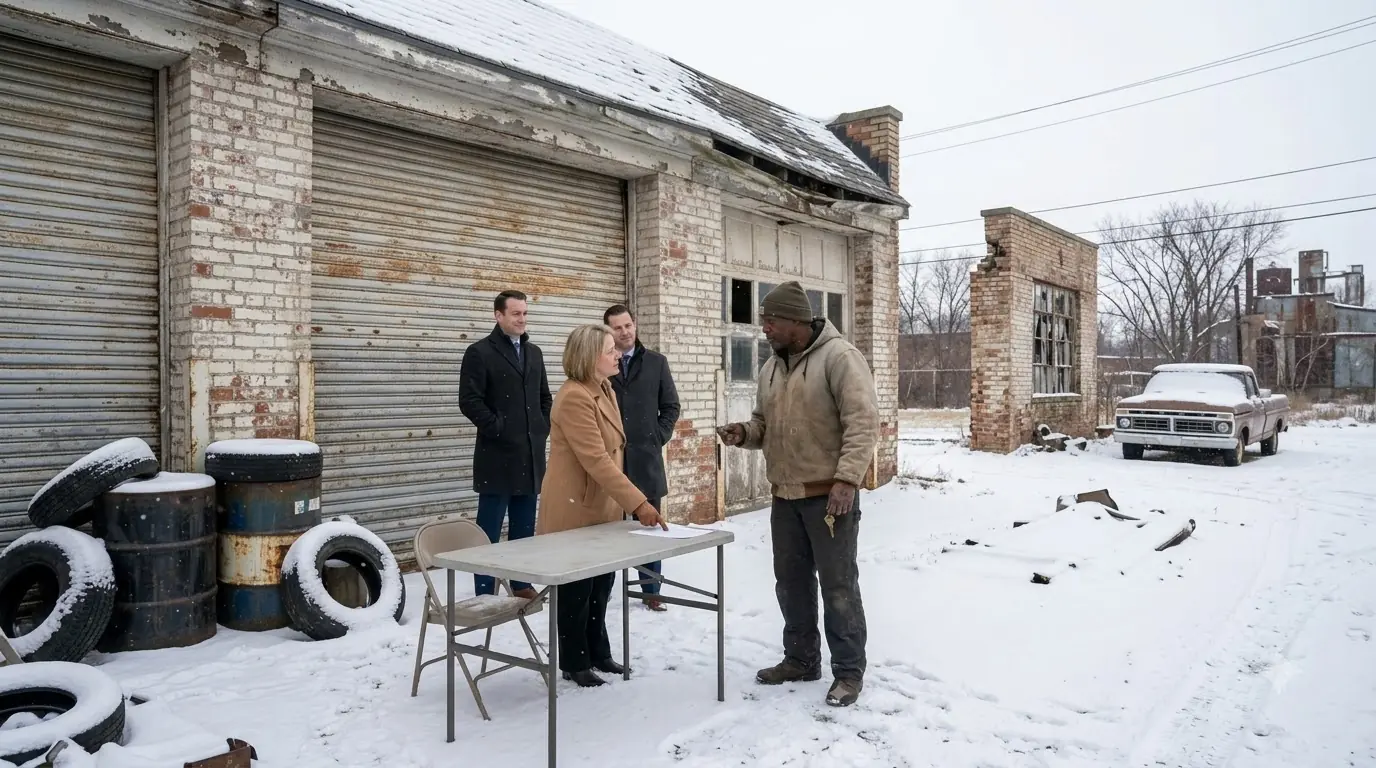
$800. That was the price a millionaire developer put on a crumbling Detroit garage she called a tetanus risk with a roof. She signed the contract on a frozen January morning, slid it across a folding table without looking up and laughed with her associates while the man across from her took the key and walked out into the snow without a single word. He wore a worn work coat and carried grease under his nails that no soap had ever scrubbed all the way out.
And she’d decided in about three seconds that he was nobody. She was wrong in a way that would cost her everything because behind a door her own team had inspected and dismissed under 11 gray tarps that nobody had bothered to lift sat something worth nearly a million dollars. And one quiet line she had signed in her own hand was about to become the paper trail that ended her career. Six months later, his name was on the front page of every business page in the state.
And she was standing on a cold sidewalk, locked out of a building that used to be hers, staring at a future she had personally signed away. His name was Elijah Reed. He grew up in a flat on Kuster Street on the east side of Detroit in rooms that smelled of motor oil, cornbread, and the particular sharpness of brake cleaner that gets into the curtains and never fully leaves. His father, Solomon Reed, had come up from Alabama in the second wave, worked the line at the Dodge main plant in Hamtramck until his shoulder gave out, then took his severance and his savings and opened a one-bay garage on the corner of Mack and Bewick in 1979.
He ran it for 31 years. Solomon Reed could not have told you the market value of a 1970 Chevelle in any language a banker would recognize, but he could lay his palm flat on a fender and tell you where the body had been hit, how long ago, and whether the man who fixed it had loved the car or only been paid to touch it. He believed in three things in this order. The Lord, his family, and the truth that lives inside a thing, whether or not anybody bothers to look for it.
He kept all three in a green spiral notebook in the breast pocket of his coveralls where he wrote down torque specs, prices, and once in a while a sentence that had nothing to do with cars at all. Elijah spent every Saturday of his boyhood in that garage. Not watching television, not running the block, learning. He learned to listen to an engine the way the deacons at Greater Bethel leaned in for the part of the sermon that mattered.
He learned to read the stress lines in a frame the way his mother read the worn pages in her hymnal, knowing which ones had been turned the most. By 16, he could name a knock by ear. By 19, he was rebuilding transmissions on the bench his father had welded out of old bed rails. By 23, he had a mechanical engineering degree from Lawrence Tech, earned on night shifts and a job at Meridian Restoration Group out in Warren, doing concours work for clients who flew in from both coasts.
He was not the loudest voice in any meeting, he was usually the most correct one. The owners trusted his appraisals. The clients asked for him by name. He was the man you called when the thing on the lift was supposed to be impossible to save.
But here is something I have learned and maybe you have learned it too. The places that depend on you the most are very often the places that will let you go without a phone call. 20 months before this story really begins, Meridian got bought by a holding company that ran the numbers and decided hand-built restoration did not scale. 11 people lost their jobs on a Friday.
The notices sent by email at 6:42 in the evening. Elijah read the message standing at the counter of a rented duplex off McNichols, still in his work clothes, the smell of the shop still on him. He did not answer it. He set the phone face down.
He sat in the dark a while and then he prayed, the short, rough kind of prayer his father taught him, the kind that is mostly listening. The next morning, he got up and made a list. He spent the better part of a year doing what a man does. He pulled engines at a salvage yard on Dequindre for cash.
He took side jobs. He paid his tithe at Greater Bethel, even the months it hurt, because his mother had taught him, “You do not start trusting God only when the account is full.” He kept his head down and his eyes open the way his father taught him to look at a wreck methodically, quietly, without expecting the answer to announce itself. He was 3four years old.











