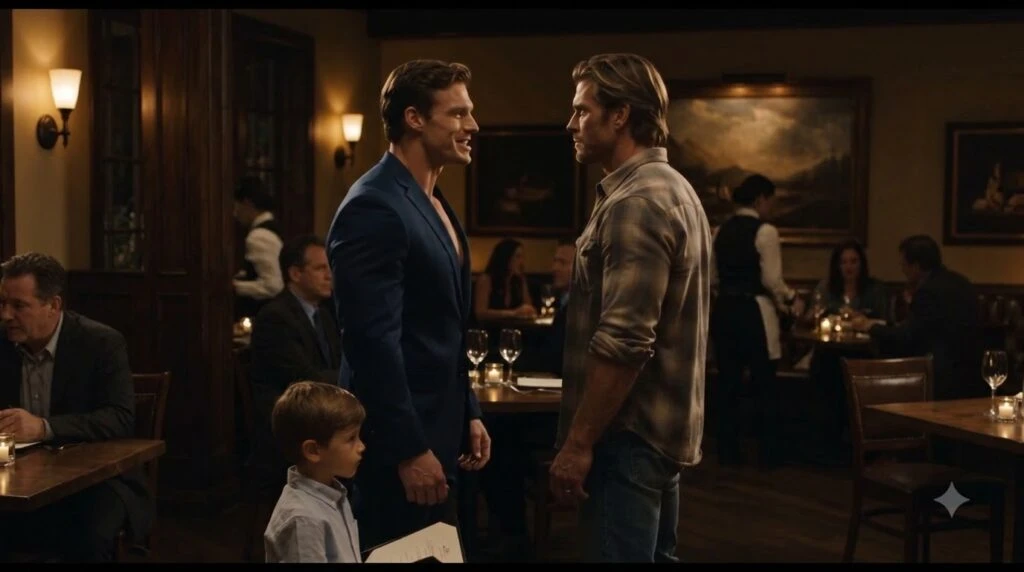
The first thing Marcus Hale noticed when Brent Wallace insulted his son was not the words themselves. It was Noah’s hand tightening around the menu.
They were standing near the edge of the dining room at an upscale steakhouse in Scottsdale, Arizona, where dark walnut paneling and candlelight made every table look private even when the room was full. Marcus had spent most of the day on a roof in the west valley under October heat, then driven home, showered fast, and changed into the cleanest clothes he owned that still felt like him: a faded flannel over a white T-shirt, work jeans, and boots he had brushed off at the truck. Noah wore a small blue button shirt with the sleeves rolled once at the wrists. He had been nervous about the restaurant from the moment they stepped inside, though he would not admit it.
The dinner was supposed to be a celebration. Noah had earned the highest score in his class on a statewide science assessment, and Marcus had promised months earlier that if he made the honor list, they would go somewhere “fancy enough to need cloth napkins.” Noah remembered promises with a precision that made casual fatherhood impossible. Marcus did not have money to waste, but he had set aside enough for one good dinner and dessert. He wanted his son to remember being celebrated before he learned how easily the world can turn achievement into pressure.
Sienna Cole, the hostess, had seated them at a two-top near the center aisle because their reservation was early and the restaurant was not yet at full capacity. She was twenty-nine, poised, observant, and practiced at reading the temperature of a dining room before conflict reached the manager. She wore a black satin dress appropriate for the restaurant and kept her hair smooth despite the desert dryness. When Noah quietly asked whether the water glasses were “free refills,” she smiled and said they were. Marcus thanked her for not laughing.
The trouble began twenty minutes later when Noah stood to let a server pass.
His chair shifted backward and touched the heel of a man at the neighboring table. It was not a hard collision. The man did not stumble. Noah immediately said, “Sorry, sir,” and moved the chair forward. Marcus had already started to tell him to be more careful when Brent Wallace turned around.
Brent was thirty-four, broad through the shoulders, gym-built, and dressed in a tailored navy suit with the collar open. He was known in the restaurant. Marcus could tell that much from the way two servers recognized him without needing his name. Brent looked at Noah, then at Marcus’s work boots, then at the faded flannel as if assembling a theory about why they were there.
“Busboys eat in the back, pal,” Brent said. The sentence was pitched just loudly enough to travel. Noah went still.
Marcus felt something old and dangerous move through his chest, but his voice stayed level. “He said sorry. He’s nine. Talk to him with respect.”
Brent smiled as if Marcus had unexpectedly improved the evening. “Or what?” he asked, turning fully toward him. “Come say it outside.”
Several diners looked up. A woman near the wine display lifted her phone. Another man at the bar stopped mid-sentence and watched. Sienna, who had been checking a reservation note at the host stand, lowered her own phone and stepped toward them.
“Brent, please sit down,” she said. Marcus kept his eyes on Brent. “I’ll say it right here.” Brent spread his arms and gave a short laugh. “You gonna cry, roofer?”
That told Marcus two things at once. First, Brent had noticed the small roofing-company patch sewn near the hem of Marcus’s flannel. Second, he wanted the confrontation to become public. Men like Brent often mistook an audience for protection because they assumed they knew how everyone in the room would interpret what happened next.
Marcus slowly removed the flannel. Noah’s eyes widened. Marcus folded the shirt once, then twice, and handed it to his son. “Hold this for me.”
A murmur traveled through the dining room. The phones came higher. Brent’s smile sharpened.
Noah took the flannel with both hands and stepped back toward the wall, just as Marcus had taught him to do whenever adults were arguing near a road, a jobsite, or any other place where bad judgment could become physical. Marcus did not look away from Brent. “Keep your eyes on me,” he said. Noah swallowed. “Dad, it’s fine.”
Marcus heard the fear under the words. He hated that more than the insult. He stepped forward once. “Then let them watch,” he said.
Brent shoved him.
It was not a dramatic movie punch, not a blow meant to knock him across the room. It was a hard two-handed push to the chest, sudden enough to send Marcus back half a step and knock a water glass from the edge of a nearby table. The glass hit the floor and broke. A woman gasped. Two people said, almost simultaneously, “Whoa.”











