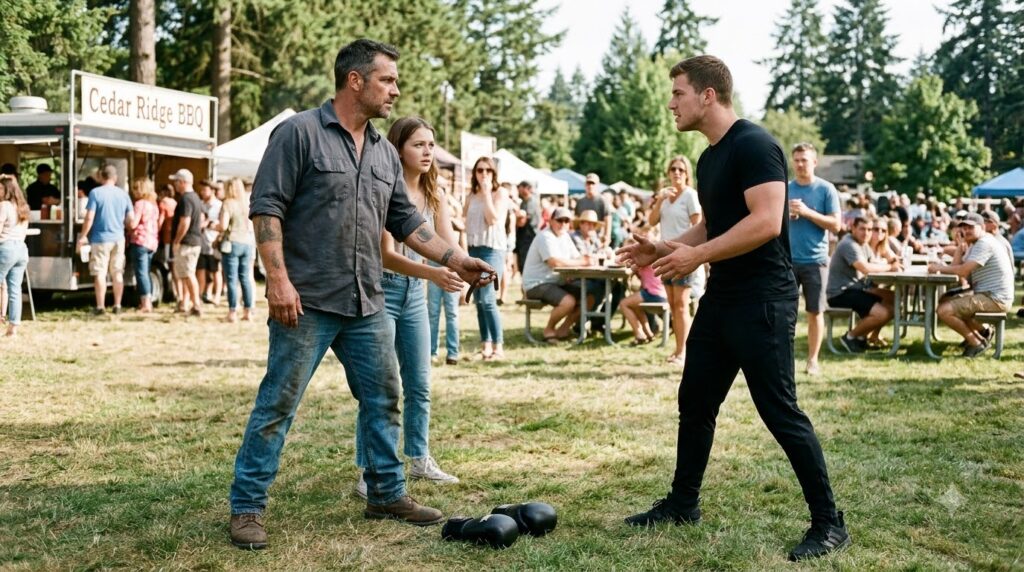
“Pick them up. One fight, right here, right now.” “Walk away.”
“You put your hands on me in front of witnesses. Now you want to leave? My son’s a state champion. Think carefully.”
“Your father only acts tough when nobody’s watching.” “Step back.” “Smart man. Keep the jewelry safe. End this quickly. I’ll drop you in front of your daughter.”
Travis Kessler had never lost a fight he started. A state title, a black belt, a father who erased consequences, nothing had forced him to reconsider his odds. So when he threw those gloves at a mechanic’s feet and announced exactly what he planned to do in front of half the neighborhood, he meant every word. He didn’t understand that those words were the most dangerous thing he’d said all day. The man he was threatening didn’t flinch, didn’t raise his voice, just removed his watch and handed it off.
The morning routine at Roark Cycle Works began before the sun cleared the mountains. Damon would unlock the garage at 6:00, start a pot of coffee, drink half of it, and spend the first hour going over whatever bike had been left the night before. By 7:00, he’d walk back into the house, knock twice on Tessa’s door, and have breakfast ready before she finished getting dressed. She was 16 now, old enough to make her own toast, but he did it anyway. Some habits formed without anyone deciding to form them.
Cedar Ridge was the kind of small Washington town where people noticed if your truck wasn’t in the driveway by 9:00. Neighbors knew Damon repaired motorcycles, kept irregular hours, and raised his daughter alone. Beyond that, they didn’t know much because Damon didn’t offer much. He wasn’t unfriendly. He’d wave, hold a door, show up when somebody needed a hand moving furniture.
But he kept conversations short and surface level, and after a few years, people stopped expecting anything deeper. They’d filled in the rest of the picture themselves, quiet widower, hardworking, kept to himself. That picture was accurate as far as it went. What it didn’t include was the phone Damon kept in the bottom drawer of his workbench, the one that buzzed with messages he never read in front of Tessa. It didn’t include the fact that three different businesses in the county had quietly resolved serious disputes after Damon made a single call.
And it didn’t include Black Ridge chapter, whose name alone was enough to make grown men in biker communities across the Pacific Northwest choose their words carefully. Damon had led that chapter for 11 years. He had not done so by being the loudest man in the room. Tessa had her own version of not asking. She’d noticed things over the years, the hum of unfamiliar engines idling outside at odd hours, the way her father always positioned himself with his back to the wall in any restaurant they entered, the faded ink running down his forearms that he never explained and she never questioned.
She wasn’t naive. She was 16, not six, and she was her father’s daughter. But there was an unspoken arrangement between them. She didn’t push, and in return, their life in Cedar Ridge stayed uncomplicated. She understood in the way teenagers understand things they can’t fully articulate that some questions changed everything permanently once asked.
The Kesslers arrived in early June and immediately altered the temperature of the street. Roland Kessler had the kind of confidence that came from decades of watching money solve problems other people couldn’t. He’d built his freight and warehousing company from a single truck he’d driven himself at 22 and somewhere along the way he’d stopped distinguishing between situations that money could fix and situations that required something else entirely. He was not a stupid man. That was part of what made him dangerous.
He was a man who’d been right often enough to stop seriously entertaining the possibility that he might be wrong. His son, Travis, was 23, built wide through the shoulders, and moved through the neighborhood with the ease of someone who hadn’t yet encountered a situation his body couldn’t handle. He’d won a state-level kickboxing title the previous winter and treated his black belt the way some men treated expensive watches, always present, always visible. He wasn’t entirely without substance. He worked hard in the gym and took his training seriously.
But Travis had grown up in a world where Roland’s money insulated him from consequences, which meant he’d never had to develop the skill of reading a room for actual danger versus perceived danger. He could read aggression. He could not read restraint. It started the way these things usually start, with small provocations that were almost easy to ignore. Travis and his friends gunned their engines late at night, parked sideways across the shared turnaround at the end of the street, and generally conducted themselves as though their entertainment took priority over everyone else’s quality of life.











