
“Get off the bag, old man. That’s not a tree.”
Victor Shaw did not stop. His fist struck leather. Again. Then again.
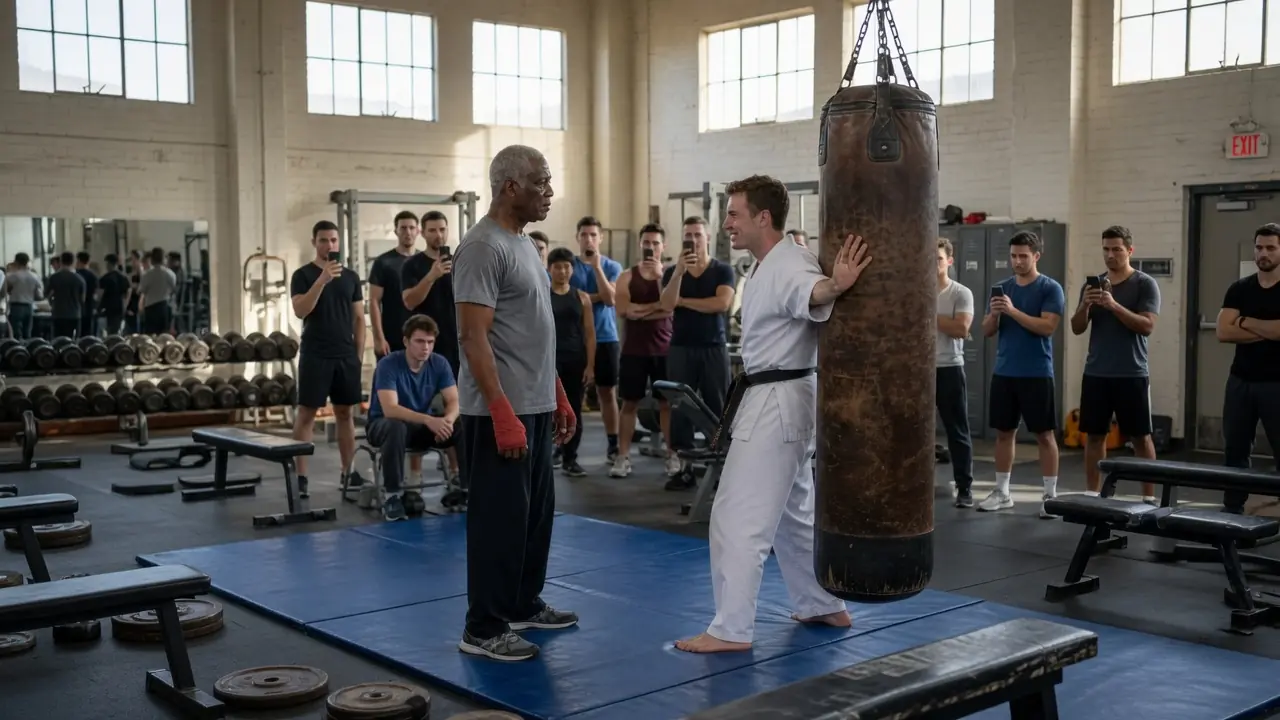
Tyler Brooks stepped closer. “You deaf, too? I said, get off.”
“I heard you.”
Victor caught the swinging bag and looked him directly in the eyes. “I just don’t care.” Nobody talked to Tyler Brooks that way. He was a black belt, the biggest name in the county, and he made sure everyone knew it. Phones came out as Tyler shoved the heavy bag aside.
“You’ve got a mouth for a stray,” Tyler said. “Let’s see if you’ve got hands on the mat. Right now. For laughs.”
Victor peeled off his wraps. Beneath them were scarred knuckles and a faded USMC tattoo he never discussed. Students formed a circle, somebody pressed record, and Tyler cracked his neck with a grin. He had no idea the quiet older man in front of him had spent thirty years teaching Marines how to control people exactly like him.
Victor Shaw’s alarm went off at 4:45 every morning. Not because he needed it. His body already knew. Thirty years of predawn reveille had carved the habit into his bones. The windup alarm clock on his nightstand, with no screen and no snooze button, was only a formality. By the time it rang, Victor was already sitting on the edge of the bed, his feet flat against the cold hardwood as he worked the stiffness from his knuckles one finger at a time.
The house was small: two bedrooms, one bathroom, and a kitchen with an east-facing window. The first morning light always fell across the counter where he made his coffee. Black, no sugar, poured into the same chipped mug every day. Ellen had bought the mug at a yard sale eleven years earlier. It carried a Marine Corps emblem, from the years when she still thought it was funny to surprise him with old military things. Ellen had been gone for three years.
Pancreatic cancer. Fast and cruel, the way the worst things usually were. Victor did not talk about it. He kept her reading glasses in the drawer beside the coffee filters. He kept her garden alive, barely, and kept her side of the bed made even though no one slept there.
Most of all, he kept moving. That was the only trick he knew. By 5:15, he was out the door. Ridgefield, Oregon, sat in a shallow valley between two ridges covered in Douglas fir. It was the kind of town where a man could run three miles and see only four cars.
Victor followed the same route every morning. He went down Maple, passed the elementary school, followed the creek trail where blackberries grew wild in summer, climbed the hill behind the Lutheran church, and returned home. The route measured 3.2 miles. He had checked it once with the odometer on his truck and never needed to check again. His legs knew the distance the way his lungs knew the air. He did not run fast anymore. His left knee had opinions about that, but he ran steadily, and he ran every day.
When he returned and stood in the driveway with steam rising from his shoulders in the cold morning air, he looked exactly like what he was: a man built for hard use who refused to let time win. The gym opened at 6:00. Victor was usually there by 6:30. Ridgefield Community Gym was not a gym in any modern sense. It had no touchscreens, smoothie bar, or walls covered in mirrors so members could admire themselves between sets. It was a converted warehouse on Third Street, with rubber floors that squeaked beneath shoes, iron plates older than most of the members, and two squat racks with chipped paint.
In the rear corner hung a heavy bag that smelled of old sweat and leather conditioner. Victor had his place, and everyone knew it: the heavy bag, a pull-up bar bolted to the wall, and a flat bench he used for stretches that looked strange to anyone watching. He performed deep hip openers, wrist rotations, and neck bridges that made people wince merely from seeing them. The movements had not come from a fitness magazine. They had come from somewhere else entirely.
Nobody asked. That was the arrangement with Victor. A person could nod, wave, or say good morning, and Victor would nod back. He might offer a few words about the weather or the Portland Trail Blazers. Beyond that, his past remained a locked room, and he did not hand out keys.
The town had theories. Dale Perkins at the hardware store figured Victor had been a drill instructor. Nancy Wallace at the post office was certain he had worked in intelligence, because quiet men always did in stories like that. The high school students simply called him the old man at the gym. A few regulars had noticed the faded green tattoo on his forearm, something involving an eagle. Whenever anyone asked about it, Victor only said, “Old mistake,” and returned to his pull-ups.











