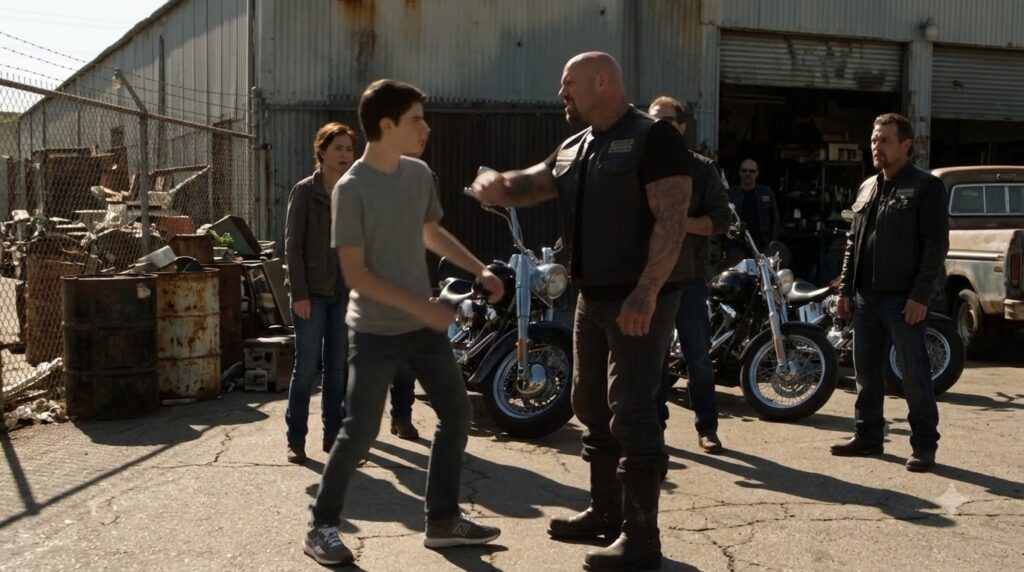
You picked the wrong place to play hero, boy.
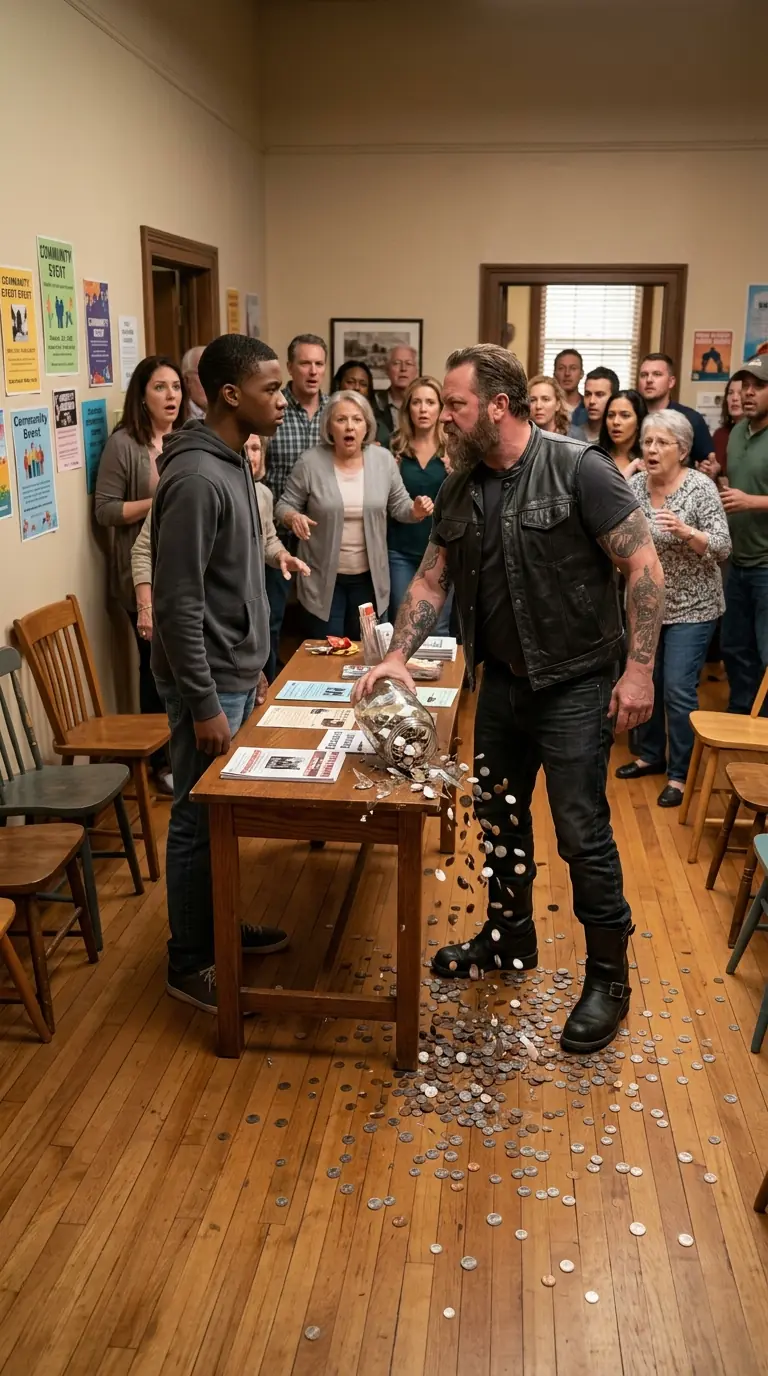
The biker leader slammed Marcus against the wall, then knocked the donation jar to the floor. Coins exploded across the community cent’s wooden floor, a symphony of shattered hopes.
Marcus didn’t flinch. 16 years old, 6’1, eyes calculating every exit point.
The five massive sovereign riders circled him, leather vests creaking, faces twisted with contempt.
“This center isn’t for your kind.”
The leader stepped closer, tobacco breath hot against Marcus’s face.
“Know your place.”
Marcus controlled his breathing. Four counts in. Four hold.
His father’s military training kicked in.
The biker mistook this stillness for fear and laughed. He shoved Marcus again, harder this time.
“What’s a boy like you going to do now?” he mocked, grinding his boot heel into the scattered coins.
He had no idea this moment would echo through their small town of Riverdale forever, leaving broken pride and transformed lives in its wake.
Riverdale’s community center had once been a forgotten municipal building, its paint peeling and windows cracked.
Now it served as the only safe haven for many of the town’s vulnerable kids.
Every weekday afternoon, children filled its rooms with laughter and the determined scratching of pencils on paper.
At the center of this transformation stood Marcus Jackson, though he’d never claimed credit himself.
For the past year, he’d volunteered 20 hours a week organizing tutoring sessions, coaching basketball, and, most importantly, creating a place where kids from Riverdale’s struggling neighborhoods could feel valued.
“Great job, Deshaawn. You’re getting these fractions down perfect.”
Marcus pointed to the next problem on the 10-year-old’s worksheet.
The boy beamed with pride, a rare expression for a child whose home life left little to smile about.
Marcus checked his watch.
5:00.
Time to start closing up.
Most of the children had left, picked up by parents or older siblings.
Only Deshaawn and two others remained in the main activity room.
“Miss Garcia’s running late again?” Marcus asked, though he already knew the answer.
Deshawn’s mother worked double shifts at the hospital.
“Yeah, she said she’d be here by 5:30.”
Deshawn stacked his papers neatly, something Marcus had taught him.
“Can we shoot some hoops while we wait?”
“Let me lock up the front first, then we’ll—”
The cent’s front door crashed open.
Five men stroed in, leather boots heavy against the floor.
The sovereign riders.
Their leader, Ray Mercer, surveyed the room with thinly veiled disgust.
Marcus positioned himself between the bikers and the children.
“We’re closing soon. Can I help you with something?”
Ry ignored the question.
He walked around the room, dragging his fingers across tabletops, examining the cent’s modest resources.
“So, this is where all the city council’s money is going these days? Interesting priorities.”
The other bikers spread out, their presence filling the space.
The children instinctively moved closer to Marcus.
“The center operates mostly on donations,” Marcus explained, keeping his voice even. “Private citizens who care about the community’s future.”
Rey laughed.
“That’s so. Heard differently. Heard my tax dollars are funding this place instead of fixing the roads my business depends on.”
He picked up a children’s book, flipped through it dismissively, then dropped it on the floor.
Marcus felt a flash of anger, but kept his face neutral.
His father’s first lesson: never let them see what affects you.
“Mr. Mercer, if you have concerns about the town budget, the council meetings are every Tuesday evening.”
Marcus stepped forward to retrieve the book.
“I’d be happy to—”
“You’d be happy to what exactly?”
Ry stepped into Marcus’ path.
“Tell me how things work in my own town? I’ve lived here 30 years, boy. My father before me.”
The children watched with wide eyes.
Marcus could feel their fear like a physical presence.
“Mrs. Washington is here for Tamika and Jerome,” called a volunteer from the doorway, visibly nervous at the tension in the room.
“Take them out the side door, please,” Marcus said, without breaking eye contact with Rey.
After the children left, only Deshaawn remained, shrinking behind a table.
“This is a community space,” Marcus said. “Everyone’s welcome during operating hours, but we’re closing now.”
“Everyone’s welcome? That right?”
Ry moved closer. The other bikers formed a loose semicircle.
“Funny. Don’t remember seeing your face around here growing up. Where’d you come from exactly?”
Marcus recognized the implication.
He’d faced versions of this question his entire life.
“I’ve lived in Riverdale for 3 years. My father moved us here after he retired.”
Marcus kept his voice neutral, though something shifted in his posture—subtle, almost imperceptible.
“Retired from what? Welfare office?”
One of the bikers snickered.
Marcus didn’t rise to the bait.
“Military. Special forces.”
Something flickered across Ray’s face—uncertainty, perhaps—but it vanished quickly.
“Well, that’s just perfect. A military brat running the community center. Does the council know you’re letting these kids run wild here?”











