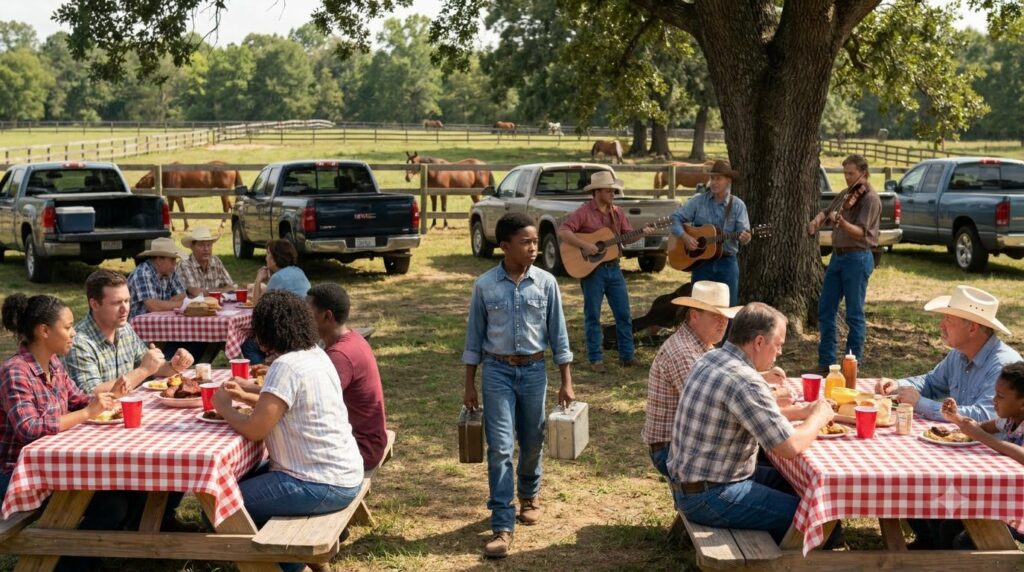
The Haskell Ranch held its community day on the second Saturday of October, the way it had for longer than anyone could say for certain. The county paper called it the Fall Gathering. Everyone else called it Ranch Day. By ten in the morning the pickups were parked nose to tail along the gravel lane, tailgates down, coolers open, and the smell of brisket smoke had crept into everything: the hay bales, people’s flannel shirts, the long rows of picnic tables someone had dragged out of the equipment barn and covered with checked plastic cloths that snapped whenever the wind came up off the pasture.
Behind the white pipe fencing, the horses watched the whole business with the patient contempt of animals who knew they would be ridden by children before the day was out. A bay mare named Dolly leaned her chest against the top rail and let a toddler pat her nose. Two geldings dozed in the shade of the cottonwood. Out past them the land rolled off toward the creek bottom in long tan swells, mesquite and bluestem and the dark seam of trees where the water ran.
The jam circle met under the big pecan by the old stone well house. It was not really a band, though people called it one. It was whoever showed up. This year there were two guitars, a mandolin, a banjo played by a retired dentist who never smiled while he picked, a woman with an autoharp in her lap, and the old rancher himself, Walter Haskell, seventy-four years old, with a fiddle tucked under a jaw that had not changed expression since about 1979. In the middle of them, holding the whole loose arrangement together, stood Lionel Cole with his acoustic bass, a big blond-wood instrument with a crack along the lower bout that had been glued so long ago the glue had turned the color of honey.
Mr. Cole kept time with his whole body. He leaned into the downbeat and rose on the off, and when the guitars got ahead of him he would simply plant his feet and wait, and the guitars, feeling the floor go out from under them, would come back.
They had just finished “Red Wing” when Andre Pruitt walked up the path from the parking field.
He was eleven years old and small for it, in a pressed denim shirt with pearl snaps that his mother had ironed that morning while telling him to hold still, jeans that were a little long, and brown boots that were not quite broken in and made him walk as if the ground were slightly farther down than he expected. In his right hand he carried a metal case no bigger than a deck of cards, dented on one corner, the paint worn off in two thumb-shaped places so the tin showed through bright.
He stopped at the edge of the circle where the folding chairs ended. There was one empty chair, a green metal one, set a little apart.
Walter Haskell lowered his fiddle and looked at the boy, and then at the case, and then at the boy again.
“That little thing’s going to get buried under all these instruments,” he said.
Andre looked down at the case as if checking that it was still there. “Maybe.”
“Banjo alone’ll eat it alive.” Walter jerked his bow toward the dentist, who did not look up. “You’d have more fun listening.”
“Mr. Cole said I could join one verse.”
“Cole says a lot when he’s busy.”
A couple of people at the nearest picnic table laughed, not unkindly, the way people laugh at a weather report. The woman with the autoharp gave Walter a look over her glasses.
Andre did not laugh. He did not step back either. He stood with his boots together and the case held against his belt buckle, and the wind lifted the collar of his shirt.
“It’s a harmonica,” he said. “It’s not that little.”
“Son, I’ve got pocketknives bigger than that.” Walter tucked the fiddle back under his chin, then thought better of it and lowered it again. “That’s a pocket toy. Fine for a porch. This here’s real music. People came out to hear it.”
Somewhere behind Andre, a man said, “Walt,” in a tone of mild warning, and Walter ignored him.
Mr. Cole had been tuning his E string, his ear bent nearly to the scroll. He straightened up now, slow, all six feet three of him, and looked across the circle at the rancher.
“This time I meant it,” he said.
The circle went quiet in the particular way that a group of musicians goes quiet, which is not silence so much as a held breath with strings still faintly ringing in it.
Walter turned his head. “You’re putting the boy in?”











