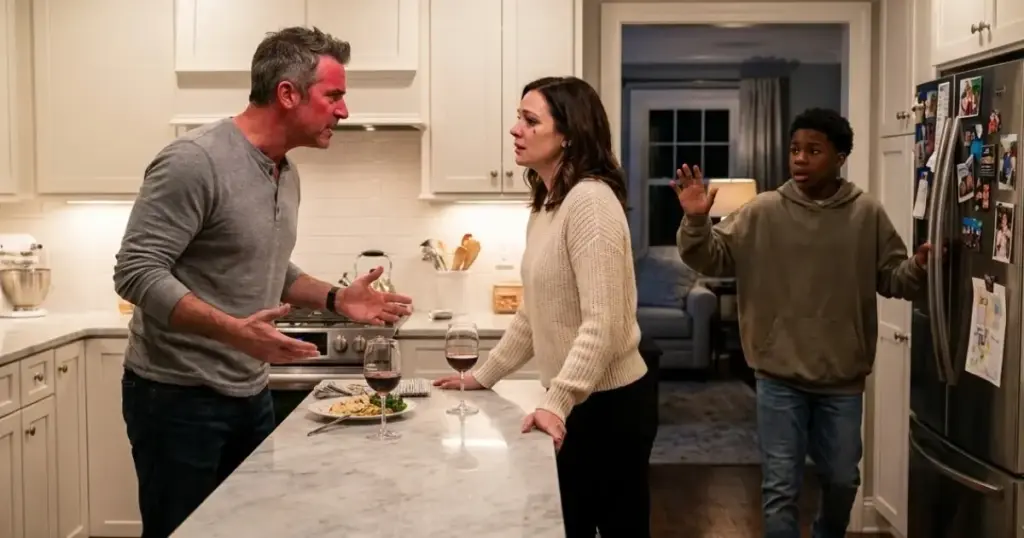
The eat-in kitchen still looked like a room that had been built for homework and birthday cake.
White shaker cabinets held the good glasses on the left and the everyday ones on the right. A wide marble island took the center of the floor like a table that had gotten ambitious. Warm under-cabinet lighting made the marble look softer than stone has any right to look. The refrigerator was a gallery of family photographs held by magnets from vacations and dentists: a white couple on a beach, a Black boy at ten with a missing tooth, the same boy at fourteen in a soccer jersey, the three of them at a courthouse with clothes too formal for the joy in their faces. Hardwood ran to the hall. Two wine glasses sat on the counter, one smudged at the rim, both unfinished. It was night in an upper-middle-class American suburban house. The indoor light was clean. The atmosphere was family, which is not the same thing as safe.
Richard Walsh stood near the island flushed and angry. He was forty-eight, a white American man with fair, lightly tanned skin, a broad solid build, short salt-and-pepper hair, blue eyes, trimmed beard stubble. Gray henley. Dark jeans. He had the body of a man who had once played a sport and now played arguments.
Facing him was Megan, forty-five, fair-skinned, slim, messy shoulder-length honey-blonde hair that had started the evening in a clip and lost the clip. Blue eyes. Mascara smudged from heat and from the kind of crying that does not agree to be pretty. Cream knit sweater. Black pants. House slippers. She was shouting. She was not backing down.
Their son was already close enough to reach them.
Andre was sixteen, a Black American boy with deep brown skin, a tall lean athletic build, dark-brown eyes, neat medium-length black locs with a clean low taper. Oversized charcoal hoodie. Dark relaxed jeans. White sneakers. He looked protective, not violent. The distinction would matter in the next ten seconds, and it had mattered for years in rooms that did not end up in a freeze frame.
What happened at the island would last about ten seconds if a person timed it by the under-cabinet lights. Inside those seconds there would be a light shove, a stumble, a body stepping between two adults, a sentence about not being born in this family, and a quiet line about a courtroom.
None of that had finished yet. The wine glasses were still only wine glasses. The photographs on the refrigerator were still only photographs. The kitchen still believed it was a kitchen.
Belief is a habit in a house like this. The cabinets believe they are for cereal bowls. The island believes it is for mail and math homework. The refrigerator believes it is for milk and for proof that people stood on courthouse steps and meant it. Habits hold until a shoulder moves. Then the room has to choose whether it is still for cake. Tonight it is for a line. Tomorrow, which this story will not enter, it may be for cake again. That is not promised. What is promised is only the ten seconds, told without extra talk, in the light the builders installed to make marble look kind.
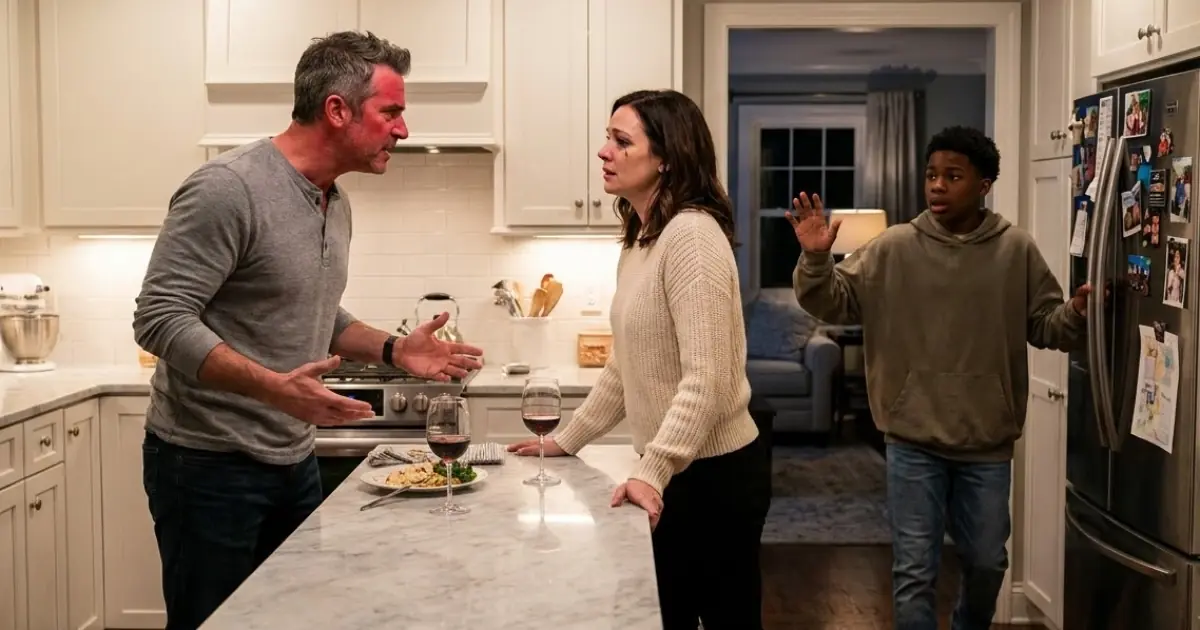
Richard’s blue eyes will look kind in other photographs. Megan’s blue eyes will look kind in other photographs. Kindness is not the question the freeze asks. The freeze asks who stands where when a hand has already done its small damage. The answer is the tall boy in the charcoal hoodie, already close enough to reach them, already finished with staying out of it.
A ten-second scene can carry eleven years if the eleven years have been loaded into the faces. Richard’s flush is not only this voicemail. Megan’s smudge is not only this shout. Andre’s calm is not only this interruption. Each face is a file. The camera, moving once at a time, opens the files without a voice-over. Readers who have kept family pictures on a refrigerator will know how to read them. They know what a courthouse step looks like years later, under a strawberry magnet, when someone in the room tries to unmake the day.
Do not punch. Do not slap. Do not add a line. Do not leave the kitchen. That was the assignment of the night, and the page keeps it.
The boy says what he says.
The father has no answer.
The mother, behind her son, learns the shape of the yes she once cried over in a clerk’s office.
Hold the three of them.
That is the piece.
Not a sermon. Not a pamphlet. A kitchen at night in a suburb that still puts photos on the fridge and still believes, most evenings, that under-cabinet light is enough. Most evenings it is. This evening the light only makes the faces readable, which is all a freeze requires. Readable faces. A marble border. A boy who will not let a shoulder be touched again without the law of a remembered Tuesday coming back into the room.











