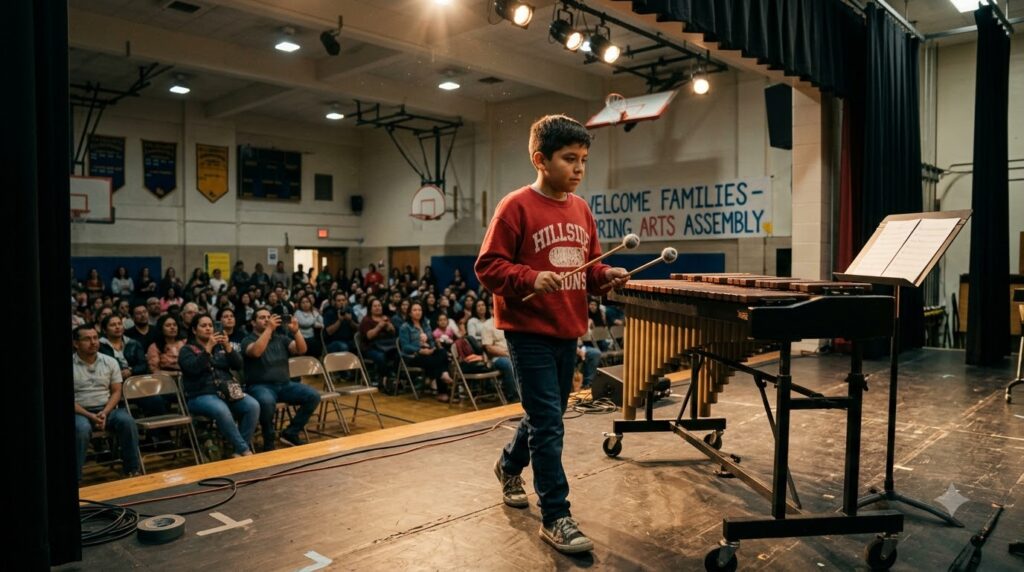
The folding chairs at Alder Creek Elementary had been set out in crooked rows by the fifth graders that afternoon, and by six-thirty every one of them was full. Parents sat with coats in their laps and phones held up a little too early, grandmothers fanned themselves with programs printed on goldenrod paper, and younger siblings slid off the metal seats and were hauled back by their wrists. The auditorium smelled like floor wax and wet October jackets. Somebody’s baby was making a sound like a squeaky hinge. Above all of it, the stage lights burned warm and gold on a single instrument that stood alone near the front edge of the stage: a concert xylophone, rosewood bars laid out in two long ranks over brass resonator tubes, its frame dark and polished, its wheels locked.
Nobody had paid much attention to it yet. It looked like furniture. It looked like the kind of thing a school rented once a year and returned with an apology for a scratch.
Ms. Helen Prescott, who taught fourth grade in Room 14 and had for nineteen years, was standing by the steps at stage left with a clipboard against her chest. Her job tonight was traffic. She was to bring her class up for “Autumn Leaves Are Falling,” which they would sing with motions, and she was to bring them down again without anyone falling off the risers, and she was to make sure that the equipment cart stayed backstage where it belonged. The cart had already been a problem. Twice she had caught boys from Mr. Danvers’s room drumming on the hand bells.
So when she turned and saw Diego Arriaga standing at the foot of the stage stairs in his red Alder Creek sweatshirt, jeans, and sneakers with the laces double-knotted, holding two xylophone mallets crossed against his chest like a small knight holding his sword, she felt the familiar tightening behind her eyes.
Diego was not in her class this year. He had been in her class last year, a quiet boy who did his work and sometimes did not, who drew in his margins, who had once fallen asleep on his arms during silent reading and had woken with the print of his sleeve on his cheek. She had written in his file that he seemed tired. She had written that he needed to apply himself. She remembered his handwriting, which slanted backward as if leaning away from a wind.
She stepped toward him.
“Diego, those mallets need to go back on the cart.”
He looked up at her. His face did not change much; it was a careful face, a face that had learned to wait.
“Mrs. Lewis told me to bring them here.”
“Because you’re helping set up.”
There were always helpers. Mrs. Lewis liked to give jobs to the kids who hung around the music room at lunch. Helen had assumed for years that this was a kindness, a way of keeping certain children off the playground where they got into trouble.
“No, because I’m playing.”
Helen almost laughed. She did not, because she was a professional, and because the mother of a girl in her class was sitting right there in the first row with a camera. Instead she lowered her voice, which she knew from long experience was more effective than raising it.
“Diego. That equipment isn’t for playing around. It’s very expensive, and it belongs to the district. If something gets dropped tonight, it’s not going to be my problem, it’s going to be yours.”
“I’m not playing around,” he said. “I’m playing.”
The distinction seemed to matter to him enormously. His knuckles had gone pale around the handles of the mallets, which were wrapped in gray yarn, the heads round and hard as walnuts.
Helen glanced at the program on her clipboard. Item seven, after the kindergarten poem and before the third-grade recorders: Featured Percussion Solo. No name. She had seen it that morning and thought nothing of it. Last year a sixth grader named Brooke Halvorsen had played something on the xylophone, something bouncing and bright, and everyone had clapped and Brooke’s father had whistled with two fingers.
“The assembly solo?” she said.
Before Diego could answer, a voice came from the stage above them.
“Where is my featured percussion student? Why isn’t he at his mark?”
Mrs. Abigail Lewis came down the steps with her reading glasses pushed up into her gray hair and a tuning fork in one hand. She was a broad, quick woman who had taught music at Alder Creek for twenty-six years and who walked as though every hallway were slightly too short for her. She saw Diego, and she saw Helen, and she saw the distance between them, and something in her face settled.
“Diego,” she said. “Two minutes. You’re after the kindergartners.”











