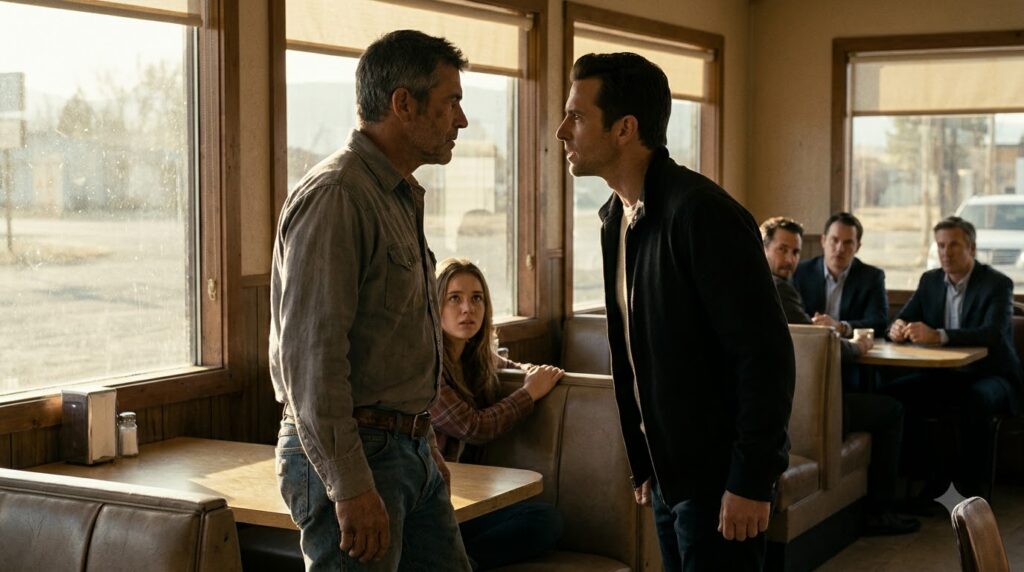
“You’ve lived between cow dung and fence posts so long you forgot what real value looks like.” “We’ll let the lawyers handle it.” “A man who won’t stand up doesn’t deserve what he’s sitting on.” “We’re done here.” “Ten days. Show up, or everyone knows.”
Derek Voss could read a room. He’d built his money knowing which men would fold, and when he looked at Graham Mercer that afternoon, he saw a quiet rancher who had refused his offer and didn’t even look bothered by it. That was the part Derek couldn’t accept.
Not the refusal, the stillness. So, he pushed. In front of the people who mattered to his deal, certain a rancher with few options would break or walk away. Graham didn’t.
He removed Derek’s hand from his collar with one controlled movement and said nothing after, as if he’d done exactly this before. Derek was already laughing. What would it cost him to keep pushing a man who hadn’t flinched once? The fence line on the eastern edge of Graham Mercer’s property had needed new posts since April, and now it was nearly June.
He’d gotten to it on a Tuesday morning. It was the kind of morning where the air still carried the cold from the night before, and the sky above the Wyoming hills was the color of old pewter. Graham worked the post hole digger alone, steady and unhurried, the way he did most things on the ranch. The 186 acres didn’t run itself, but after enough years it began to feel that way.
Each task fit into the next like sections of a fence he’d repaired so many times, he no longer needed to think about which board came first. He was 43, though most people who met him on the road into town might have guessed older. Not because he looked worn down, but because he carried himself like a man who had already settled the question of who he was and didn’t need to revisit it. His hands were rough from the work, his voice low when he used it, which wasn’t often.
The neighbors who’d known him for years said Graham Mercer was the kind of man you trusted with your property line or your word, the kind who didn’t need a handshake because you already knew he’d follow through. Tessa came out around 9:00 with coffee in one of the old thermos cups and stood watching him for a moment before setting it on top of the fence post he’d just set. She was 19 and had her mother’s directness, a way of looking at a problem and naming it before you’d finished considering whether to mention it at all. She’d taken on more of the ranch’s bookkeeping over the past year, learned the ordering schedules, and had opinions about which pasture needed to be rested before the fall.
Graham didn’t ask her to do any of it. She just did. Rebecca had been like that, too. She died six years before after a long illness that took most of the last two years of her life to finish what it started.
Graham had left the army well before that. And the years he spent by her side through the worst of it were the years he thought of most when he drove the fence line alone. She had asked him once, in plain language, the way she always spoke, to promise that he wouldn’t go looking for danger anymore, that he would stay and raise their daughter and build something that lasted. He’d made that promise.
He intended to keep it. What Tessa knew about his time in the service was limited to the general shape of it that he had served, that it had taken him overseas, that it was the reason he sometimes sat outside alone at night without being able to say exactly why. She had never pressed him on the details, and Graham had never volunteered them. The awards that had come from one particular tour in the Middle East were folded inside an old shoe box in the back of the bedroom closet along with photographs he didn’t display and letters from men whose names Tessa wouldn’t have recognized.
He hadn’t put them away out of shame. He’d put them away because he didn’t want her to grow up measuring him against something she couldn’t fully understand and he didn’t want to become a man whose identity lived in the past. The ranch was the present. The cattle were the present.
The fence posts that needed setting in June were the present. That was enough.
The first time Graham saw Derek Voss, it was at the county clerk’s office in town where Graham had gone to file a routine water access renewal. Derek was at the front counter with two people who carried the particular posture of attorneys, straight-backed and deliberate, and he was speaking in the tone of someone accustomed to conversations that ended in his favor. He was younger than Graham by several years, lean and put together, with the kind of physical confidence that came from a person who had decided his body was also a project to be managed and optimized. Graham didn’t know his name then.











