Sarah renegotiated vendor contracts and saved fourteen percent annually.
Thomas pretended he understood how.
He did not.
“Fourteen percent.”
He said one evening.
“You enjoy repeating that number.”
“I enjoy knowing we’re paying fourteen percent less.”
“You enjoy being married to a genius.”
Thomas looked at her.
“That too.”
Sarah blushed.
Still.
Months later.
Ridiculous.
Their marriage became real not in a single kiss but in ordinary repetition.
Morning coffee.
Evening books.
Arguments over pasture rotation.
Thomas asking whether Sarah wanted company before entering her room.
Sarah pulling him inside by his shirt sometimes without answering.
Mature desire became less frightening.
Not less intense.
Simply safer.
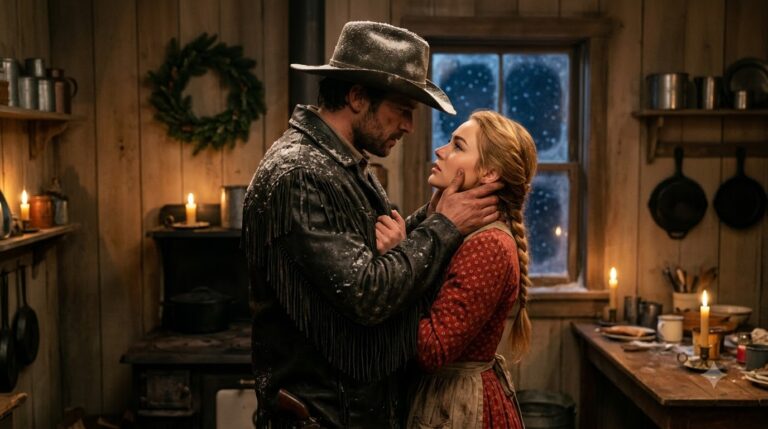
One evening she sat on the desk in the study while Thomas stood between her knees.
The door was closed.
For once.
Sarah ran her fingers along his collar.
“You’re staring again.”
“I’m allowed.”
“Allowed?”
Thomas immediately corrected:
“Invited.”
“Better.”
His hands settled at her waist.
Sarah smiled.
“You have become very trainable.”
“That is an insulting word.”
“Accurate.”
Thomas kissed the corner of her mouth.
Sarah turned her face deliberately away.
He stopped.
“What?”
“Nothing.”
“You’re smiling.”
“No.”
“You are.”
Sarah looked at him.
“You’re going to have to work harder than that.”
Thomas’s eyes changed.
“How much harder?”
She whispered something against his ear that made the disciplined owner of twelve thousand Montana acres forget every useful thought for several seconds.
Sarah laughed.
Thomas caught her around the waist.
“Woman.”
“Yes?”
“You enjoy causing trouble.”
“Immensely.”
He kissed her properly.
Later Sarah lay beside him listening to rain against the window.
Thomas’s hand rested over hers.
She said:
“You know what’s strange?”
“Most things involving you.”
She pinched him.
He smiled.
“What?”
“I thought the contract meant I’d sold myself.”
Thomas became quiet.
Sarah continued.
“And perhaps in some ways I had.”
“I was desperate.”
“You were frightened.”
“We both made decisions that weren’t entirely free.”
Thomas turned toward her.
“I hate that.”
“I don’t.”
He frowned.
Sarah explained.
“I hate that circumstances cornered us.”
“But I don’t hate where I chose afterward.”
“That matters more.”
Thomas watched her.
“You really believe that?”
“Yes.”
“Do you?”
He thought.
“I’m learning.”
Sarah smiled.
“Acceptable.”
They eventually replaced the marriage contract.
Not legally necessary.
Emotionally.
Caldwell drafted partnership papers.
Sarah became a documented financial partner in Blackwood Ranch.
Her annual allowance disappeared.
Instead she received a defined share of profits.
Thomas offered fifty percent.
Sarah refused.
“Why?”
“Because I did not build the first twenty years.”
“But you’re building the next.”
“Thirty-five.”
Thomas stared.
“What?”
“Thirty-five percent.”
“Forty.”
“Thirty-five.”
“Thirty-eight.”
Sarah smiled.
“You negotiate badly when emotionally compromised.”
Thomas leaned closer.
“Thirty-seven.”
“Done.”
Caldwell witnessed the agreement.
Margaret called them both ridiculous.
The rose cutting came from Margaret’s sister the following spring.
Sarah planted it beside the south wall.
Thomas helped.
Margaret supervised and criticized technique.
“You’ll drown it.”
“I have planted flowers before.”
“Not Montana flowers.”
“It came from Billings.”
“Exactly.”
Sarah looked toward Thomas.
“Help.”
Thomas shook his head.
“This is your war.”
Coward.
By autumn the rose bloomed.
One flower.
Deep red.
Sarah stood with Thomas outside the house.
He put one arm around her.
The ranch stretched beyond them.
Twelve thousand acres.
Stable.
Not perfect.
Real.
Thomas said:
“I would do it again.”
Sarah turned.
“The advertisement?”
“All of it.”
“That is a terrible moral lesson.”
“I didn’t say it was moral.”
“You would lie about the bank again?”
“No.”
“Good.”
He looked at her.
“I would make every wrong decision that brought me to the moment when I finally learned to tell you the truth.”
Sarah considered.
“That is slightly better.”
Thomas smiled.
“High praise.”
She leaned into him.
Their story became one people told later.
Not accurately.
Stories rarely remained accurate.
Some said Sarah arrived as a mail-order bride with nothing but a dress and a Bible.
False.
She had three dresses and no Bible.
Some said Thomas was a millionaire.
Ridiculous.
He had land, debt, cattle, and anxiety.
Some said Sarah discovered thousands of dollars in stolen money.
The amount was smaller.
The betrayal larger.
Some said Gideon Marsh tried to burn the ranch.
He did not.
He used paperwork.
Far more dangerous in Sarah’s opinion.
Some said Thomas had ordered a wife because he was lonely.
Partly true.
He was also afraid of losing the ranch.
Some said Sarah stayed because she loved him.
True.
But incomplete.
She stayed because Blackwood Ranch became work she valued.
People she loved.
A place where her mind mattered.
A future she had helped design.
Years later, when young women asked Sarah whether she believed in marrying for love, she annoyed them by answering:
“I believe in marrying with information.”
That was not what they wanted.
They expected romance.
Sarah would smile.
“Love without information is imagination.”
“Information without love is accounting.”