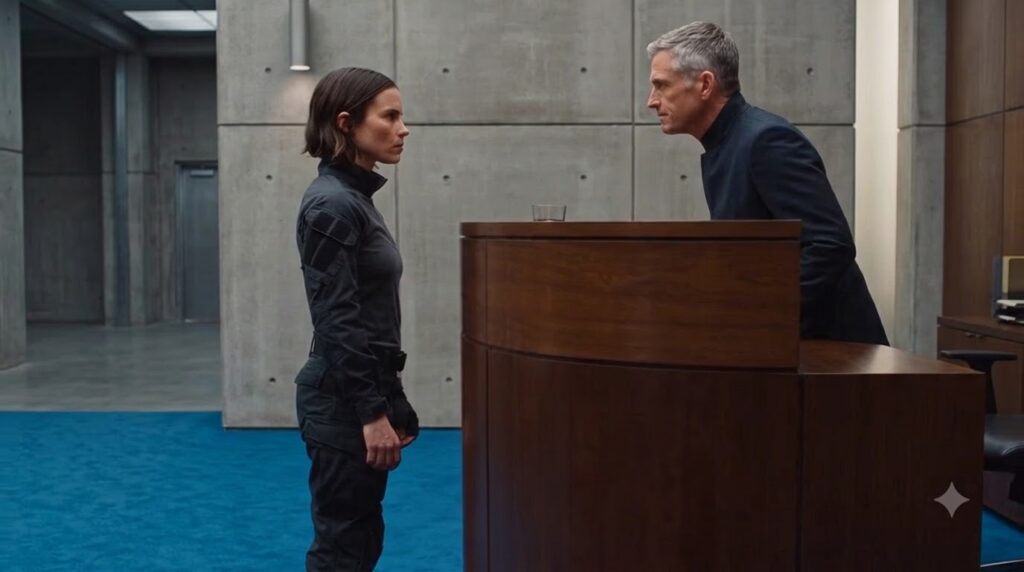
The lights in Hearing Room Four were the kind that did not forgive anybody.
They hung in long white panels from the ceiling, and they lit everything the same way: the raised bench of dark paneled wood, the blue carpet worn pale in a path down the center aisle, the six rows of officers in their pressed green, the two guards in gray standing by the double doors with their hands folded in front of them. There were no windows. There was no clock. Somebody had decided, years ago, that a room where careers ended should not have a clock.
Sergeant Kate Arden stood at the table on the left side of the room, alone.
She was thirty-two years old and she looked like she had come straight from somewhere hard, because she had. Her olive field uniform was plain and creased and gray at the knees with a fine pale dust that had settled into every seam. Her hair was dark blond, pulled back into a low knot that had been tight four days ago and was now coming loose in strands around her ears. She had the kind of face people called beautiful without thinking about it first, high cheekbones, a straight nose with a scatter of sun freckles across the bridge, a wide mouth with chapped lips, and eyes that were a pale gray-green, like creek water over stone. There was a bruise along the left side of her jaw, yellowing at the edges, and a thin scrape at her hairline that someone had cleaned and not bandaged. Dust sat in the fine lines at the corners of her eyes. She wore no makeup. She had not slept in a bed in three nights.
On her right hand she wore a single black tactical glove, old, the leather of the palm gone soft and shiny with use, the hard knuckle guard on the back scuffed down to a dull charcoal. Her left hand was bare. There was a cut across the back of it, healing.
Across the room, behind the center of the bench, sat Major General Raymond Hale.
He was fifty-five, and he had the kind of stillness that men practiced until it looked natural. His gray hair was cut short enough to show the shape of his skull. His dark green service uniform was perfect, every line of it, and the overhead light made it look almost black. To his right sat Colonel Ines Varga, narrow and dark-haired, a pen held motionless above a legal pad. To his left sat Lieutenant Colonel Gideon Pratt, heavyset and red in the neck, who kept glancing at the rows of officers as if counting them.
The rows were full. Hale had ordered it. Every officer of the command not on duty that morning had been told to attend, and they had come, and they sat in their rows with their hats on their knees and the polite, guarded faces of people who had been told they were about to learn a lesson.
In the front row, at the end nearest the aisle, sat an old man in a dark suit.
He was seventy-two. His name was Walter Ainsley, and he was the senior civilian official of the Office of Service Review, which meant that on paper he could sit in on any board in the department and that in practice nobody wanted him to. He had thin white hair combed straight back and a long, lined face that had been handsome once and was now only careful. A cane rested against his knee, black lacquered wood with a silver handle worn smooth by his palm. He had not taken off his overcoat. He looked like a man who had come to see something with his own eyes and intended to leave the moment he had.
Hale let the silence stretch. Then he leaned forward, very slightly, toward the microphone that he did not need.
His voice was quiet and it carried everywhere, and there was something almost amused in it. “Look at you. Dirt on your face, and you still think you belong here?”
A ripple went through the rows. Not laughter. Something smaller than laughter.
Kate did not move.
“Sergeant,” Pratt said, “you’ll answer the general.”
“I wasn’t asked a question, sir,” Kate said. “I was asked if I think something. I do.”
Pratt’s neck went a shade redder. Hale lifted one finger off the bench, and Pratt closed his mouth.
“Let the record show,” Hale said, “that the respondent appears before this board in field condition. Unwashed. Out of uniform regulations. Bearing injuries she sustained while committing the offenses for which she is being separated.” He looked at her the way a man looks at a stain. “Two days ago, you crossed the closure line into the Harrow Valley without orders. You took a vehicle that was not yours to take. You took two soldiers who were not yours to command. You rolled that vehicle into a ravine and abandoned it. You put lives at risk for what your own report calls ‘personal reasons.’ Is that accurate?”











