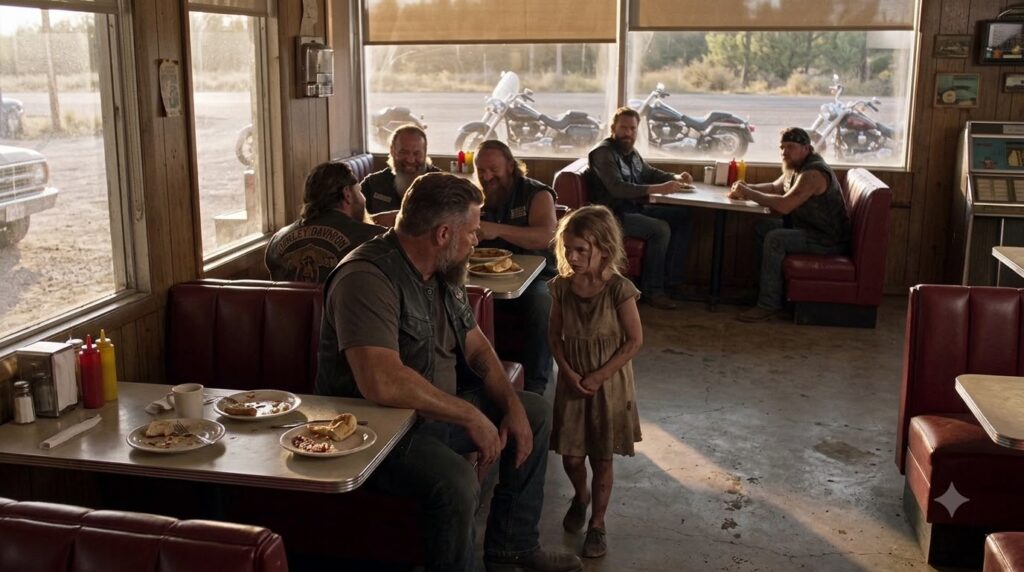
A noisy roadside diner near the Kentucky-Tennessee line was the last place Caleb Mercer expected his life to split open. Forks clinked against thick white plates. A waitress balanced three coffee cups in one hand while calling an order toward the kitchen. Truckers talked over the low hum of an old ceiling fan, two construction crews filled the booths along the windows, and the nine riders from Caleb’s charity convoy had taken over a pair of tables near the back after five straight hours on the road.
Their motorcycles stood outside in the late-afternoon heat, chrome flashing beyond the glass. Inside, the men were halfway through burgers and iced tea when a tiny voice cut through the noise. “Sir.” Caleb looked down.
A little girl stood beside him. She could not have been more than seven. Her brown hair was tangled, her knees were dusty, and one shoelace had come completely undone. There was a gray smear on her cheek and a faint red mark around one wrist.
She was breathing too fast, as though she had crossed the whole parking lot without stopping, but what caught Caleb hardest was her expression. She was trying not to cry because she believed crying would make her slower. The other riders quieted without anyone telling them to. Caleb was forty-six, broad through the shoulders, with a heavy beard and the kind of scarred hands that made strangers assume the worst before he opened his mouth.
He had worked twenty-three years as a diesel mechanic and spent almost as long riding with the Gray Wolves, a fictional local motorcycle charity club whose members delivered groceries, raised money for burn units, escorted veterans’ funerals, and occasionally looked intimidating on behalf of people who needed to feel less alone. Their wolf-head patch had frightened more than one motel clerk over the years. Children, strangely, tended to like it. Caleb turned in his seat and lowered his voice.
“Hey. You okay?” The girl glanced toward the counter. A man in a dark jacket sat three stools down from the register.
Mid-thirties, maybe forty. Clean-shaven. Neat hair. He had a paper cup in front of him he had not touched.
His body was turned toward the counter, but his eyes were fixed on the child through the mirrored panel behind the pie display. The girl leaned close enough for Caleb to smell dust and strawberry shampoo. “That’s not my dad,” she whispered. Every instinct Caleb had learned as a mechanic, rider, uncle, and man who had once made the mistake of ignoring a bad feeling snapped into focus at once.
He did not look toward the man again. He did not reach for the girl. He did not stand fast enough to scare her. Instead, he shifted his chair sideways, opening the space between himself and the wall.
“Okay,” he said. “Come stand right here.” She slipped behind him. Caleb felt her fingers catch the back of his vest and hold on.
Around the table, the Gray Wolves changed posture in the subtle way men do when they have spent enough time together to communicate without speeches. Mason Dale, a retired paramedic, set down his fork. Tuck Avery reached slowly for his phone. Leon Briggs, who had once worked county road maintenance and knew every deputy in three surrounding jurisdictions, moved his chair two inches toward the aisle.
The man at the counter noticed. He pushed his cup away and stood. Caleb finally turned his head. The man offered a small, irritated smile, the kind designed to make everyone else feel foolish for taking something seriously.
“There you are,” he said. “I’ve been looking all over for you.” The girl’s grip tightened. Caleb stood then, not suddenly, but enough to place his body between her and the aisle.
He was six foot three in boots. The man at the counter was perhaps five ten. Size did not decide what happened next, and Caleb knew better than most men the danger of believing it did. Still, presence mattered.
The man stopped three steps away. “She with you?” Caleb asked. The stranger’s smile thinned.
“My niece. She gets nervous around crowds.” Behind Caleb, the girl whispered, “No.” The stranger’s eyes sharpened.
Caleb heard the waitress near the kitchen stop moving. He heard one of the truckers mutter something to the man beside him. Tuck was already speaking quietly into his phone beneath the table, giving the county dispatcher the diner’s location without announcing it to the room. Caleb kept his voice low.
“What’s her name?” The stranger hesitated just long enough. “Emily.” The little girl’s hand twisted in Caleb’s vest.
“My name’s Ellie,” she said. The room changed. There was no shout, no cinematic rush, only a collective adjustment of attention. The stranger looked toward the front door.











