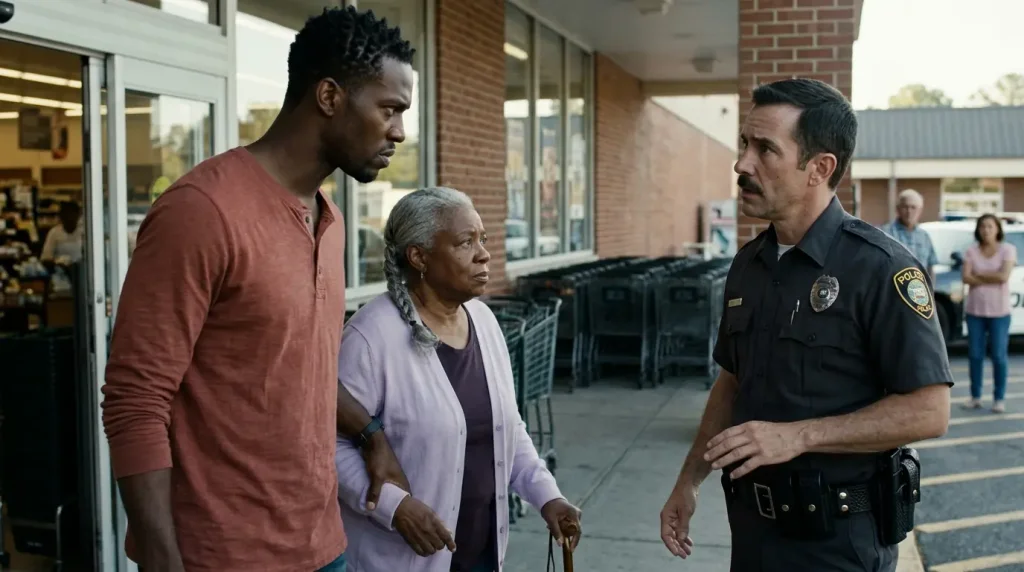
The cane made a dry scraping sound as Sergeant Dale Morris pulled Evelyn away from the grocery store entrance.
Marcus Hayes heard it before he fully understood what he was seeing.
His mother’s burgundy shoe shifted sideways. Her pale lavender cardigan stretched beneath the sergeant’s fingers, and her free hand tightened around the wooden cane as she tried to place it securely on the pavement.
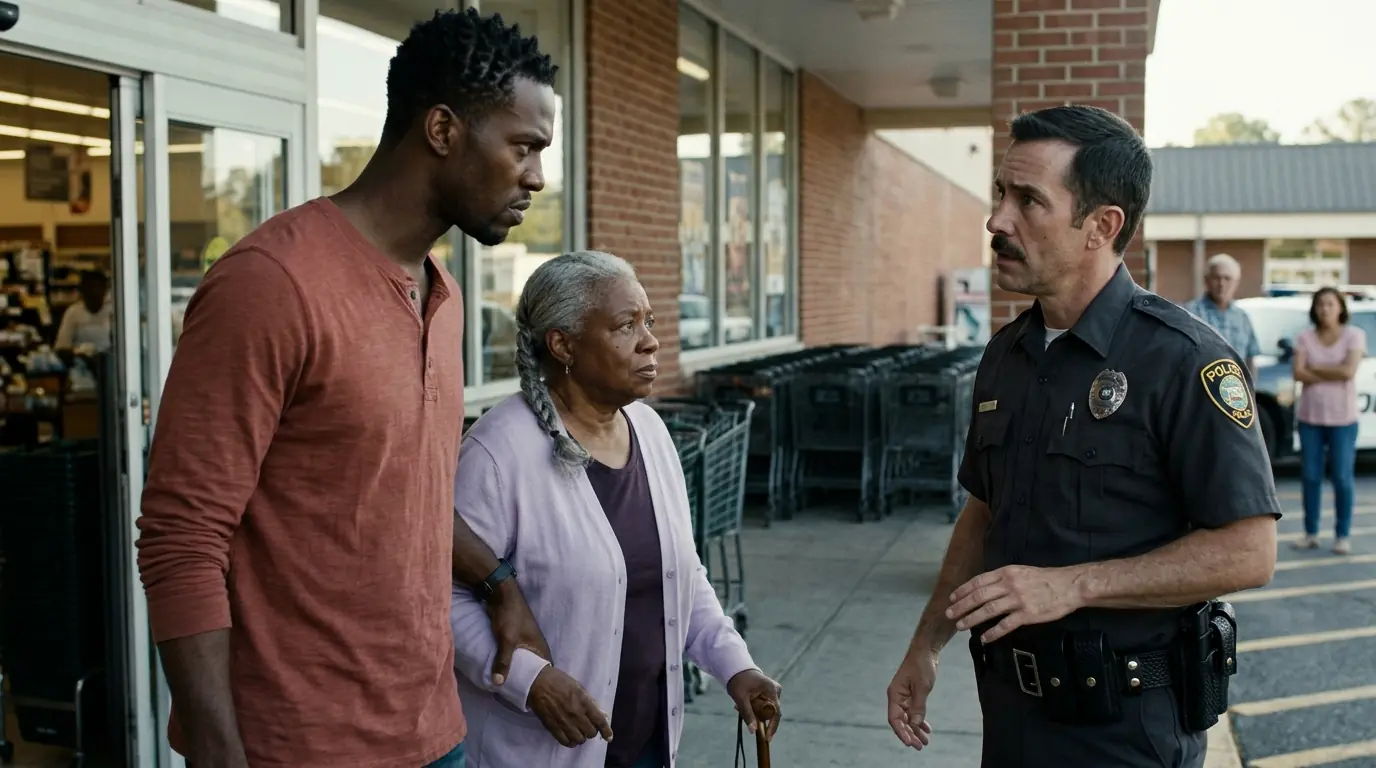
Morris kept pulling.
Marcus crossed the space between them.
“Take your hand off my mother.”
The sergeant turned his head and looked up.
Marcus was exceptionally tall, lean enough that his height appeared even more pronounced beside the patrol car. His faded rust henley and olive canvas trousers were ordinary clothes, but there was nothing uncertain about the way he planted his black boots beside his mother.
The morning had begun with Evelyn informing him that she intended to choose her own groceries.
She did not make the announcement as a challenge.
She made it while standing in her kitchen with a list in one hand and the cane resting against the table beside her.
Marcus had arrived carrying an empty reusable bag and an offer to save her the trip.
At seventy-five, Evelyn appreciated offers.
She preferred them to remain offers.
He understood that in principle. In practice, he sometimes saw the distance from a parking space to a store entrance and imagined every awkward curb between them before his mother had put on her shoes.
She could read that calculation on his face.
“You can carry the bags,” she told him. “I’ll handle deciding what goes in them.”
Marcus looked at the list.
It contained more items than he expected.
“I thought you needed three things.”
“I remembered some others.”
“How many others?”
“Enough that I’m glad you’re here.”
He smiled despite himself.
She folded the list and put it in her purse.
That ended the discussion more efficiently than another explanation would have.
Evelyn was short and full figured, with silver hair gathered into a low braid. She had put on navy trousers, practical burgundy shoes, and the cardigan she liked for stores that seemed determined to keep their customers colder than their vegetables.
The cane was part of going out.
She no longer treated it as something to apologize for carrying.
Marcus had watched that change happen gradually.
At first, she left it behind on days when she felt better. Then she carried it without using it much. Eventually, she accepted that an object could make a journey easier without making the person using it less capable.
He had needed to learn a related lesson.
Helping did not mean anticipating every movement until she had no movement left to make herself.
He had been told that more than once.
Now he took the bag, waited while she collected the cane, and opened the door without offering an arm she had not requested.
Outside, the daylight was clear.
A breeze moved along the front path, lifting the edge of the cardigan before settling it against her trousers again.
Evelyn paused at the step.
Marcus waited.
She placed the cane, brought one foot down, and followed with the other.
The entire movement took only a few seconds.
Years earlier, he might have filled those seconds with unnecessary encouragement.
Now he understood that watching patiently could be more respectful than turning every ordinary action into an achievement.
At the car, he opened the passenger door.
She settled herself, brought the cane in beside her, and arranged her purse where it would not slide.
Then she looked up at him.
“You can stop supervising.”
“I’m opening a door.”
“You’re opening it very attentively.”
He laughed and closed it once she was ready.
Their relationship had acquired that kind of exchange over the years.
Affection carried inside correction.
Concern softened by humor before it became suffocating.
Marcus knew his mother could still do a great deal without him.
He also knew she sometimes concealed discomfort because she disliked seeing people reorganize themselves around it.
Both things could be true.
Learning to respond to the person in front of him, rather than to every worry he could imagine, required attention.
He was trying.
The first thing Marcus remembered about his mother’s kitchen was the sound of a spoon tapping against the side of a pot. It was not a grand memory. He could not have identified the year or the season, and he was certain that the room had changed several times since then. The cabinets had been painted. A window latch had been replaced. The old table, scarred by homework and hot dishes, had finally given way to the smaller one where Evelyn now kept a jar of pencils and a bowl for keys. Yet in his mind the kitchen remained a place where somebody noticed what was needed before anybody had to ask.











