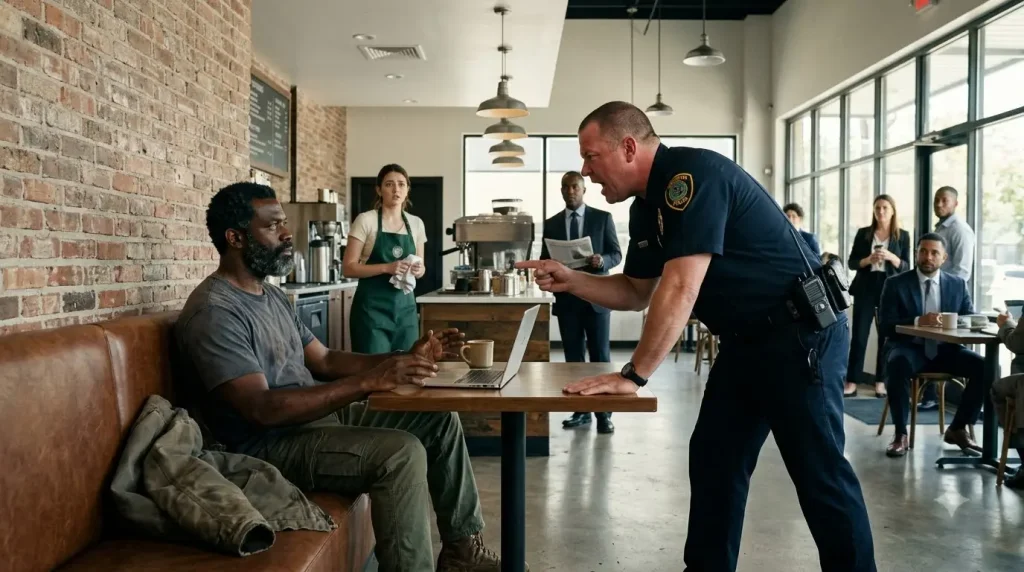
The first thing Supervisory Special Agent Lucas Hayes wanted that Tuesday morning was a cup of coffee dark enough to make him forget the last fourteen days. The second thing he wanted was to get home without anyone asking him a question.
By eight o’clock, he had been awake for almost twenty-seven hours, his knees ached from sleeping in places that were never meant for sleeping, and Houston was already heating the sidewalk like a stovetop. He was not looking for a confrontation when he walked into the Grind and Press on Westheimer. He was looking for twenty quiet minutes in a booth where nobody knew his name.
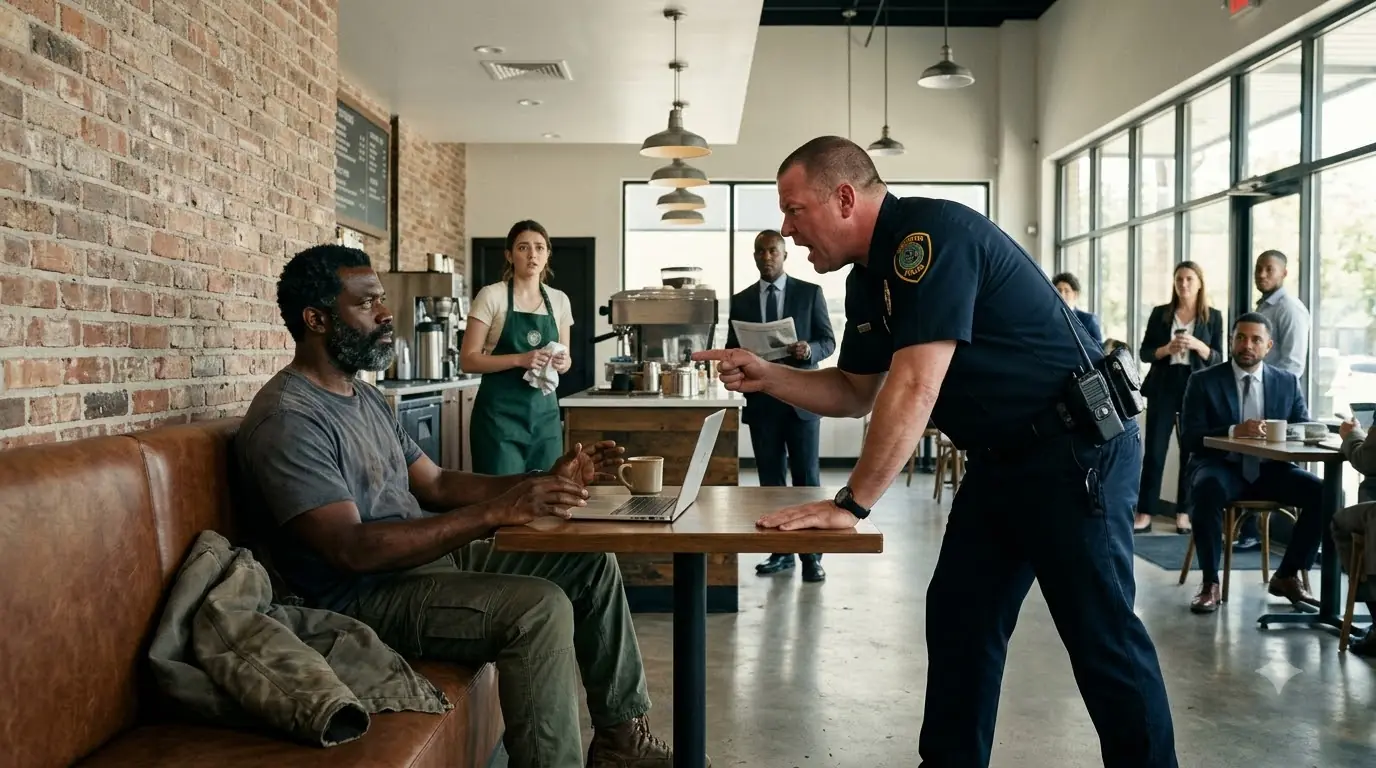
The man who followed him into the coffee shop would later claim that everything began with a legitimate concern about neighborhood crime. Officer Mateo Hayes would say he had acted on his training, that he had observed suspicious behavior and attempted a routine investigation. Those were the phrases he used in his report, in his first conversation with his union representative, and again when a television camera found him outside his attorney’s office. He had rehearsed those words so thoroughly that he might almost have believed them. What he never explained was why his concern disappeared the moment he discovered that the man he had cornered carried an FBI badge.
At 8:12 that morning, Mateo stood over a Black man in a stained shirt, one hand near his holster, demanding identification that he had no lawful basis to demand. Minutes later, that same officer was asking for forgiveness and offering to buy the man’s coffee. By lunchtime, a young barista who had been threatened for speaking up was giving a recorded statement. By the end of the week, people who had been afraid to challenge Mateo for years were calling investigators with names, dates, and copies of papers they had once believed would never matter.
Four months later, Mateo would stand in federal court and hear a judge describe the distance between a public servant and a man who used public authority to satisfy his own prejudice. There was no magic in the badge Lucas placed on the cafe table. It was a piece of evidence about who Lucas was, not a reason his rights suddenly existed. The real case would be built out of what Mateo did before he knew that fact, and what the people around him had been told to endure before anyone listened. But on that hot Tuesday morning, none of us could have seen how far the consequences would travel.
Houston in August has a way of stripping romance from the idea of summer. The air hangs against the buildings, the asphalt keeps yesterday’s heat, and even the shade feels busy trying to hold back the sun. The city wakes early because it has to, with delivery vans backing into loading bays and people moving from one air-conditioned room to the next as quickly as possible. Out on Interstate 45, the traffic was already building when Lucas steered his dented Chevrolet Tahoe north from the coast. His left hand was stiff around the wheel, and the radio had been off for forty miles.
He had finished a joint investigation in Galveston only hours earlier. For two weeks, he had worked around a freight operation where contracts, missing cargo, and suspicious payments had blurred the line between ordinary corruption and more serious offenses. The work required him to appear as a struggling dock laborer, a man who could fix a broken pallet jack and keep his head down when somebody with more money walked past. Lucas had worn three faded shirts in rotation, scuffed steel-toed boots, and cargo pants that had acquired stains no washing machine would ever quite remove. It was the kind of disguise that depended less on makeup than on other people’s willingness not to look closely.
He was forty-two, with an athletic but increasingly tired frame and a beard that had grown unevenly along his jaw. In the photographs on his federal credentials, his face was clean-shaven, his tie was straight, and his eyes were as controlled as a courthouse clock. In the rearview mirror that morning, he looked like a man who had spent the night helping somebody move furniture in a storm. He did not mind the difference. One of the lessons of his job was that appearances could be useful, dangerous, and almost always misleading.
Lucas had grown up on Houston’s east side, where his mother worked long shifts as a respiratory therapist and his father repaired industrial equipment until an injury persuaded him to take a desk job he never enjoyed. Samuel Hayes used to bring home broken radios and small appliances to teach his son patience. Gloria Hayes taught him something less mechanical and more difficult: how to stay composed when a stranger assumed that anger was the only language a Black man possessed. Their lessons did not make him immune to humiliation. They made him understand its price, and the price of pretending not to notice it.











