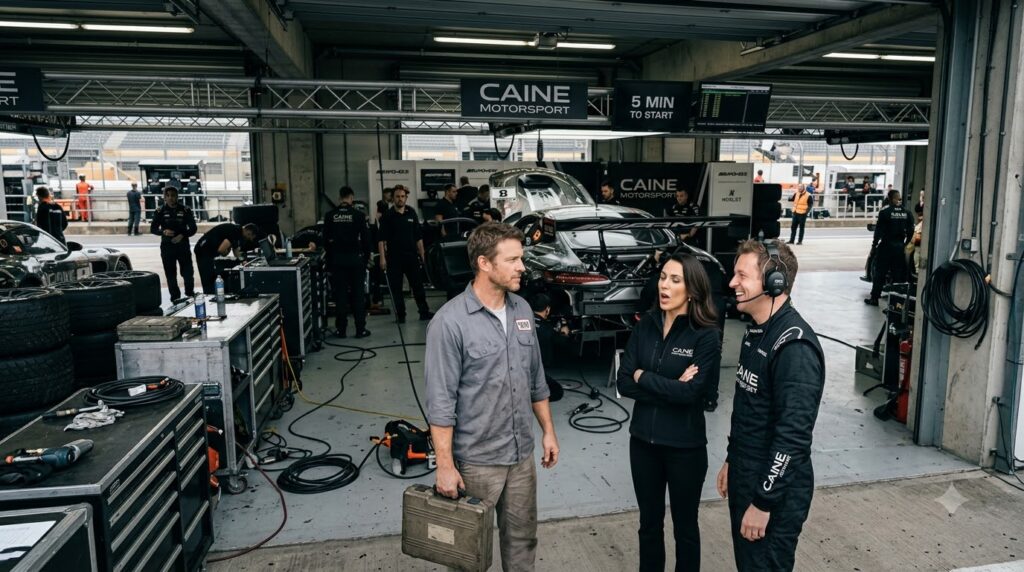
The race was supposed to start in 23 minutes. 80,000 people filled the grandstands. Television cameras were already broadcasting live to more than 40 countries. Sponsors had paid millions for the event.
The driver’s helmet was on. The countdown clock above the pit lane kept moving. And the car wouldn’t start. Not because of a crash.
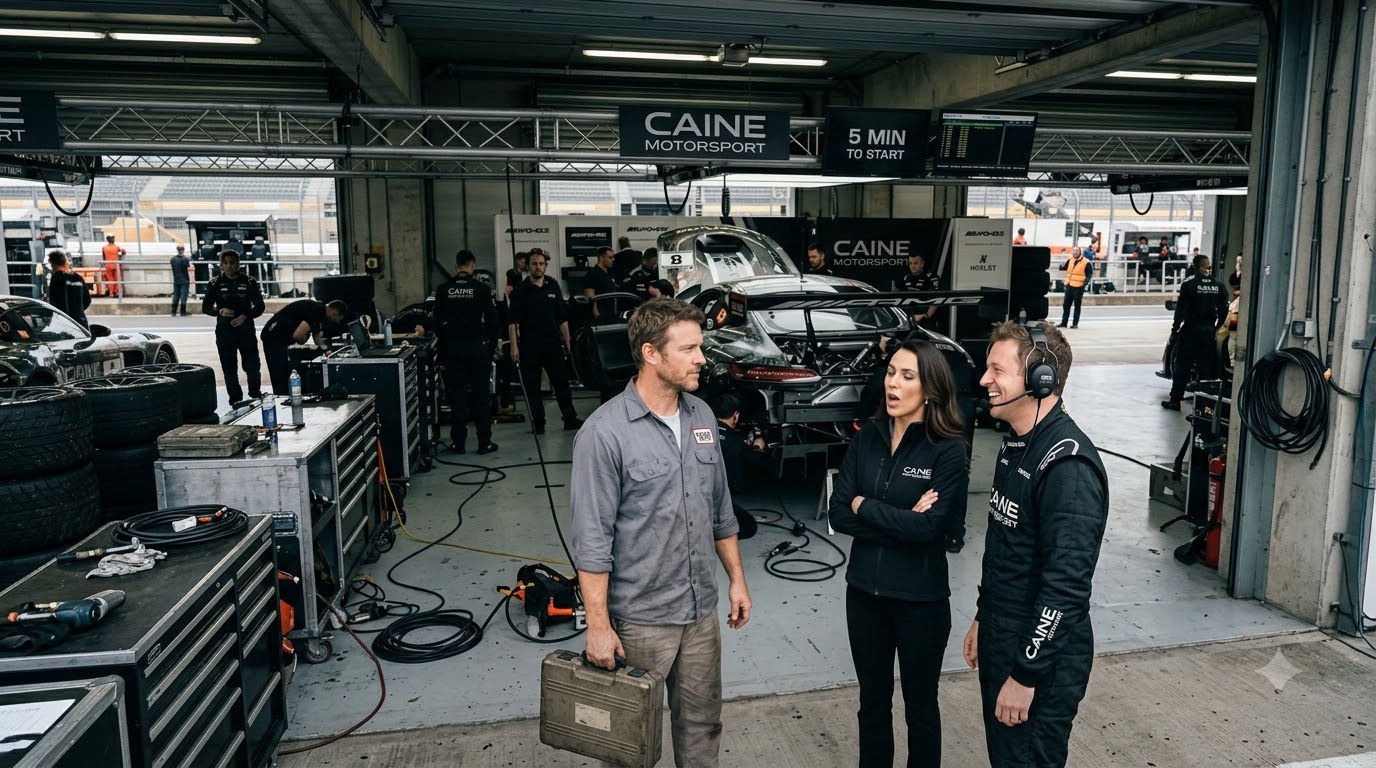
Not because of a blown engine. Not because of a fuel problem. The car simply refused to come alive. Victoria Caine stood in the center of the pit garage staring at a machine worth nearly 18 million dollars while engineers surrounded it from every direction.
Laptops, diagnostic carts, factory computers, telemetry specialists, powertrain specialists, electrical specialists. 100 mechanics had looked at the car in the previous 3 hours. 100 and not one of them had an answer. The lead engineer pulled his headset off and looked at Victoria.
His face told her everything before he spoke. “We’re out of ideas.” The words hit harder than she expected. Because this wasn’t just any race.
This was the Grand Prix. The biggest event of the season. The race that could decide the championship. And right now, her car was nothing more than an $18 million sculpture sitting on four tires.
Around her, the garage had gone silent. Nobody wanted to say what everyone was thinking. If the car didn’t start, the race was over before it began. Then a voice came from the back of the garage, calm, almost casual.
“Five minutes.” Every head turned. A man stood near the tool cabinets holding a worn diagnostic case, gray work shirt, light beard, 42 years old, not wearing a team uniform, not wearing a sponsor logo, just standing there like he belonged. One of the engineers frowned.
“Who are you?” The man looked at the car, then at the crowd of specialists around it, and finally at Victoria. He said, “I can have it running before the race starts.” For a second, nobody moved.
Then several mechanics laughed. One actually shook his head. Victoria stared at him. “You think you can fix something 100 mechanics couldn’t?”
The man looked back at her, completely calm. “No.” The laughter grew louder. Then he finished the sentence.
“I think I can find what they missed.” The garage became quiet again, because confidence sounded different when it wasn’t trying to impress anyone. What Victoria Caine didn’t know was that the man standing in front of her wasn’t just another mechanic. And what those 100 specialists didn’t know was that the answer had been sitting in front of them the entire morning.
Ethan Cole did not wake up that morning expecting to be standing inside a Grand Prix garage. He woke up because his daughter, Emma, forgot where she had left her science project. The project was a cardboard model of a wind turbine she had spent four evenings building at the kitchen table. And at 6:32 in the morning, she appeared in the doorway of Ethan’s bedroom with the specific expression children wear when they have realized a problem exists and have decided that a parent is the solution.
“Dad.” He opened one eye. “Mm-hm?” “I can’t find my turbine.”
He sat up immediately. Not because the project itself was important, because Emma thought it was important. There was a difference. five minutes later, they were searching the house. The turbine eventually appeared exactly where Ethan suspected it would be, on top of the refrigerator, where Emma had placed it the night before to keep the cat from knocking it over.
Emma looked relieved. Ethan looked at the clock. School started in 52 minutes. The day was underway.
Their house sat on a quiet street outside Newark. Nothing special. Two bedrooms. Small kitchen.
Old wooden floors. The kind of place that required constant maintenance, but somehow always felt warm. Emma’s notebooks occupied half the kitchen table. Ethan’s repair manuals occupied the other half.
They had been sharing the space for years. Emma ate breakfast while reviewing her science presentation. Ethan made coffee and listened. When she finished explaining the project, she looked at him.
“Do you think it’ll work?” “The turbine?” She nodded. He considered the question.
“The design works.” She frowned. “That’s not what I asked.” A smile appeared at the corner of his mouth.
No, it isn’t. She pointed her spoon at him. “You always do that.” “Do what?”
“Answer the question underneath the question.” He poured coffee into a travel mug. “That’s usually the important one.” Emma seemed satisfied by this.
She opened her notebook and wrote something down. Ethan had stopped asking what she wrote months ago. The notebook had become her version of a toolbox, a place where useful things lived until she needed them later. At 7:38, they left the house.
At 7:52, Emma was dropped off at school. At 8:10, Ethan was back at the repair shop where he worked. The shop wasn’t glamorous, no television commercials, no racing teams, no celebrity customers, just honest repair work. The kind that paid bills, the kind that kept families moving, the kind most people never noticed until their car stopped working.











