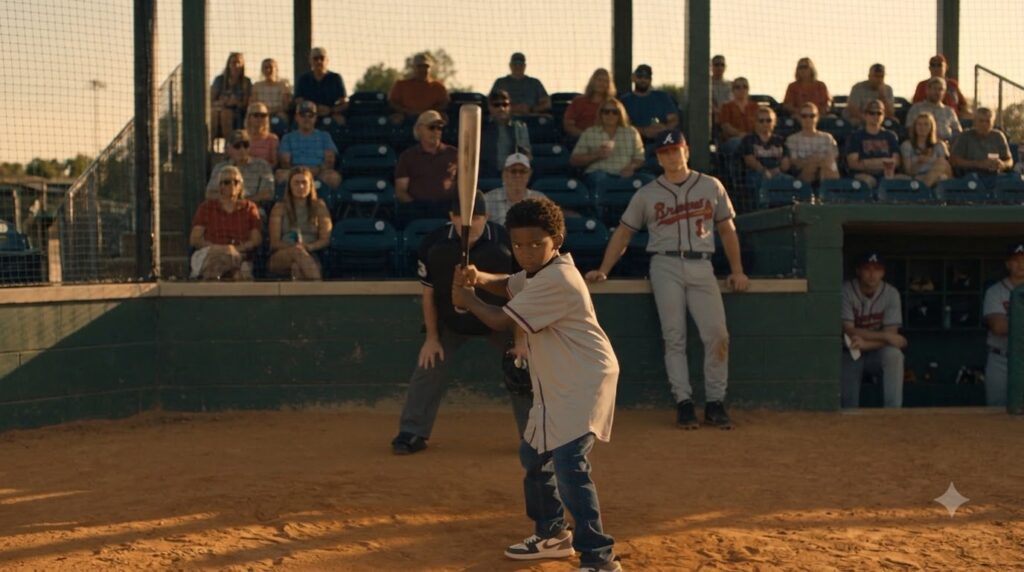
“Throw It”: The Fourth-Inning Kid Under the Lights at Merriwether Park
The lights at Merriwether Park came on in stages, the way they had for sixty years, the first bank over the third-base line flickering and catching while the others waited their turn. By the bottom of the fourth inning they were all burning, and the moths had found them, and the whole field had gone that impossible green that only exists under stadium lights in late August, a color that seemed to belong to no other place on earth.
The Calder Springs Millhands were down two runs to the Pell City Foundrymen. Nobody in the stands much cared. It was Dollar Dog Night and Youth Challenge Night both, and the crowd of a little over four thousand had come for the evening more than the score: for the warm wind off the Muskeen River, for the smell of fryer grease and cut grass, for the between-innings entertainment that the Tri-River League had perfected over decades of having nothing much else to sell.
When the third out of the top of the fourth settled into the left fielder’s glove, the public address system crackled, and the voice of Gus Rademacher, who had been announcing Millhands games since before most of the players were born, rolled out over the seats.
“Ladies and gentlemen, boys and girls, it is time once again for the Clothesline Challenge, brought to you by the Calder Springs Savings and Loan! Three young hitters. One pitch each. Put it past the Clothesline and your name goes up on the Board forever!”
A grounds crew of two teenagers jogged out with a length of orange rope strung between short stakes and laid it in a gentle arc across the outfield grass, a hundred and fifty feet from home plate. A third teenager carried a portable mound, a fiberglass hump painted to look like dirt, and set it down forty-six feet from the plate. The Millhands’ left-handed reliever, Ray Castellano, walked out after it with a bucket of baseballs and the expression of a man who had been told that this was part of his job and had decided to be gracious about it.
The first two hitters had already gone.
The first was a twelve-year-old girl named Maddie Kurtz who had a real swing, a coached swing, and who caught Castellano’s pitch a hair too low and sent it straight up into the night, so high that the crowd had time to gasp and then laugh kindly as it came down thirty feet behind the mound. The second was an eleven-year-old boy built like a refrigerator, who hit the ball hard and on the ground, a two-hopper that died in the grass well short of the rope. Both of them got a commemorative bat, a handshake, and a round of applause. Both of them walked off looking happy and a little stunned, the way kids look when they have been inside something bigger than themselves for thirty seconds.
The third hitter was waiting by the on-deck circle.
He was ten years old and small for it, and the team T-shirt they had given him at the gate came down nearly to his knees, the word MILLHANDS stretched across his chest in red script and the sleeves hanging past his elbows. He wore jeans that had been washed so many times they had gone pale at the knees, and a pair of white sneakers that had been carefully cleaned that afternoon with a toothbrush and a cup of dish soap. He held a youth bat, thirty inches, aluminum, its grip tape wound fresh. On his left wrist was a green silicone band with a number printed on it in white.
His name was Jayden Whitlock, and he had been waiting for this for forty-one days.
The umpire working the event came over to him slowly. He was a big man gone soft at the middle, sixty-one years old, in the dark slacks and powder-blue shirt of the Tri-River League umpiring staff, though he was not working the plate tonight. He had a clipboard under one arm and a face that had spent a lot of years squinting into sun. His name was Lyle Bettencourt, and he had umpired in this league for thirty-six seasons, and for the last nine of them he had also run the Clothesline Challenge, because nobody else had wanted to and because Lyle was the kind of man who would rather do a thing himself than watch it done badly.
He looked down at Jayden. He looked at the shirt, and the bat, and the sneakers. Then he looked up at the crowd, which was settling in, getting ready to cheer, phones already rising in the front rows.
“You’re going to turn this into a comedy show, kid.”











