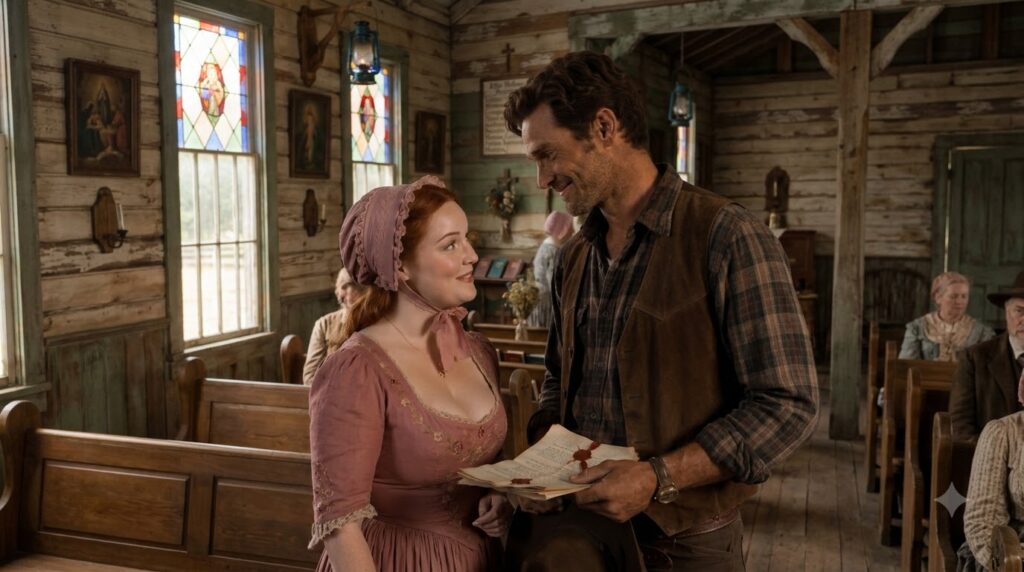
The mail-order bride first saw the rancher before the stagecoach had completely stopped.
He stood alone across the dusty Montana street with one hand resting near his belt and a black hat shading most of his face.
Everyone else moved.
Horses stamped.
Men carried crates.
A woman hurried a child into the general store.
Wind rolled dust against the wooden buildings.
The rancher did nothing.
He simply watched the coach.
More specifically, he watched her.
The mail-order bride tightened both hands around the small carpetbag resting in her lap.
Three weeks earlier she had possessed more courage than good sense.
At least that was what one of the women at the boardinghouse had told her when she answered the advertisement.
Widowed rancher seeks respectable woman willing to help raise young daughter. Marriage possible upon mutual agreement. Montana Territory.
There had been no poetry in the advertisement.
No promise of love.
No description of sunsets or mountain views.
No ridiculous claims about a handsome gentleman seeking a gentle soul.
Only facts.
Ranch.
Widower.
Daughter.
Marriage possible.
She appreciated that.
At twenty-seven, she had learned to distrust promises wrapped too beautifully.
Her mother was gone.
Her father had died owing more than he owned.
The small teaching position she once depended on disappeared when the school closed.
After months of moving between relatives, boardinghouses, and temporary work, she reached the point where staying felt more frightening than leaving.
So she wrote to a stranger.
His letters had been exactly like his advertisement.
Short.
Direct.
Almost painfully practical.
My daughter is six.
The ranch is thirty miles from town.
Winters are severe.
You will have your own room.
If you arrive and decide against the arrangement, I will pay your return fare.
Nothing romantic.
Yet she had read those letters repeatedly.
There was something reassuring about a man who did not sell himself.
The stagecoach stopped with a violent wooden groan.
The driver opened the door.
“We’re here.”
The other passengers began gathering their belongings.
The mail-order bride remained seated for half a second longer.
She looked again through the window.
The rancher still had not moved.
Tall.
Broad-shouldered.
Weathered.
A thin pale scar showed near one temple.
He looked less like a man awaiting a bride than a man waiting to learn whether a storm would hit.
She nearly stayed on the coach.
Then she remembered there was nowhere meaningful to ride back to.
She stepped down.
Her boot caught on the edge.
The world tilted.
A large hand closed around her elbow.
Firm.
Warm.
Careful.
She looked up.
The rancher had crossed the distance so quietly she had not seen him move.
For one brief moment, his face was only inches from hers.
Dark eyes.
Sun-darkened skin.
A rough jaw.
A mouth that seemed unaccustomed to smiling.
He released her arm as soon as she regained her balance.
“You’re the woman from the letters.”
His voice was deeper than she expected.
She nodded.
“And you’re the rancher.”
“Yes.”
That appeared to complete the introduction.
She waited.
He waited.
The silence became unbearable.
“If you’ve reconsidered,” she said quickly, “I understand.”
One eyebrow shifted.
She continued before courage failed.
“I can return east. I have enough money for part of the fare and I can find work for the rest. I don’t want you thinking I expect—”
He took the carpetbag from her.
She stopped speaking.
“The wagon is this way.”
That was all.
He turned.
She stared at his back.
Then followed.
The wagon waited behind the livery.
A large bay horse stood hitched to it.
The rancher placed her bag carefully beneath the seat, helped her up, climbed beside her, and started them toward open country.
For the first mile, neither spoke.
The mail-order bride became painfully aware of every sound.
Leather reins.
Wooden wheels.
The horse’s breathing.
Her own skirts shifting whenever the wagon struck a rut.
She watched the town disappear.
Then the land opened.
Grass rolled beneath an enormous sky.
Mountains rose in the distance, their upper slopes still holding snow.
Small creeks cut silver lines across the valley.
The silence no longer felt empty.
It felt vast.
The rancher finally spoke.
“You should know some things.”
She straightened.
“All right.”
“I have a daughter.”
“I know.”
“She’s six.”
“You wrote that.”
He nodded.
“She remembers her mother.”
The mail-order bride looked at him.
He kept his eyes on the road.
“How long has she been gone?”
“Three years.”
“I’m sorry.”
His jaw tightened.
He gave no answer.
A few moments passed.
“She needs stability,” he continued.
The mail-order bride understood what he was trying to say.
“She needs someone in the house.”
“Yes.”
“To cook.”
“Yes.”
“Keep things running.”
“Yes.”
“And help raise her.”
“Yes.”
She looked at her hands.











