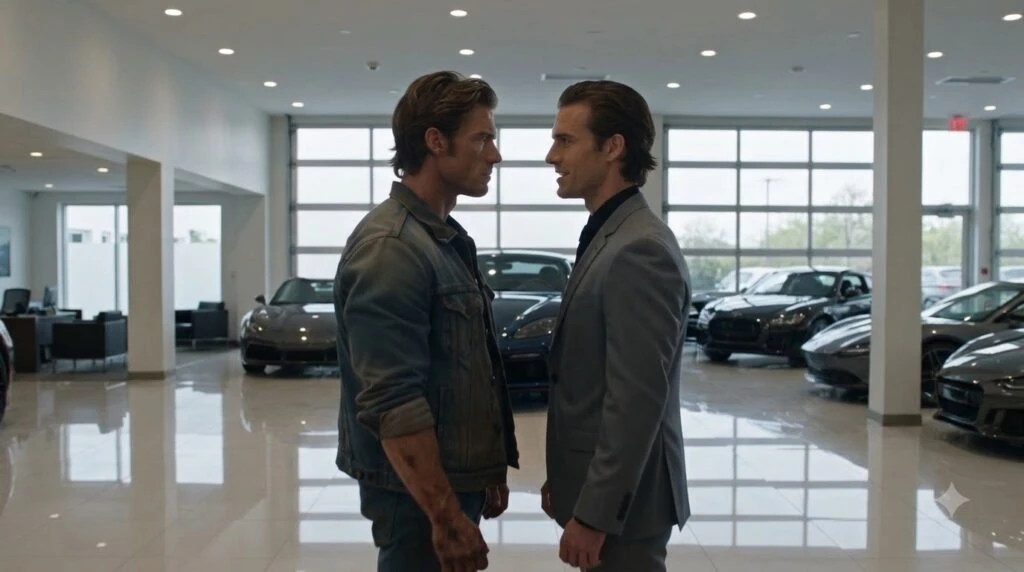
The showroom floor at Stroud Meridian Motors looked less like a place where cars were sold than a gallery where wealth had been trained to stand still under perfect white light. Polished stone reflected ceiling panels so cleanly that every shoe, wheel, and chrome edge seemed doubled beneath itself. Leather chairs sat in careful clusters near a wall of smoked glass, and every vehicle on the floor was positioned with the precision of sculpture. On a warm Thursday afternoon in Beverly Hills, two customers were sipping espresso near a silver coupe while another couple waited for paperwork at a low walnut desk. Nothing in the room looked accidental.
Eli Brooks did.
At thirty-nine, Eli had the kind of face people remembered even when he did not seem interested in being remembered. His jaw was hard and sharply cut, his gray eyes steady, and the California sun had marked his skin around the forehead and cheeks from years spent leaning over open engine bays in outdoor yards and parking lots. He wore a faded denim jacket over a black T-shirt, work jeans, and scuffed boots. Dark grease sat in the creases of his knuckles despite two washings. If someone judged income by fabric, Eli looked like a man who had entered through the wrong door.
Gavin Stroud noticed him within fifteen seconds.
Gavin was thirty-five, slim, expensive, and polished in a way that suggested he had learned early that appearance could function like a credential. His gray suit fit with almost aggressive precision. His dark hair had been slicked back without a strand out of place, and the watch at his wrist flashed whenever he moved his hand. He was the showroom’s top salesman three quarters running, a fact he found ways to mention even when discussing weather. More importantly, he was the nephew of the dealership’s minority investor, which meant people often let his arrogance pass as confidence because correcting him felt administratively expensive.
Eli stopped three feet from a low graphite coupe near the center of the floor and crouched slightly to look through the front wheel. He did not touch the car. He leaned, narrowed his eyes, then rose and glanced toward the nearest salesperson. Gavin had already started toward him.
“Wait outside,” Gavin said before Eli could speak. “This isn’t a bus station.”
The sentence carried farther than he probably intended. One customer in the leather seating area looked up. Vanessa Ruiz, the receptionist near the front desk, stopped typing. Eli turned his head slowly toward Gavin, not shocked exactly, but measuring whether he had heard correctly.
“I asked a simple question,” Eli said. His voice was low. “Answer it with respect.” Gavin smiled in the way people smile when they believe witnesses improve their performance. “Make me, grease monkey.”
The room changed.
It did not become loud. It became attentive. A woman near the espresso machine lifted her phone. A younger man waiting by the finance desk did the same. Vanessa stepped from behind reception with her own phone lowered at her side, face tightening as she watched Gavin move closer.
“Gavin, stop,” she said. Eli did not look away from him. “I’m not leaving.” Gavin spread his arms and glanced theatrically at the polished floor. “Scared of the floor polish?”
Eli exhaled once, took off his denim jacket, folded it carefully, and placed it on the edge of an empty leather chair. He was not preparing to fight. He was removing a garment with metal snaps before getting close to expensive paint, a reflex drilled into him after twenty years of working around cars. Gavin misread the motion completely.
“Give me a second,” Eli said. Vanessa’s attention sharpened. “Wait,” she said. “Look at his eyes.”
Gavin ignored her. “Security’s on its way,” he said.
Eli stepped forward exactly one pace. No clenched fists, no raised shoulders. Only enough movement to close the unnecessary distance Gavin had created between them. “They can watch too.”
By then, Vanessa knew two things Gavin did not.
The first was that Eli was not angry in the way men about to swing become angry. His breathing had not changed. His hands remained open. His eyes were doing what technicians’ eyes often do when they are listening to a problem instead of reacting to a person: taking in details, storing sequence, separating noise from evidence. The second was that she had seen those gray eyes before, in a confidential internal file emailed to three department heads and reception that morning.
The subject of the message had been simple: independent technical review, 2:00 p.m. The attached photograph had shown the man differently—clean black polo, arms crossed in front of a bank of tool cabinets, the embroidered patch of Brooks Diagnostic & Restoration over one chest pocket. Vanessa had glanced at it only long enough to know whom to expect. The email instructed staff to direct Mr. Brooks to General Manager Martin Voss on arrival and not to discuss the purpose of his visit on the sales floor.











