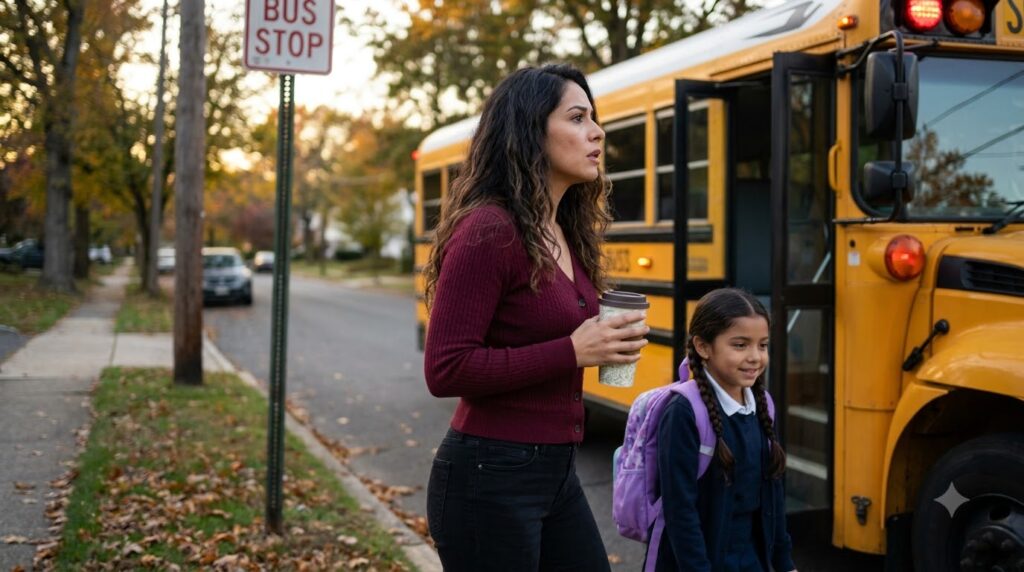
The bus came around the corner of Larch Street at 3:19, eleven minutes after dismissal, the way it always did, its yellow nose dipping as it braked for the speed bump in front of the Hendersons’ house. Sofia Martinez had been standing at the stop since 3:02. She had never been early before. She had never, in two years of afternoons, been anything but exactly on time or a few breathless minutes late, her car keys still in her hand, her phone still warm against her ear from the last call of the workday. Today she had left the office at two, told her supervisor it was a dentist appointment, and driven home with the radio off.
It was October, and the maples along Larch Street had gone the color of rust and candle flame. A wind came down the block and lifted the hem of her burgundy cardigan, and she pulled it tighter across her chest and folded her arms. Her long dark hair kept blowing into her mouth. She did not bother to fix it.
The doors folded open with their rubber sigh. Children spilled down the steps in a tumble of backpacks and lunchboxes and half-finished arguments. Then Mia appeared at the top step, small and solemn in her navy school uniform, her dark braids tied off with the yellow elastics Sofia had put in that morning, her purple backpack hanging from one shoulder like a sack of rocks. She saw her mother and stopped.
It was not the stop of a child who was happy to be surprised. It was the stop of a child who had been told one thing and was now seeing another, and who was trying very hard to work out which of the two was true.
“Mommy?” Mia said. “Daddy said not to wait for you today.”
The words went into Sofia like a cold coin dropped down the back of her shirt. She kept her face still. She had learned, over seven years of motherhood, that a child read your face before she read your words, and that whatever you let slip there was what she would carry home.
“What did Daddy say?” Sofia asked. She crouched so that they were eye to eye, and she put a hand on Mia’s backpack strap and drew her gently down the last step onto the curb.
Mia looked at her shoes. “He said today was a Miss Ashley day.”
Behind them, the bus driver had not closed the doors. She was a broad-shouldered white woman somewhere in her late fifties, with cropped gray hair and reading glasses pushed up onto her head and a fleece vest with the district logo stitched over the heart. Her name was Donna Kessler. Sofia knew that only because Mia talked about her at dinner — Miss Donna lets us sing on Fridays, Miss Donna has a dog named Biscuit, Miss Donna said a bad word when the truck cut her off but she said it in Polish so it doesn’t count. Donna leaned out over the steering wheel, looking past Sofia and up the street, her brow furrowed.
“I was actually expecting another woman,” Donna said.
Sofia straightened slowly. “Another woman?”
Donna’s expression shifted, the way a person’s face shifts when she realizes she has stepped onto ice she did not know was there. She looked at Sofia, then at Mia, then back at Sofia, and there was something in her eyes that might have been apology and might have been calculation.
“She’s picked Mia up here twice this month,” Donna said. “She’s on the list. Your husband called the transportation office and put her on the authorized list back in September. I figured — ” She stopped. “I figured you knew.”
Sofia did not know. Sofia had not known about a list, or a phone call, or a woman. She felt the ground under the curb grow slightly less solid, as though the asphalt had been poured over something soft.
She turned back to her daughter. She made her voice as warm as she could manage, which was warmer than she would have thought possible.
“Sweetheart, who is she?”
Mia twisted one braid around her finger. “Miss Ashley.”
“And where does she take you?”
Mia looked up then, and for a moment her face was perfectly open, perfectly unguarded, the face of a child who had not yet understood that the truth could be a dangerous object.
“To Daddy’s other house,” she said.
The wind came down Larch Street again, and a drift of maple leaves skittered across the asphalt and caught against the bus’s front tire. Somewhere a dog barked twice and stopped. Donna Kessler was very carefully looking at her side mirror.
Sofia opened her mouth and found that there was nothing in it.
Then Mia’s face changed. She was looking past her mother’s shoulder, up the street toward the stop sign at Larch and Willoughby, and she lifted her hand in a small, uncertain wave.











