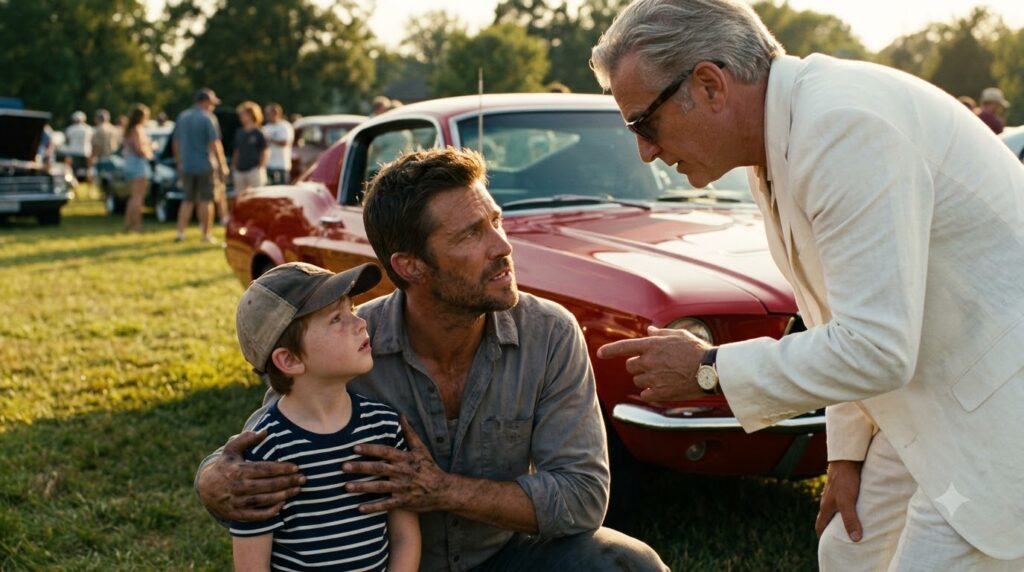
The field had been a hayfield once, and on certain afternoons it still remembered. Under the smell of wax and gasoline and kettle corn there was a deeper smell, green and bruised, coming up from the grass where four hundred tires had pressed it flat since morning. The sun was warm and low enough by three o’clock to lie along the chrome in long gold bars, and everywhere people were bending down to look at their own faces in it.
Jake Calloway had not meant to come. He had told himself that all week, and he told himself again as he parked the truck at the far end of the gravel lot, where the field ended in a line of cottonwoods and a sagging wire fence. He told himself that he was here because Noah had seen the flyer stapled to the telephone pole outside the hardware store, and because a boy of eight should get to walk up and down rows of old cars on a Saturday in September, and because the tickets were only five dollars for kids. All of that was true. None of it was the reason.
He looked down at his hands on the steering wheel. He had scrubbed them twice with the orange pumice soap that morning, and still the grease sat in the creases of his knuckles and under the rims of his nails like a second set of fingerprints. It never came out entirely. Annie used to say she could find him in the dark by the smell of him, solvent and coffee and cut steel. He had stopped minding years ago. Today he minded.
“Are we getting out?” Noah asked.
“We’re getting out.”
“You said that a minute ago.”
“I’m saying it again so it’s true.”
Noah was already unbuckling. He wore the red baseball cap that had been his since kindergarten, the brim curved almost into a tube from his habit of bending it in both hands while he thought, and a striped tee, navy and white, that Jake’s sister had bought him and that he refused to let go into the wash more than once a week. The freckles across his nose had come out over the summer as if someone had flicked a paintbrush at him. He had Annie’s freckles. He had Annie’s way of leaning forward when he was interested in something, as if the world might get away from him if he stayed upright.
They walked in through the main entrance under a banner that said CLASSICS ON THE GREEN in red letters, and a woman with a cash box and a sunburned nose stamped the backs of their hands with a blue star. Then the rows opened up in front of them, and Jake felt the old thing happen in his chest, the thing that had first happened when he was nine and his father took him to a show like this one, two counties over, and he had stood in front of a 1957 convertible the color of a robin’s egg and understood, without words, that a machine could be beautiful the way a song was beautiful.
They went slowly. Noah wanted to see everything. There was a pickup from the forties with wooden slats in the bed, polished until the grain looked wet. There was a long low coupe with fins like a shark’s. There was a station wagon with wood paneling on the sides and a family of mannequins in the seats, dressed for a picnic, which made Noah laugh so hard he had to sit down on the grass. There were men in folding chairs beside their cars, most of them past sixty, with coolers at their feet and binders on the hoods full of photographs of the cars as they had been before: rusted, gutted, sunk into blackberry brambles behind barns. Jake liked those men. He liked the binders. He liked the honesty of saying, here is the ruin, here is the work, here is what came of it.
He knew where they were going. He did not hurry. But Noah, running ahead, found it first.
It was parked at the end of the third row, apart from the others, on a square of artificial turf that had been laid over the real grass, inside a perimeter of brass stanchions and red velvet rope. A small white tent stood beside it with two director’s chairs and a table with a pitcher of iced tea sweating onto a linen cloth. A placard on an easel read, in gold script, 1967 — FRAME-OFF CONCOURS RESTORATION — PRIVATE COLLECTION. And in the middle of all that, as if it had been set down by a careful hand from a great height, sat a cherry-red 1967 muscle car.
Jake stopped walking.
The color was right. That was the first thing. He had mixed it himself, over three weeks, with a paint man named Ortiz who had since retired to Arizona, matching it against a chip of original lacquer they had found protected under the rear seat bracket, the only square inch of the car that the sun and the rain had not gotten to in forty years of sitting. Cherry red, but not candy, not modern; a red with a little brown buried in it, like the inside of a ripe plum. The chrome on the bumpers was right. The stance was right, the slight forward rake. The hood scoops. The way the light broke over the rear quarter panel and ran down into the trunk line without a single ripple.











