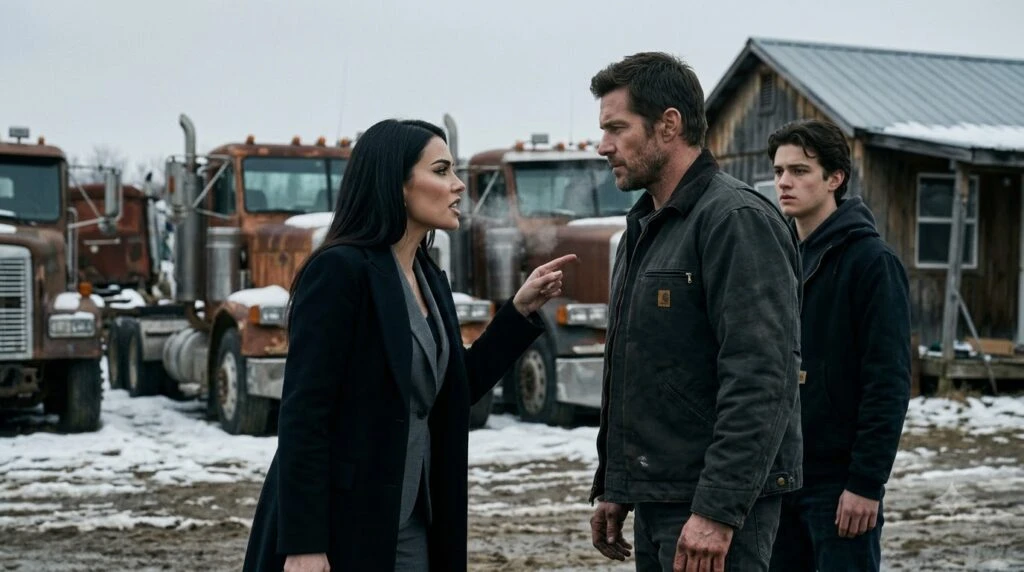
People say some things cannot be saved. A rusted junkyard, a man with nothing left, and the cold verdict of a powerful woman who has never once been wrong. Charlotte Vance stood in the middle of rusted iron and looked at Logan Mercer without blinking. She said it plainly, “This place is trash.
Sell it before it pulls you under.” Logan did not argue. He nodded, turned, and walked away. But inside his mind, a plan had already begun to take shape, one Charlotte had never considered, and one that would force her to redefine two words entirely, real value.
The morning Logan Mercer drove out to his father’s property for the first time as its legal owner, the sky was the color of old concrete, flat gray and indifferent to everything beneath it. The sign at the entrance read Mercer’s Yard in faded black paint. The metal post it was bolted to had rusted through at the base, and the whole thing leaned at an angle that made it look like it had long since given up. Logan sat in his truck for a long moment before he stepped out.
He was 40 years old that winter. Broad-shouldered with a mechanic’s hands, the kind of hands that knew the weight of a torque wrench the way a musician knows the neck of a guitar. The lines in his palms had engine oil in them that no amount of scrubbing had ever fully removed. He had spent 15 years as a lead technician for one of the region’s largest freight haulers, diagnosing engine failures, rebuilding transmissions, keeping entire fleets moving through ice and heat and driver error.
He understood the anatomy of a commercial vehicle the way a surgeon understands the body. Not from textbooks alone, but from the particular intimacy that comes from putting your hands inside something broken and finding your way to what went wrong. Then the company restructured, and Logan’s name was first on the severance list. His father, Harold Mercer, had run the yard for 30 years, collecting decommissioned trucks, salvaging parts, living quietly off the margins of the freight industry.
Harold had died of a stroke 3 weeks earlier quietly in the office chair that still sat behind the desk in the leaning wooden building at the back of the property. He had not been a wealthy man. What he left behind was a junkyard nearly 3 acres in size. 60 or so retired trucks in various states of decay, 3 40-ft steel containers, four diesel generators that had not run in years, a workshop with a corrugated tin roof, and a debt of roughly $220,000 split between the bank, the county tax office, and a material supplier Harold had owed since the previous spring.
Logan’s older brother Jason had made his position clear inside 48 hours of the funeral. He signed a formal waiver of inheritance rights without sentiment, told Logan the place was a money pit, and drove back to his life in another state. Logan was the one who signed for everything. Not because he had a plan in that first moment, but because the yard was the last thing his father had built, and he could not watch a stranger buy it at auction for the price of the land alone.
The bank sent a notice shortly after. Logan had 90 days to demonstrate sufficient financial activity or the property would be placed in foreclosure proceedings. He had just under $3,000 in his checking account. Caleb, Logan’s son, was 20 years old and living with his father after walking away from his second year of college without finishing the semester.
He stood at the edge of the yard on that gray morning and looked out at the rows of dead trucks, the rusted containers, the weeds growing through cracked asphalt, and asked quietly, “You sure about this, Dad?” Logan did not answer right away. He walked to a spot near the fence line where a pipe wrench lay half buried in gravel, picked it up, wiped it clean on the leg of his jeans, and tucked it into his jacket pocket. Then he turned and started walking the perimeter of the yard, slowly, systematically, the way a technician walks a machine before deciding what it needs.
He did not answer Caleb’s question with words. The answer was in the way he moved.
Charlotte Vance arrived 9 days later in a black SUV that was too clean for a property like this, followed by a second vehicle carrying two members of her team. Charlotte was 38 with the posture of someone who had learned that the way you walk into a room determines how much of the conversation you control before a word is spoken. She had built Vance Freight and Development from a regional logistics brokerage into the largest freight and commercial real estate operation in the area over 8 years. Not through charm, though she had plenty of it, but through the kind of relentless accuracy that makes other people in a room feel slightly behind.











