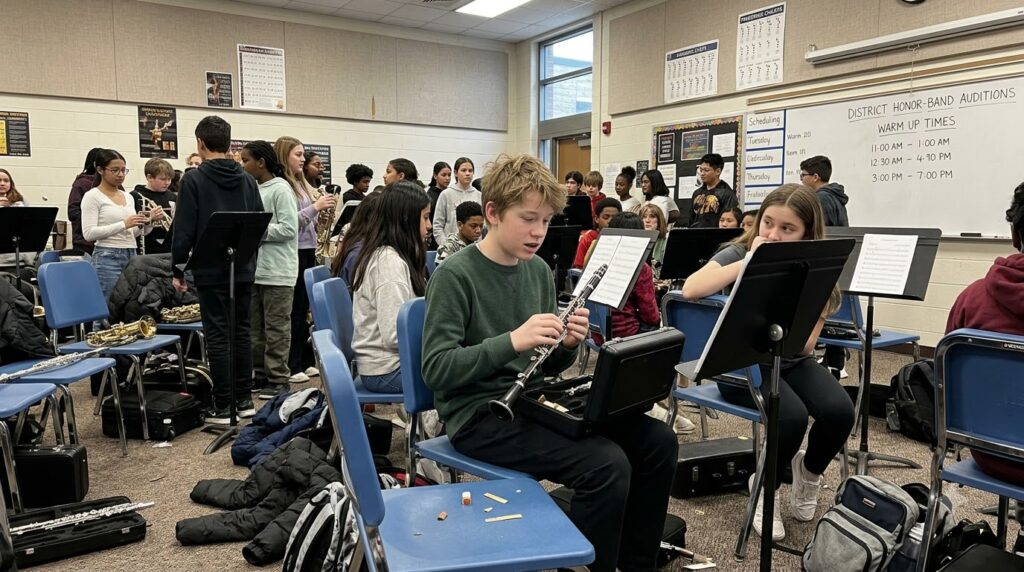
The band room at Westfield Middle School smelled of valve oil, floor wax, and the particular warm dust that rises off old radiators the first cold Saturday of the year. Someone had pushed the chairs into ragged rows that still remembered Friday’s rehearsal, and the music stands stood among them at every angle, some cranked high, some collapsed to knee height, like a crowd of thin gray people who had stopped mid-argument. Along the back wall the percussion racks held their sleeping instruments under canvas covers: the timpani with their copper bellies, the marimba stretched out like a long brown animal, a xylophone, a rack of suspended cymbals that hummed faintly whenever the heating system came on.
It was the morning of the district honor-band auditions, and the room had been turned into a waiting area. Forty-some students from six schools sat or stood or paced among the chairs. A trumpet player in the corner kept buzzing his lips into his mouthpiece with his eyes shut. Two flutists sat cross-legged on the risers doing breathing exercises from a worksheet. A tall girl with a bass clarinet case nearly as long as she was had fallen asleep against the wall, or was pretending to, which is a skill some musicians learn early. Every few minutes the door to the small practice room down the hall opened, and a name or a number was called, and the room went quiet in the way rooms go quiet when everyone is pretending not to listen.
Ben Ostrander sat in the third row, near the end, with his clarinet case across his knees.
He was thirteen, sandy-haired, with braces that caught the fluorescent light whenever he forgot himself and smiled. He wore a green sweater his mother had told him was lucky, though she had told him that about the gray one last year, and black pants that were a little short at the ankle because he had grown in August and it was not yet the right time, financially, to grow again. The case on his knees was plain black plastic, scuffed white at the corners, with a latch that had to be pressed with the thumb and lifted at the same moment or it wouldn’t open. On the handle, someone long ago had wrapped electrical tape, and the tape had gone soft and gummy and then hard again over many summers.
He had opened the case once already, to check the reed, and closed it again. He was waiting until his number was close. His mother had taught him that: you assemble when you’re two out, not ten out, because a clarinet sitting assembled on your lap gets cold and goes flat, and a boy sitting with an assembled clarinet on his lap starts to feel like he is being watched.
Two chairs down, a man in a camel-colored overcoat was explaining something to his son.
The man was perhaps forty-five, broad through the shoulders, with the sort of haircut that cost money every three weeks and a watch that he consulted more often than there was time to consult it. His son, a slight dark-haired boy of thirteen or so, sat beside him holding a clarinet case of polished wood with brass corners, the kind that looked as though it ought to contain dueling pistols. The boy was not opening it. He was holding it the way you hold something on a bus when you don’t want to be noticed.
Ben had been half-listening for a while. The man’s voice was a pleasant, carrying baritone, the voice of someone used to conference tables, and it had been explaining the difference between grenadilla wood and plastic, and the importance of bore design, and how a professional mouthpiece “opens up the whole upper register,” and the boy had been saying “I know, Dad,” at intervals, more and more quietly.
Then the man’s eye fell on Ben’s case. Ben saw it happen. He watched the man’s gaze travel from the taped handle to the white-scuffed corners to the molded plastic latch, and something settled in the man’s face, a small expression of recognition, like a person spotting a misspelling.
“Still using a student clarinet at these auditions?”
He said it lightly, leaning forward a little, smiling. It was the tone of a man making conversation with somebody else’s child at a cookout.
Ben looked down at the case and then up again.
“It works.”
“For class, maybe.” The man spread his hands, as though conceding a point. “Most of the serious candidates upgraded years ago. Fifth grade, sixth grade. You hit a ceiling with those.”
“It’s the instrument I practice on,” Ben said.
The dark-haired boy shut his eyes for a second. “Dad, leave it alone.”
“I’m not saying anything bad.” The man turned to his son, then back to Ben, and his voice took on the patience of somebody being generous with information. “I’m explaining why serious musicians upgrade. The resistance is different. The tone is different. A judge can hear a student horn from the hallway. It isn’t your fault. It’s physics.”











