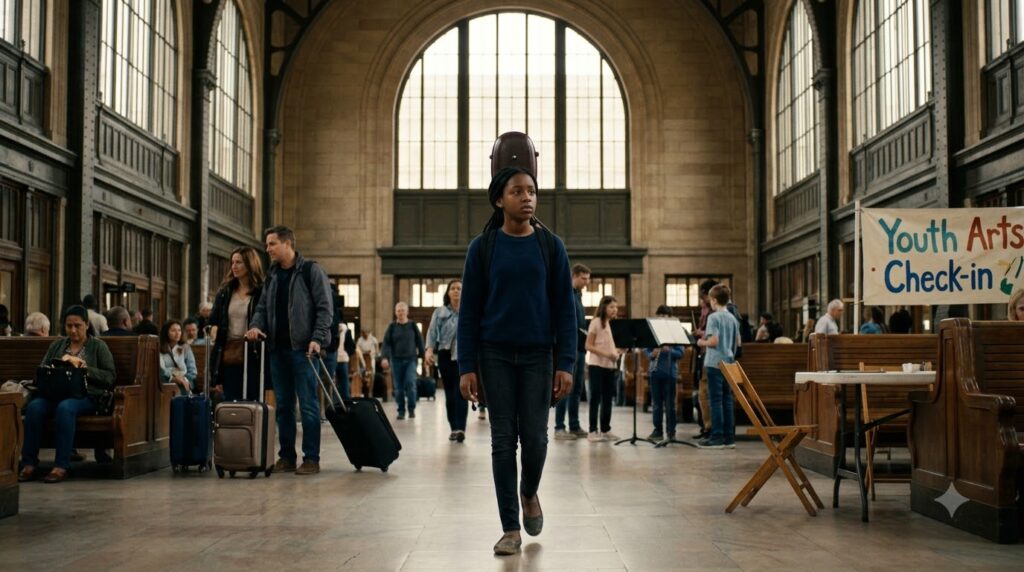
At twenty minutes past three on the second Saturday of October, the light came into Halvorsen Union Station the way it had come in for a hundred and six years, slanting down through the tall arched windows on the west wall and laying long gold panels across the marble floor, so that anyone crossing the great hall walked through stripes of brightness and shadow like a person passing between the bars of a piano keyboard. The windows were forty feet high and divided into small panes, and some of the panes were old glass that had sagged over the decades and made the light ripple. Pigeons lived somewhere up in the coffered ceiling. Nobody had ever managed to get rid of them, and after a while the city had stopped trying.
The hall was loud with ordinary noise. A train from the south had come in fifteen minutes earlier and its passengers were still flowing through the brass doors from the platforms, pulling suitcases whose small wheels clattered over the seams in the stone. A man in a gray coat was arguing on the phone with someone about a rental car. Two grandparents stood at the foot of the departures board holding a hand-lettered sign that said WELCOME HOME JOJO, and kept lifting it higher every time a new cluster of people came through the doors, and lowering it again. The long wooden benches, worn pale along their edges by a century of coats and elbows and sleeping travelers, were crowded with families who had come for the youth arts program, and with travelers who had not come for anything and found themselves, with mild surprise, in an audience.
At the north end of the hall, under the great clock with its iron hands, the station’s events office had built a temporary stage: a plywood platform eighteen inches high, skirted in black fabric, with two speakers on stands and a microphone that squealed whenever anyone walked too close to it. In front of the platform, a line of chrome stanchions held up a thick red rope, the kind used outside theaters, and behind the rope stood the parents. They held phones up. They held coats and water bottles and younger siblings. A banner hung from the balcony rail above the stage, printed in cheerful orange letters: HALVORSEN STATION YOUNG ARTISTS AFTERNOON — MUSIC IN MOTION.
So far there had been a fourth-grade recorder ensemble, a boy of ten who did a tap routine on a square of plywood laid over the plywood, two teenage sisters who sang a duet from a musical, a trumpet player who cracked his high note and then grinned so hugely about it that everyone forgave him, and a dance troupe of eleven girls in matching purple who had trouble fitting onto the stage and had performed partly off of it. Between each act there was a little interval of shuffling, of folding chairs carried and uncarried, and in one of those intervals a girl in a blue sweater came walking up the center aisle between the benches carrying a cello in a soft black case.
She was twelve. Her braids were pulled back and tied at the nape of her neck with a plain elastic, and they fell down between her shoulder blades. The sweater was a deep cornflower blue, a little too big in the sleeves, which she had pushed up to her forearms. Her jeans were dark and her flats were worn pale at the toes, and the left one had a small split along the seam that she had colored in with black marker so it wouldn’t show. The cello case was the cheapest kind, padded nylon with a zipper that ran all the way around, and one of its shoulder straps had been replaced with a length of webbing from a backpack. She carried it in front of her, hugging it at the neck the way you might carry a sleeping younger child, and she moved through the crowd carefully, turning her body sideways to slip between people, saying “excuse me” in a voice nobody heard.
Her name was Kiara Bennett, and she had been thinking about this afternoon for nine months.
At the rope stood a volunteer in a green lanyard. She was sixty-four years old, tall and broad-shouldered, with silver hair cut short and reading glasses pushed up on top of her head where she had forgotten them. She wore a fleece vest over a striped shirt and a name tag that said DOREEN, and under the name, in smaller letters, HALVORSEN STATION FRIENDS. Doreen Pratt had volunteered at the station for eleven years. She led history tours on Thursday mornings and handed out maps at the information booth on weekends, and today she had been given the job of keeping the area in front of the stage clear, which mainly meant moving the rope stanchions back an inch at a time as the crowd pressed forward, and smiling, and saying, over and over, the same few sentences.











