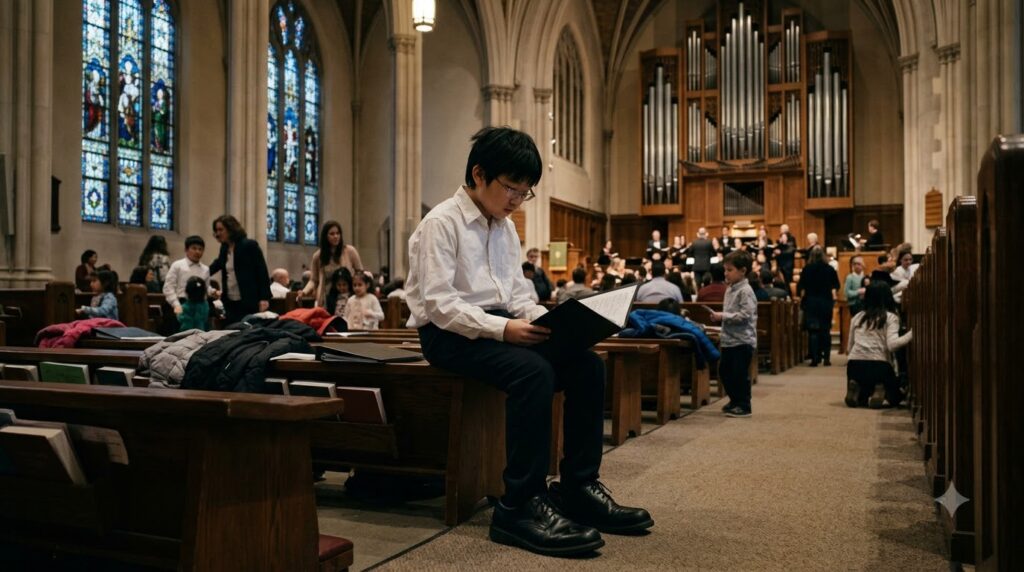
The sanctuary of First Covenant Church on Halsted Avenue had been built in 1911 by people who believed God could be persuaded by height. The ceiling rose in ribs of dark oak to a peak so far above the pews that, in winter, the heat never quite reached it, and the ushers liked to say there was a separate climate up there where the angels wore sweaters. Along both walls the stained-glass windows told the story of the prophets in panels of cobalt and ruby and a yellow so deep it looked edible, and at six o’clock on an October evening, with the sun going down behind the parking lot, the west windows threw long stripes of color across the varnished pews as if someone had spilled a box of ribbons down the aisle.
At the front, to the left of the chancel, sat the organ console.
It was not the organ itself. The organ itself was everywhere else: in the gilded pipes that climbed the front wall in a fan of silver and gold, in the hidden chambers behind the screens on either side, in the swell boxes and wind chests and leather bellows that no one in the congregation had ever seen and that most of them assumed were simply the building breathing. The console was only the place where a person sat to command all of it. It was a great curved cabinet of walnut, three keyboards stacked one above the other like stairs, and on either side of them, rising in terraced rows, were the stop knobs, more than sixty of them, white ivory faces lettered in black: Open Diapason 8′, Gedackt 8′, Flute Harmonique 4′, Trompette 8′, Vox Humana, Contra Bombarde 32′. Beneath the bench lay the pedalboard, a fan of long wooden keys meant for the feet, thirty-two of them, darker at the sharps and worn pale at the center where ninety years of shoes had slid back and forth across low C.
The choir had been called for six-fifteen. At six-oh-four, most of the chairs in the choir loft were still empty, the black choir folders stacked on them in tidy towers, and the only sounds in the sanctuary were the far-off clank of the furnace and someone in the fellowship hall testing a coffee urn.
Walter Hargrove came up the side aisle with his folder under his arm and his reading glasses pushed up onto his forehead, where he would forget them for the next twenty minutes. He was seventy-three years old, a retired insurance adjuster, a bass, and had sung in the First Covenant choir for forty-one years without missing a Christmas. He had a broad, slightly stooped frame and a face that had settled, over time, into an expression of mild disappointment, the way a house settles toward the side that gets the weather. He was not a cruel man. He would have been offended by the suggestion. He was a man who knew where things belonged, and he had the habit, common among people who have been in one place a long time, of mistaking that knowledge for a kind of ownership.
He stopped when he saw the boy.
The boy was sitting on the organ bench. He was small, eleven perhaps, with straight black hair combed flat and parted with the kind of precision that meant an adult had done it with water. He wore glasses with thin wire frames, a white dress shirt buttoned to the collar, dark trousers that had been hemmed by hand, and on his feet, which did not quite reach the pedals, a pair of black leather shoes so much too big for him that they looked like boats he had been asked to steer. The toes curled slightly upward with age. The heels stuck out a full inch behind his own heels. He was sitting very still with his hands folded in his lap, looking up at the stop knobs the way some children look at a night sky.
Walter set his folder on the front pew.
“Son, this organ has more controls than you know what to do with.”
The boy turned. Behind the glasses his eyes were steady, and he did not get up.
“Mrs. Parker told me to wait here.”
Walter glanced toward the choir room door, which was shut. He smiled the patient smile he used on new ushers and grandchildren.
“She probably meant with the youth choir.”
“She said the organ.”
“Did she.” Walter came a few steps closer. Up close he could see that the boy’s shirt had been ironed, and that a crease ran down each sleeve as sharp as a ruler. “This isn’t the keyboard in a school music room, you understand. You press the wrong thing on this and the whole building hears about it. People in the parking lot hear about it.”











