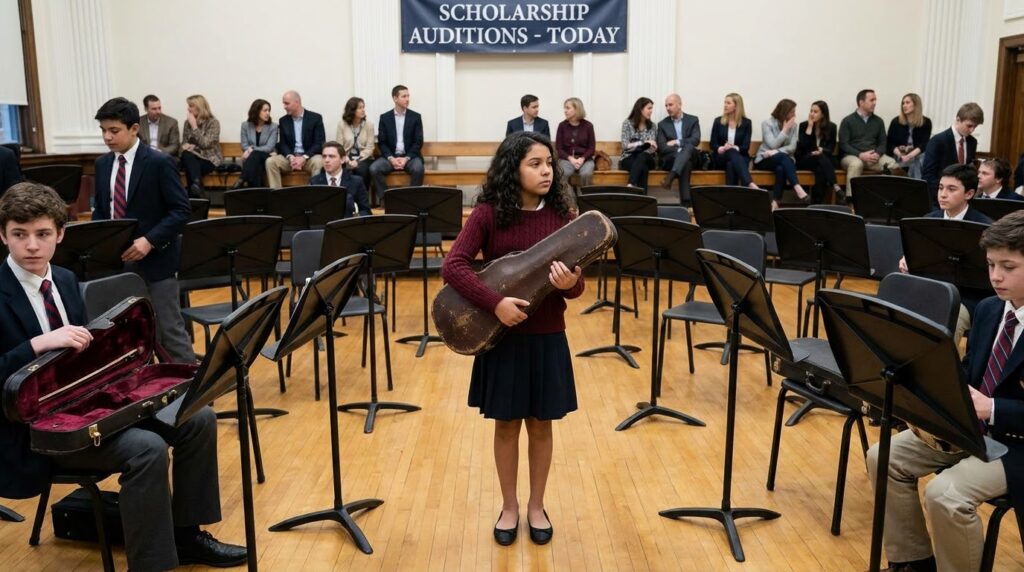
The orchestra room at Ashbury Academy had been built to hold sound in the way a cupped hand holds water. The ceiling rose in pale wooden ribs. The floor was oak, sanded and sealed so many times that it had the depth of a still pond, and the music stands stood on it in three neat semicircles, black and identical, their feet set down on small felt pads so they would not scratch. At the far end, beneath a tall window that looked out on a lawn of impossible green, a single stand had been placed apart from the others, and beside it a plain wooden chair that no one was allowed to sit in yet.
It was a Saturday in late March, and the room was full of people trying to look calm.
The students wore what their parents had told them to wear. Boys in navy blazers with brass buttons, girls in black dresses with sleeves, a few in velvet, one in a white blouse buttoned so high it made her hold her chin like a heron. Their instrument cases rested against their knees or lay open on the risers, and the cases were beautiful: carbon fiber in deep wine and graphite, molded shells with suspension interiors, brushed-steel latches, hygrometers set into the lids like small clocks. A boy near the cellos had a case with his initials embossed in gold. When he opened it, the smell of rosin and new velvet came out like a sigh.
Along the back wall the parents sat in a row of folding chairs that had been upholstered, because even the folding chairs at Ashbury were upholstered. They held their phones on their knees, face down, the way people hold a hand of cards. Some of them talked in the low voices of people who were used to being listened to. Some of them did not talk at all and only watched their children with a hunger that had nothing to do with music.
Sofia Ramirez stood near the door.
She was twelve, and she had come on two buses and a long walk up the hill from the stop on Fenwick Road, where the sidewalk ended and the hedges began. She wore a burgundy sweater that had been her cousin’s, a dark skirt that reached just past her knees, and simple black flats with a little scuff on the left toe that she had colored over with a marker that morning. Her hair was pulled back and pinned. In her right hand she held a violin case.
The case was old. That was the first thing anyone would have said about it, and the last thing most of them would have bothered to say. It was the shape of a coffin for a very small saint, the old-fashioned kind, narrow at the neck, its black covering worn through at the corners to the gray cardboard underneath. Someone had once written something on the lid in silver marker and someone else had tried to scrub it off, and what was left was a ghost of letters that did not spell anything. One of the latches was a replacement, brass where the other was nickel. Down the side ran a long scratch, pale and deep, as if the case had once been dragged along a brick wall. The handle had been wrapped in black electrical tape so many times that it had the thickness of a rope.
She held it the way you would hold the hand of someone who was nervous, not the way you would hold luggage.
For a few minutes no one noticed her. Then a man in the second row of parents turned to say something to the woman beside him and saw her over his shoulder, and his eyes went to the case, and stayed there.
He was perhaps fifty, broad in the shoulders, with a good haircut going silver at the temples and the kind of tan that came from boats rather than fields. His name was Graham Whitcomb. His name was also on a plaque in the main hall, and on the scoreboard at the athletic center, and on a wing of the library that smelled of new carpet. He wore a gray suit without a tie, which was how men like him said that they were relaxed. Beside him, on the end of the student riser, sat his daughter, Celeste, sixteen, in a dark green dress, a violin on her lap that had been made in Cremona two hundred and ten years earlier and insured for a sum that could have bought every house on Sofia’s street.
Graham stood up. He did not need to, but he was a man who preferred to say things standing. He crossed the polished floor in four easy strides and stopped near Sofia, smiling the way people smile at a dog they are not sure about.











