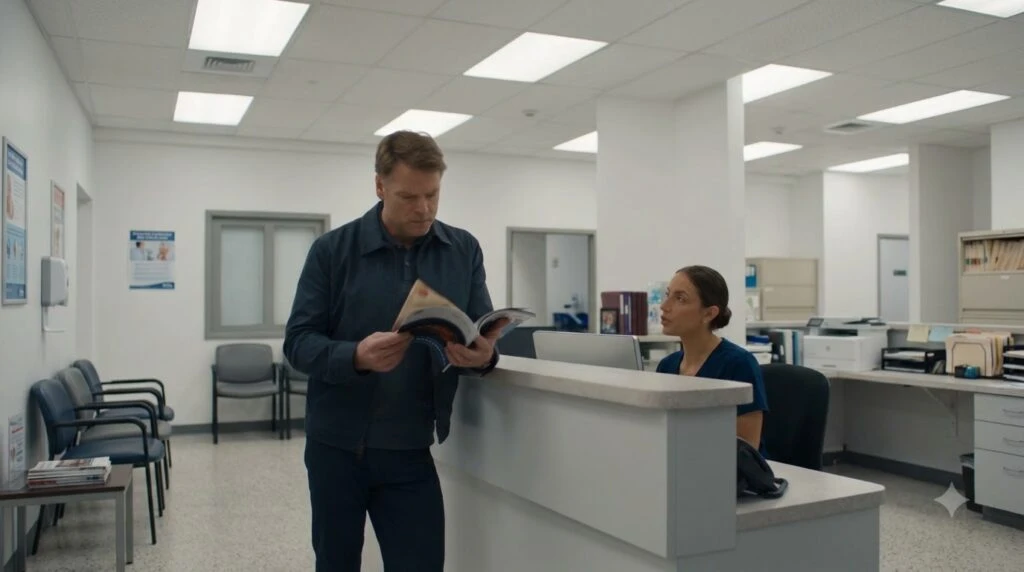
The waiting room of Front Range Orthodontics had been designed by someone who believed that light could fix things. It came from everywhere at once: from the long windows that faced west toward a strip of parking lot and, beyond it, the brown shoulders of the foothills; from the recessed panels in the ceiling that hummed at a pitch only dogs and twelve-year-olds could hear; from the white counter of the reception desk, which threw the glare back up into the faces of the parents leaning over it with their clipboards. At a quarter to five on a Thursday in late September, the sun was low enough to come in sideways, and it laid long gold rectangles across the gray carpet and the molded plastic chairs where the teenagers sat folded over their phones.
Robert Hayes had not been inside the building in almost a year. He noticed this the way a man notices that he has forgotten the name of a street he once lived on. The fish tank was new. The tank had a single blue tang drifting through a plastic arch, and a small boy with a cast on his wrist was tapping on the glass while his mother said his name in a voice that was not yet angry but was rehearsing for it. There was a new poster on the wall about elastics, a cartoon tooth giving a thumbs-up. The coffee machine was the same. The chairs were the same. Through the open doors behind the desk, he could see the long bright bay where the chairs reclined in a row, each one under its own lamp, and the assistants in teal scrubs moving between them with trays, their voices pitched in the cheerful register people use with children and dentists use with everyone.
He was forty-three years old, and he had just come off a flight from Charlotte that had landed at two-ten, and he was still wearing the charcoal jacket he had worn through three days of meetings, over a navy polo that had been clean on Tuesday. He had not shaved since then either. He was a sturdy man, built like someone who had played linebacker in high school and then spent twenty years sitting in conference rooms, and his sandy-brown hair was cut short enough that it did not need anything from him. His eyes were blue and tired. He had come to the appointment because he had texted Megan from the gate, *landed early, I can make Ben’s ortho*, and she had written back *you don’t have to*, and he had read that as generosity and come anyway.
Ben sat two chairs down from him with the hood of his school sweatshirt pulled halfway up, the gray one with the Hamilton Middle School hawk printed in maroon across the chest. He was twelve and had the long, unfinished look of a boy who had grown two inches over the summer and had not yet been told what to do with them. His brown hair needed cutting. When he smiled, which he had not done since Robert walked in, the brackets on his teeth caught the light, small squares of silver strung on a wire. He was playing something on his phone that involved a great deal of swiping.
Megan was at the desk. She had gone up to check them in while Robert was still in the restroom, and she was standing now with one hand flat on the counter and the other holding a pen she was not using. She was forty, and she looked, from behind, the way she had looked at twenty-eight, which was a thing Robert sometimes thought and never said: shoulder-length blonde hair tucked behind one ear, the fitted cream sweater she wore on days when she had to present something at work, dark jeans. She worked in grants administration for the university hospital system on the Anschutz campus, and she was good at forms. She was the one in the family who was good at forms.
The receptionist was a woman in her fifties with reading glasses on a beaded chain and a name tag that said TASHA. She had a voice that carried, not because it was loud but because it had been trained by years of calling names across this room. She was tapping at a keyboard.
“Okay, we’ve got Ben for a wire adjustment at five, Dr. Mehra,” she said. “And I’m just doing our annual verification, since it’s been a year on the forms. Address and insurance are the same?”
“Same,” Megan said.
“Emergency contact still Linda Kowalski?”
“Yes. My mom.”
“Great.” Tasha scrolled. Robert, three steps away now, had come up beside his wife to be useful, to put his card down if a card was needed. He put his hand lightly on the small of Megan’s back, and he felt her go still under it, which he did not think about until later.











