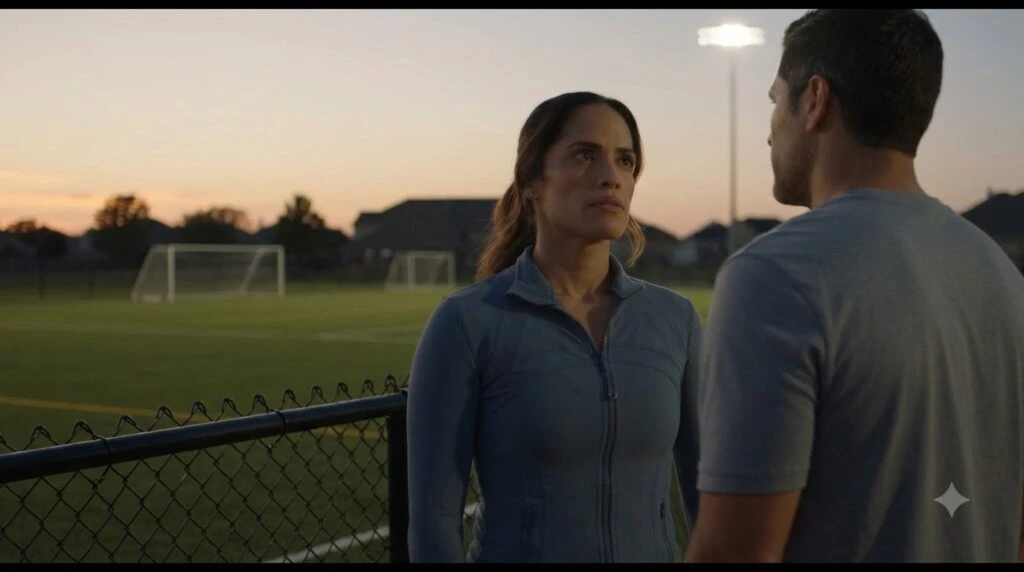
The floodlights over Field Four at Hillcrest Park came on the way they always did in October, not all at once but in a slow, humming reluctance, as if they had to be talked into it. First a gray flicker, then a sickly lavender, then finally the hard white that turned the grass a color no grass actually was. Elena Torres had watched that transition from the chain-link fence perhaps two hundred times in the past four years, and she still found herself waiting for it, the way some people wait for the green flash at sunset that almost never comes.
She had arrived early for once. Tuesday and Thursday evenings were usually a sprint for her: the last patient at the physical therapy clinic in Richardson, the charting she promised herself she would finish and never did, the crawl down Central Expressway with the brake lights stretching ahead like a string of red beads. But her five-thirty had cancelled, a retired mail carrier with a rebuilt knee who had texted the front desk that his granddaughter was having a baby, and Elena had taken the gift of an empty hour without examining it. She had changed in the staff bathroom into the navy athletic jacket and black leggings she kept in her locker, pulled her hair back into the long ponytail that had been her uniform since she was fifteen, and driven north with the windows down because the heat had finally broken and the air smelled like cut grass and someone’s distant brisket.
Along the fence the other parents stood in their usual constellations. The two fathers who had played college ball and talked about formations as if the nine-year-olds were Barcelona. The mother in the Lululemon set who was always on a work call, one finger pressed to her ear. The grandmother who brought a folding chair and a thermos and never missed a game, whose grandson was the smallest boy on the team and the fastest. Elena nodded to them, received their nods, and leaned her forearms on the top rail of the fence.
On the field the Hillcrest Hornets, under-ten division, were finishing their scrimmage in a swarm. Nine-year-olds did not really play soccer so much as they migrated across the grass in a single dense flock, the ball somewhere at the center like a seed. Mateo was in the flock. She could pick him out without trying, the way she could pick out his voice in a crowded gymnasium: the red jersey, the same red as everyone else’s, but worn differently, untucked on the left side, his dark hair sticking up in the back where it always had since he was a baby. He ran with his elbows out. He had run that way since he was two.
Coach Brandon Kessler blew his whistle, three short blasts, and the flock dissolved into individual children. Kessler was a big, soft-spoken man in his early fifties, a high school chemistry teacher during the day, with a gray goatee and a Hornets cap that he had clearly owned since the Hornets were founded. He had coached Mateo for two seasons. Elena liked him. He knew every child’s name and every child’s sore spot, and he never yelled at the slow ones.
The children streamed toward the sideline, toward the mesh bags and the water bottles and the shin guards they would rip off and drop wherever they stood. Two assistant coaches began collecting the orange cones, stacking them into tall leaning towers. A few parents peeled away from the fence and drifted toward the bench. The lights reached full brightness and the field took on its nighttime look, a lit stage in a darkening suburb, the houses of the subdivision beyond going blue and indistinct.
Mateo found his bag, slung it over one shoulder, and turned toward the parking lot gate. He did not look at the fence. He looked at the gate, and at the curb beyond the gate where the cars idled, and he scanned it with an expression Elena did not recognize: expectant, a little eager, the face he made on Christmas morning at the top of the stairs.
Then he turned, saw her, and the face changed. Not disappointment, exactly. Confusion.
He jogged over, his cleats clacking when he hit the concrete path.
“Mom? Where’s Dad’s friend?”
Elena laughed, because it seemed like the kind of thing a nine-year-old said that would make sense in a minute. “What friend?”
Mateo’s eyebrows pulled together. He looked back toward the gate, then at her, and a small doubt entered his face, the doubt of a child who suspects he has said something adults will turn into a conversation.
Coach Kessler had come up behind him, a clipboard under his arm and a mesh bag of balls over his shoulder. He gave Elena his usual friendly nod, then glanced past her toward the curb.











