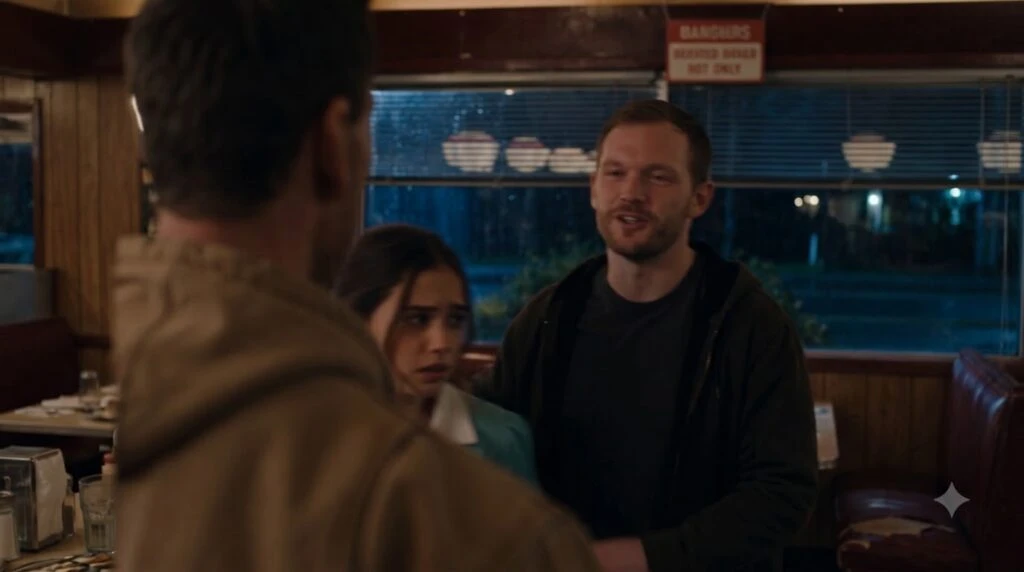
The rain had come in off the plains a little after nine, and by eleven it was falling on Wood River, Nebraska, the way it only falls in October, steady and cold and sideways, as if the sky had decided to wash the whole flat county down the Platte and start again. Along the old highway the Starlite Diner sat where it had sat since 1961, a long chrome box with a red neon star on a pole out front. The star buzzed. The rain ran down the big front windows in crooked rivers, and the neon came through the water and laid itself in pink and red smears across the booths, across the counter, across the plates and the coffee cups and the backs of the hands of the people who were still there that late.
There were not many of them. A long-haul driver in a seed-company cap sat at the far end of the counter with a slice of cherry pie he had stopped eating. An old woman in a quilted coat had the corner booth by the jukebox, a paperback face down beside her teacup. Two teenagers, a boy and a girl in matching Northwest High School hoodies, shared a basket of fries near the restrooms and held hands under the table where they believed nobody could see. In the booth by the front window, the one with the strip of silver tape across a split in the red vinyl, sat a man named Marcus Hale and his daughter, Rowan.
Marcus was thirty-eight and looked older at that hour. He was a sturdily built man, wide through the shoulders the way men get from lifting things for a living rather than from lifting for the mirror, with dark hair cut short enough that he did not have to think about it and eyes that had been tired for so long they no longer knew any other way to be. His work jacket had been brown once. Now it was the color of a field in March. His jeans had a hole worn at the left knee from kneeling on concrete. He had a cup of coffee in front of him that he had refilled twice and drunk once.
Rowan was six. She was small for six, brown-haired, with a cowlick at the crown that no amount of water would flatten, and she wore a yellow hoodie with the sleeves pushed up past her elbows because she said they made her hands feel trapped. In front of her was a stack of silver-dollar pancakes, cut into exactly nine pieces, because nine was her number that month. She had eaten six of them. She was dragging the seventh through a puddle of syrup and talking, as she had been talking since they sat down, about a boy in her class named Oliver who claimed he could hold his breath for a whole minute and who had been proven, at recess, a liar.
“He only did twenty-two,” she said. “Hazel counted.”
“Maybe Hazel counted fast,” Marcus said.
“Hazel doesn’t count fast. Hazel counts perfect.”
He smiled at that, and it was a real smile, though it cost him something to bring it up from where it had been sleeping. He had worked a double. He had been awake since four in the morning, and his back held a long low ache like a stove left on in another room. He should have taken her straight home. But it was Friday, and it was raining, and breakfast for dinner at the Starlite was the oldest promise he had ever made her, older than her memory of her mother living in the same house, and he did not break that one.
At the counter, two men were drinking.
They had come in around ten, already loud, already loose in their joints the way men get when the evening started early at somebody’s garage and continued at the Silver Spur on Main and arrived here only because the Spur had finally cut them off. The Starlite did not serve hard liquor, but it had a license for beer, two taps and a cooler of cans, and the men had been ordering them steadily, one after another, and the young waitress had been bringing them, one after another, with her face set in the pleasant blankness of someone counting the minutes until close.
The bigger of the two wore a canvas coat with a feed-store logo on the breast and a camouflage cap pushed back on his head. He was red in the face and thick in the neck and his laugh had an edge in it that kept going up a little higher than a laugh should. The other was thinner, younger, with a patchy beard and a Huskers sweatshirt, and he laughed whenever the bigger man laughed, a half second late, like an echo that wasn’t sure of the room.











